




Ohio homes quietly host more than one ant species at a time, and most homeowners never realize it until the problem is already out of hand. Pavement ants raid your kitchen while carpenter ants hollow out a water-damaged beam in your basement. Each species plays by different rules, responds to different treatments, and signals a different underlying problem in your home. Treating them all the same is the fastest way to waste money and still have ants. This guide walks you through identifying the most common Ohio ant invaders, understanding their behavior, and applying the right strategy to stop them for good.
Table of Contents
- How to recognize common ant invaders in Ohio homes
- Pavement ants: The persistent kitchen foragers
- Carpenter ants: Detecting and stopping home damage
- Other household ant species to watch for in Ohio
- Effective ant prevention and elimination strategies for Ohio homeowners
- Our take: Why a species-by-species approach is the only way to win
- Take the next step toward a pest-free Ohio home
- Frequently asked questions
Key Takeaways
| Point | Details |
|---|---|
| Know your ant species | Correctly identifying ants is essential for successful removal and prevention. |
| Pavement ants seek food indoors | These ants enter kitchens through cracks and are attracted by crumbs and sweets. |
| Carpenter ants can damage homes | Large, black carpenter ants nest in damp wood and can cause costly repairs if unchecked. |
| Prevention outperforms repeated treatment | Maintaining a dry, sealed, and clean home keeps ants out better than any spray or bait. |
How to recognize common ant invaders in Ohio homes
Getting the ID right is not optional. It is the foundation of every effective treatment. A bait that works perfectly for pavement ants may be completely ignored by carpenter ants. Before you buy anything or call anyone, spend five minutes observing the ants you are dealing with.
Here is a quick reference for the most common species found inside Ohio residences:
| Species | Size | Color | Most common indoor location |
|---|---|---|---|
| Pavement ant | 2.5–3 mm | Dark brown to black | Kitchen floors, baseboards, basement |
| Carpenter ant | 6–13 mm | Black | Wall voids, window frames, attic |
| Odorous house ant | 2–3 mm | Dark brown | Kitchen, bathroom |
| Thief ant | 1–2 mm | Yellow to light brown | Pantry, food storage areas |
| Crazy ant | 2–3 mm | Dark brown | Near electronics, wall voids |
Visual clues matter a lot here. Pavement ants are tiny, dark brown, and move in well-organized trails. They nest under sidewalks and driveways, then enter your home hunting for grease, crumbs, and sweets. Carpenter ants are hard to miss. They are large and black, nesting in damp wood like rotting window sills or water-logged wall studs. Carpenter ants can forage up to 100 yards from their nest, which means the colony causing your problem may not even be inside your house.
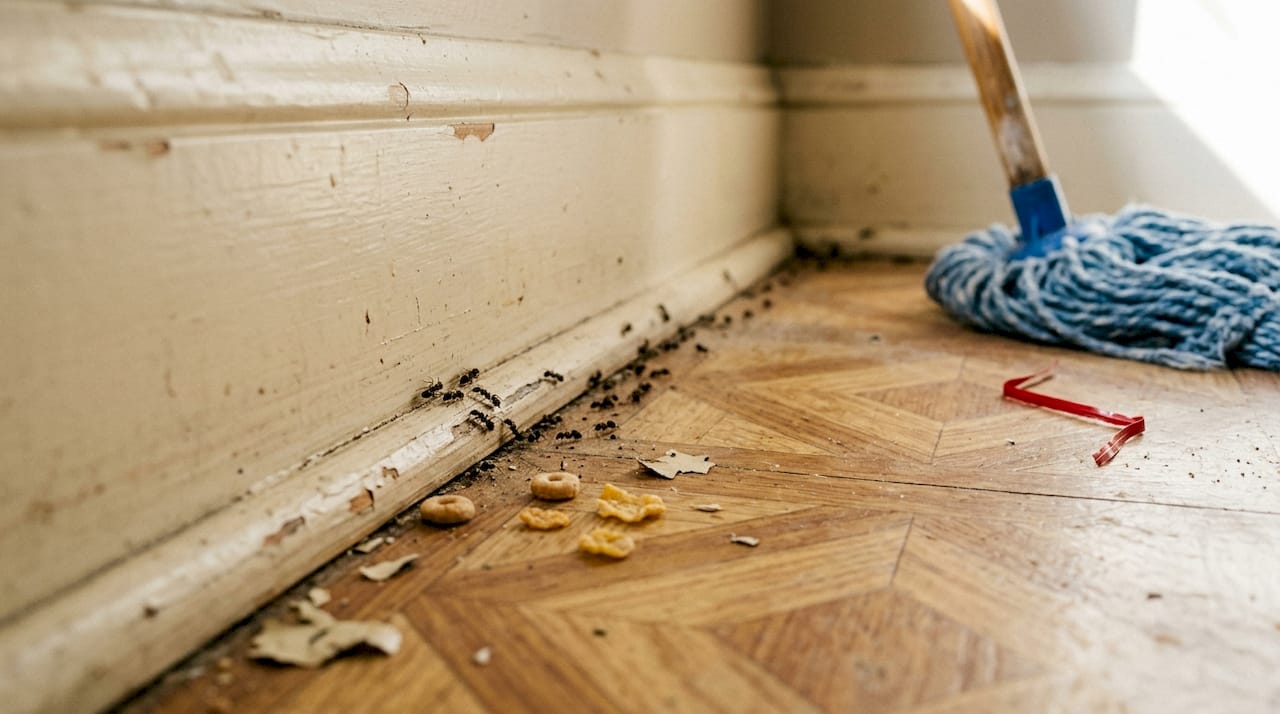
Knowing the difference between ants and termites is also critical, especially when you spot large winged insects or unexplained wood damage. Many homeowners confuse the two, and the treatment approaches are completely different.
Common indoor hiding spots by species:
- Pavement ants: Along baseboards, under kitchen appliances, near foundation walls in the basement
- Carpenter ants: Inside wall voids, around plumbing, in attic insulation, near window frames with moisture damage
- Odorous house ants: Under sinks, inside wall cracks near warm pipes
- Thief ants: Inside pantry shelving, behind refrigerators, in food packaging
If you are unsure which species you have, reaching out to an Ohio ant control service for a professional inspection saves you time and money compared to trial-and-error treatments.
Pavement ants: The persistent kitchen foragers
Pavement ants are the most common ant complaint we hear from Ohio homeowners. They are small, relentless, and surprisingly organized for an insect most people dismiss as a minor nuisance.
These ants nest under concrete slabs, driveways, and sidewalks. They enter homes through the tiniest cracks in your foundation, around pipes, and under door thresholds. Once inside, they are drawn to almost anything edible: grease from your stovetop, crumbs under the toaster, pet food left in a bowl overnight, and sugary spills. Their foragers work in coordinated trails, which is why you often see a neat line of tiny ants marching across your kitchen floor.
One of the most telling signs of a pavement ant presence is small piles of soil pushed up through cracks in your driveway or along your foundation. These are the displaced earth from their tunneling. In spring, you may also witness something that looks like a battle: pavement ants are territorial and will fight neighboring colonies in large groups on sidewalks and driveways. If you see this, it signals that multiple large colonies are active close to your home, raising your infestation risk significantly.
Pavement ant foragers organize their entire colony’s feeding from a single kitchen crack.
Kitchen-proofing tips to cut off pavement ants fast:
- Store all food in sealed containers, including pet food
- Wipe down counters and stovetop after every meal
- Fix dripping faucets and pipes under the sink
- Seal foundation cracks with weatherproof caulk
- Keep garbage cans tightly lidded and away from the house
Pro Tip: Place non-toxic gel bait directly on the ant trail rather than spraying it. Sprays kill foragers on contact but do not reach the queen. Gel bait gets carried back to the colony, targeting the source. Place it near entry cracks and refresh it every few days until activity stops.
For a broader approach, natural ant removal in Ohio covers low-toxicity options that work well alongside bait placement. Combining good sanitation with targeted baiting is the most reliable way to break a pavement ant cycle without repeated chemical applications. Pairing that with habits from maintaining a pest-free home keeps them from coming back season after season.
Carpenter ants: Detecting and stopping home damage
Carpenter ants are a different problem entirely. They are not after your food. They are after your wood, specifically wood that is already softened by moisture or decay. That makes them a structural threat, not just a nuisance.
These ants are attracted to window frames with failed caulking, leaky roof areas, basement beams near plumbing, and any wood that has been repeatedly wet. They do not eat the wood. Instead, they tunnel through it, pushing out smooth, sawdust-like material called frass. Finding frass near baseboards, window sills, or in your basement is one of the clearest signs of an active carpenter ant infestation.
How to check for structural damage:
- Tap wooden beams and door frames with a screwdriver handle. A hollow sound suggests tunneling inside.
- Look for frass, which resembles fine sawdust mixed with insect parts, near wall voids or on basement floors.
- Watch for large black ants (6 mm or bigger) moving at night, especially near moisture sources.
- Inspect exterior wood like deck boards, fascia, and window frames for soft or spongy spots.
- Check your attic after rain for any damp insulation or discolored wood.
Understanding the carpenter ants vs termites distinction is critical before you act. Here is a side-by-side comparison:
| Feature | Carpenter ants | Termites |
|—|—|—|
| Wood behavior | Tunnel only | Eat the wood |
| Debris left | Smooth frass (sawdust) | Mud tubes |
| Target wood | Damp or decayed | Any wood |
| Body shape | Pinched waist | Straight body |
| Urgency | High | Very high |
Untreated carpenter ant colonies can cause extensive structural damage over several years, especially in older Ohio homes with wood framing and aging moisture barriers. The single most important step you can take is fixing the moisture problem first. Dry the wood out, repair the leak, and the colony loses its reason to stay. Then treat with natural carpenter ant control methods or professional treatment to eliminate remaining workers.
Other household ant species to watch for in Ohio
Beyond pavement and carpenter ants, a few other species occasionally move into Ohio homes and can be surprisingly difficult to manage without the right approach.
Odorous house ants are small, dark brown, and give off a rotten coconut smell when crushed. They nest in wall voids and under floors, often near warm pipes. They are attracted to sweets and moisture and tend to relocate their colonies frequently, which makes bait treatments less reliable without patience.
Crazy ants move in fast, erratic patterns rather than organized trails. They are drawn to electrical equipment and can cause short circuits by nesting inside outlets and appliance housings. If you see ants moving unpredictably near electronics, take it seriously.
Thief ants are so small (about 1 mm) that they are easy to miss entirely. They sneak into other ant colonies to steal food and larvae, and they do the same in your pantry. They squeeze through gaps that most other ants cannot reach.
Signs and entry points by species:
- Odorous house ants: Trails near bathroom pipes, musty smell when ants are crushed, entry through window frames
- Crazy ants: Erratic movement near outlets or appliances, entry through utility line gaps
- Thief ants: Tiny ants in sealed pantry areas, entry through hairline cracks and gaps around plumbing
While these species build large colonies outside and enter homes only occasionally, occasional does not mean harmless. A thief ant colony in your pantry or crazy ants in your electrical panel are serious issues.
Pro Tip: A consistent perimeter treatment applied around the foundation every 60 to 90 days dramatically reduces entry from all ant species. It creates a barrier that foragers encounter before they ever find a crack to squeeze through. Check residential pest control tips for a practical perimeter treatment schedule and the Ohio home pest guide for seasonal timing specific to Ohio.
Effective ant prevention and elimination strategies for Ohio homeowners
Knowing your enemy is only useful if you act on it. Here is a practical action plan built around Ohio’s climate, where ant activity spikes in spring and again in late summer when colonies are at peak size.
Step-by-step action plan:
- Identify the species before buying any product. Use the table in the first section or call a professional for a fast ID.
- Locate the entry points. Walk your foundation perimeter and look for cracks, gaps around pipes, and damaged weatherstripping.
- Eliminate food and moisture sources that are drawing ants inside. This step alone stops many minor infestations.
- Apply targeted bait or treatment matched to the species. Gel bait for pavement ants, moisture repair plus perimeter spray for carpenter ants.
- Monitor for two to three weeks. If activity does not drop, the colony may be larger or better hidden than expected.
- Schedule follow-up prevention before the next active season, typically late February through early March in Ohio.
Home exclusion and hygiene checklist:
- Seal all foundation cracks and gaps around utility lines with caulk or foam
- Fix leaky pipes, gutters, and roof flashing
- Keep firewood stacked away from the house and off the ground
- Trim tree branches and shrubs that touch your exterior walls
- Proper food storage and airtight containers in the pantry
- Empty and clean pet food bowls each evening
Pro Tip: If you have tried bait and exclusion for three or more weeks with no reduction in ant activity, it is time to call a professional ant control Ohio service. Large or hidden colonies, especially carpenter ant colonies inside walls, rarely respond to surface-level DIY treatments. A professional can locate the nest and treat it directly. Review essential ant prevention tips to stay ahead of the problem between service visits.
Our take: Why a species-by-species approach is the only way to win
After decades of treating Ohio homes, we have seen the same mistake repeated more than any other: homeowners buy a generic ant spray, knock back the visible trail, and consider the problem solved. Two weeks later, the ants are back, often in a different room.
Here is the uncomfortable truth. Generic sprays repel foragers without killing the queen or the colony. For pavement ants, this scatters the trail and makes it harder to trace back to the source. For carpenter ants, it does nothing to address the moisture problem driving the infestation. We once inspected an Ohio home where the owner had been spraying carpenter ant trails for two seasons. The colony had grown significantly in that time because the spray never touched the nest inside a water-damaged wall.
Every ant species in Ohio has specific weaknesses. Pavement ants respond well to slow-acting bait. Carpenter ants need moisture control plus direct nest treatment. Odorous house ants require patience because their colonies relocate. Treating all three the same way guarantees failure with at least two of them.
The most cost-effective approach is building your defenses before the season starts. Persistent prevention beats repeated elimination every time. Investing in targeted ant control services once is almost always cheaper than three rounds of DIY products that do not solve the root problem.
Take the next step toward a pest-free Ohio home
Understanding which ants you are dealing with is the first win. Acting on that knowledge is what actually protects your home. When prevention steps are not enough and the colony is already established, professional help is the most reliable path forward. Apex Pest Control has been solving Ohio ant problems since 1969, and we know exactly how each species behaves across Ohio’s seasons. You can compare residential pest solutions to find the right fit for your situation, or connect directly with our Ohio ant control experts for a free quote. Do not wait for a minor ant trail to become a structural problem.
Frequently asked questions
Which ant species most often enter Ohio homes?
Pavement ants and carpenter ants are the most common invaders inside Ohio residences, attracted by food or damp wood. Carpenter ants specifically target homes with moisture-damaged wood and can cause significant structural harm over time.
What signs show a pavement ant infestation?
Look for small soil mounds near sidewalks or foundation cracks and trails of tiny dark brown ants in kitchens and basements. Territorial ant battles on your driveway in spring are also a strong indicator of nearby colonies.
How do I know if I have carpenter ants or termites?
Carpenter ants leave sawdust-like frass and tunnel through wood, while termites build mud tubes and actually consume the wood. Carpenter ants also have a pinched waist, while termites have a straight, uniform body shape.
What is the best way to prevent ants in Ohio homes?
Seal cracks, fix moisture problems, and keep food tightly stored to prevent ant infestations. Proper home maintenance combined with seasonal perimeter treatments gives you the strongest year-round defense against all common Ohio ant species.