



TL;DR:
- IPM emphasizes prevention, monitoring, and targeted treatment over broad chemical use.
- Regular inspection and record-keeping are vital for effective, sustainable pest control.
- Implementing IPM reduces costs, environmental impact, and resistance issues over time.
Pests don’t wait for a convenient time to show up. One week your Ohio warehouse is spotless, and the next you’re finding rodent droppings near your inventory. Or maybe you’ve already tried a spray-and-hope approach at home, only to watch the same ants return two weeks later. The problem isn’t effort. It’s strategy. Integrated Pest Management, or IPM, is a structured, science-backed approach that protects your property without defaulting to chemicals at every turn. This guide walks you through each step so you can build a real, lasting defense against pests in your Ohio home or business.
Table of Contents
- Understanding integrated pest management: What you need to know
- Step 1: Prevention and preparation
- Step 2: Monitoring and identifying pests
- Steps 3-6: Thresholds, control tactics, and record-keeping
- A smarter approach: Why IPM always wins in the long run
- Get expert IPM help for your Ohio property
- Frequently asked questions
Key Takeaways
| Point | Details |
|---|---|
| IPM is stepwise | Follow prevention, monitoring, thresholds, and targeted interventions for best results. |
| Prevention is crucial | Most pest problems can be stopped before they start with sanitation and exclusion. |
| Always monitor | Regular inspections catch issues early and help avoid unnecessary pesticide use. |
| Use chemicals last | Start with least-toxic control methods and use targeted pesticides only when truly needed. |
Understanding integrated pest management: What you need to know
IPM isn’t a single product or a one-time treatment. It’s a system. The goal is to manage pests in the most effective, least disruptive way possible, using a layered approach that puts chemical treatments at the end of the line, not the beginning.
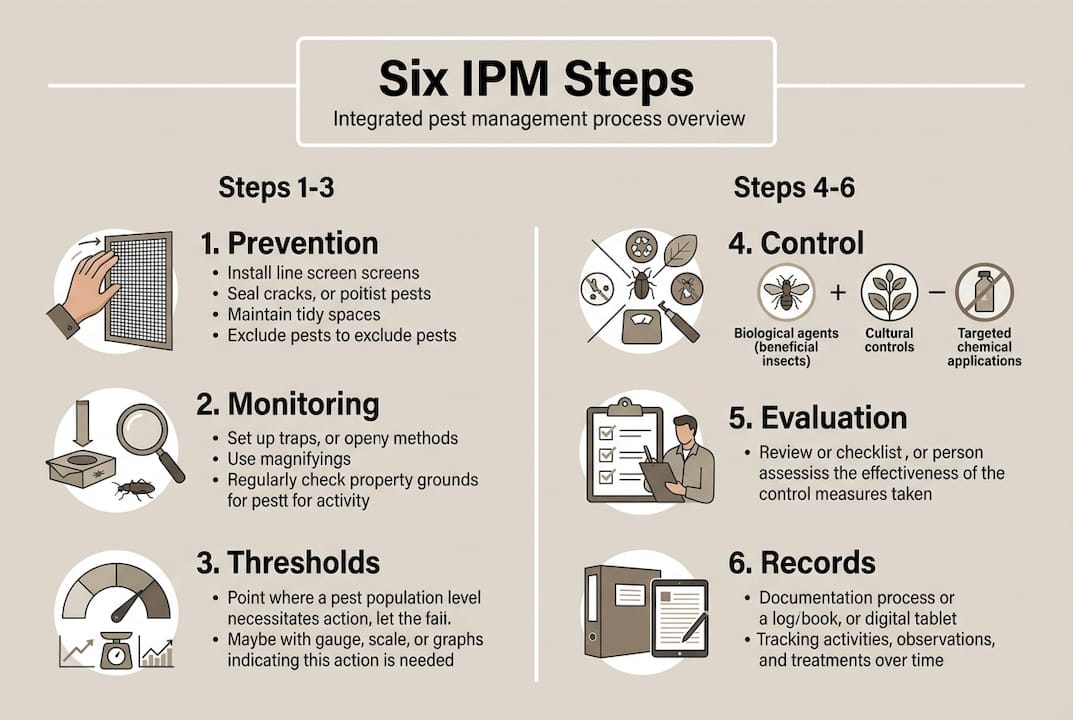
At its core, IPM fundamentals break the process into six repeatable steps: prevention through cultural practices like sanitation and proper landscaping, monitoring and identification of pests, setting action thresholds, applying control tactics starting with the least toxic options, using chemical controls only when necessary, and ongoing evaluation with record-keeping. These steps work together as a cycle, not a checklist you complete once.
For Ohio property owners, this matters more than you might think. Ohio’s climate supports a wide variety of pest species, from carpenter ants and house mice to the invasive box tree moth that’s been spreading through the state. Traditional “spray-first” approaches often make things worse. Broad-spectrum pesticides can wipe out beneficial insects, trigger resistance in target pests, and cause secondary outbreaks of species that were previously kept in check by natural predators.
IPM in Ohio has proven to reduce pesticide use, lower long-term costs, and protect local ecosystems by preserving beneficial insects like parasitic wasps and ground beetles that naturally suppress pest populations.
Here’s a quick comparison of IPM versus traditional pest control:
| Factor | Traditional approach | IPM approach |
|---|---|---|
| First response | Chemical spray | Inspection and prevention |
| Pest resistance risk | High | Low |
| Long-term cost | Higher (repeat treatments) | Lower |
| Environmental impact | Often significant | Minimized |
| Effectiveness over time | Decreasing | Increasing |
Common Ohio pests that respond well to IPM include:
- Ants (carpenter, odorous house, pavement)
- Rodents (Norway rats, house mice)
- Box tree moth (invasive, spreading rapidly)
- Cockroaches (German and American species)
- Stinging insects (yellowjackets, wasps)
Pro Tip: The Ohio State University Extension office offers region-specific pest resources for Ohio counties. Checking IPM examples from local case studies can help you understand what works in your specific area.
Step 1: Prevention and preparation
Prevention is where IPM earns its reputation. It’s also the step most property owners skip because it doesn’t feel as immediate as spraying something. But fixing the conditions that attract pests in the first place is far more cost-effective than treating an active infestation.
IPM control tactics prioritize non-chemical methods first: cultural controls like sanitation and habitat modification, mechanical controls like physical barriers and traps, and biological controls before reaching for any pesticide. This order matters because it reduces resistance and limits environmental impact.
For Ohio homeowners, practical prevention steps include:
- Seal entry points: Caulk gaps around pipes, windows, and foundation cracks. Mice can squeeze through a hole the size of a dime.
- Control moisture: Fix leaking pipes and clear standing water. Moisture attracts cockroaches, silverfish, and carpenter ants.
- Manage food sources: Store food in sealed containers, clean up crumbs immediately, and keep outdoor trash bins tightly covered.
- Maintain landscaping: Trim shrubs away from your building’s exterior and remove leaf piles where pests overwinter.
- Inspect deliveries: Businesses receiving regular shipments should inspect boxes for hitchhiking pests before bringing them inside.
For commercial properties, the stakes are higher. A restaurant with a cockroach problem or a warehouse with rodent activity faces regulatory consequences on top of the pest issue itself. Addressing pest risk factors specific to your building type before a problem develops is always the smarter call.
“The most effective pest management starts before a single pest is spotted. Sanitation, exclusion, and habitat modification are your first and most powerful tools.”
Pro Tip: Ohio State University Extension publishes free, county-specific guides on cultural prevention practices. These are written for Ohio’s climate and pest pressures, making them far more useful than generic advice. Pairing their guidance with eco-friendly pest control practices gives you a strong foundation.
Step 2: Monitoring and identifying pests
Once prevention measures are in place, monitoring is what keeps you informed. You can’t make smart decisions about pest control without knowing what pest you’re dealing with, how many there are, and where they’re concentrated.

Effective monitoring involves scheduled visual inspections, sticky traps in key areas like corners, under sinks, and near entry points, and keeping a written log of what you find and when. Consistency matters more than frequency. A monthly check done thoroughly beats a weekly glance that misses the corners.
Here’s a quick-reference table for common Ohio pests:
| Pest | Signs to look for | Monitoring method |
|---|---|---|
| Rodents | Droppings, gnaw marks, grease trails | Snap traps, glue boards |
| Ants | Trails, frass near wood | Bait stations, visual inspection |
| Cockroaches | Egg cases, musty odor | Sticky traps, flashlight inspection |
| Box tree moth | Webbing, defoliation on boxwoods | Visual scouting, pheromone traps |
| Stinging insects | Nests near eaves or underground | Visual inspection in spring/summer |
The importance of monitoring can’t be overstated, especially with invasive species. Ohio State University Extension specifically emphasizes scouting boxwoods for box tree moth, avoiding preventive sprays that cause resistance, and reporting confirmed sightings to local authorities.
A numbered approach to setting up your monitoring routine:
- Map your property and identify high-risk zones (kitchens, storage areas, entry points).
- Place sticky traps or bait stations in those zones.
- Inspect traps on a set schedule, at least monthly.
- Record what you find: pest type, quantity, location, and date.
- Report any invasive or unusual species to your local OSU Extension office.
Pro Tip: Take photos of any pest you can’t identify. Many county Extension offices and pest professionals can help with ID from a photo, saving you from treating the wrong pest entirely. Keeping a monthly maintenance log also helps you spot seasonal patterns over time.
Steps 3-6: Thresholds, control tactics, and record-keeping
Monitoring gives you data. Now you use that data to decide when and how to act.
Step 3: Set action thresholds. An action threshold is the point at which a pest population is large enough to justify intervention. Not every pest sighting demands a response. One ant near a window is different from a trail leading to your pantry. Economic and aesthetic thresholds vary by situation. Ornamental plants like boxwoods have low tolerance for damage, while a mature shade tree might tolerate some pest pressure without needing treatment.
Step 4 and 5: Choose and apply control tactics. Work through the hierarchy:
- Cultural controls: Remove food sources, improve sanitation, adjust irrigation.
- Mechanical controls: Install door sweeps, use snap traps for rodents, apply physical barriers.
- Biological controls: Introduce or protect natural predators. In Ohio, ground beetles and parasitic wasps naturally suppress many common pests.
- Chemical controls: Use only when other methods fail. Choose targeted, low-toxicity products and apply them only in infested areas.
Avoiding broad-spectrum insecticides protects the predator insects that do free pest control for you. Wiping them out often causes secondary outbreaks of mites or other pests that were previously kept in check.
For Ohio-specific guidance, county Extension offices provide treatment recommendations tailored to local pest pressures and seasonal timing.
Step 6: Evaluate and keep records. After any intervention, document what you did, what product or method you used, and what happened. Did the ant activity drop? Did the rodent traps catch anything in the following two weeks? This record becomes your most valuable tool for improving your approach each season.
Pro Tip: Reviewing your pest records before each new season lets you anticipate problems and adjust your prevention plan before pests become active. Staying current with ongoing pest education helps you refine your approach as new threats emerge in Ohio.
A smarter approach: Why IPM always wins in the long run
After more than 50 years working with Ohio property owners, we’ve seen what happens when people skip the system and go straight for the spray can. The pests come back. Sometimes faster and in greater numbers than before. Chemical overuse doesn’t just fail to solve the problem; it actively makes it harder to solve later.
What actually makes the biggest difference over time isn’t the product used. It’s the record-keeping and the patience to let non-chemical methods work before escalating. Property owners who track their pest activity and stick to the IPM process consistently see fewer infestations year over year.
The uncomfortable truth is that quick fixes feel satisfying but rarely solve anything. A targeted, documented IPM program that leans on eco-friendly results will outperform a cabinet full of pesticides every time. Pests adapt to chemicals. They can’t adapt to a property that’s been systematically made inhospitable to them.
Get expert IPM help for your Ohio property
Implementing a full IPM program takes knowledge, consistency, and the right tools. Apex Pest Control has been helping Ohio homeowners and businesses build effective pest management systems since 1969. Whether you need a residential pest control guide tailored to your home or professional-grade rodent extermination for your commercial property, our team designs solutions around your specific situation. We don’t default to chemicals. We follow the same IPM principles outlined in this guide, backed by decades of Ohio-specific experience. Get a free quote today and take the first step toward a pest-free property.
Frequently asked questions
What are the six steps of integrated pest management?
The six IPM steps are prevention, monitoring and identification, setting action thresholds, applying control methods from least to most toxic, using chemicals only when necessary, and evaluation with record-keeping.
Why is monitoring pests regularly important in Ohio?
Regular monitoring helps you catch problems early and respond with targeted action. Ohio State University Extension specifically recommends scouting for box tree moth to avoid unnecessary treatments that cause resistance.
Are chemical pesticides always necessary for pest control?
No. IPM prioritizes non-chemical methods like sanitation, exclusion, and biological controls first, using pesticides only when other approaches haven’t resolved the issue.
How can IPM save Ohio property owners money?
IPM lowers long-term costs by preventing infestations before they start, reducing how often pesticides are needed, and avoiding the repeat treatments that come with chemical resistance.
Recommended
- 7 Essential Pest Control Safety Tips for Ohio Homes
- Fall Pest Prevention Steps to Protect Your Ohio Home
- How to Maintain Pest Free Home Naturally in Ohio
- Integrated Pest Management Explained: Safer Ohio Homes
- Termite prevention guide for Illinois homeowners 2026