



TL;DR:
- Pest logs are essential tools for both legal compliance and effective pest management.
- They help property owners document pest activity, treatments, and patterns to prevent infestations.
- Digital and detailed records protect against disputes and improve treatment efficiency.
Most Ohio homeowners and property managers assume pest logs are something only large commercial operations need to worry about. That assumption is exactly what leads to recurring infestations, costly disputes, and, in some cases, serious legal exposure. A pest log is a simple record, but it can be the single most powerful tool you have for proving compliance, identifying patterns, and solving pest problems before they spiral. This article cuts through the confusion, explains what Ohio law actually requires, and gives you a clear, practical system for keeping logs that work hard for you every single day.
Table of Contents
- What are pest logs and why do they matter?
- Ohio law: What pest logs must include for compliance
- How pest logs help in resolving disputes and liability
- Best practices: Creating and using effective pest logs
- Why most Ohio property owners underestimate pest logs (and how to avoid their traps)
- Take pest management to the next level with local expertise
- Frequently asked questions
Key Takeaways
| Point | Details |
|---|---|
| Essential for compliance | Pest logs are required by Ohio law for commercial applicators and recommended for all properties. |
| Critical for dispute resolution | A well-kept pest log protects you in landlord-tenant disagreements and legal claims. |
| Easy, effective recordkeeping | Simple digital or paper logs help track issues and improve pest management strategies. |
| Not just for pros | Every property owner can benefit from pest logs, even when not legally required. |
| Best practice for IPM | Integrating logs into pest prevention routines yields better, longer-lasting results. |
What are pest logs and why do they matter?
Let’s clear up the biggest misconception right away. A pest log is not a complicated government form or a binder full of scientific jargon. At its core, a pest log is a structured record of pest activity, treatments applied, and outcomes observed at a property. Think of it the way a doctor thinks about a patient chart. Without that chart, every visit starts from scratch. With it, patterns emerge, treatments improve, and outcomes get better over time.
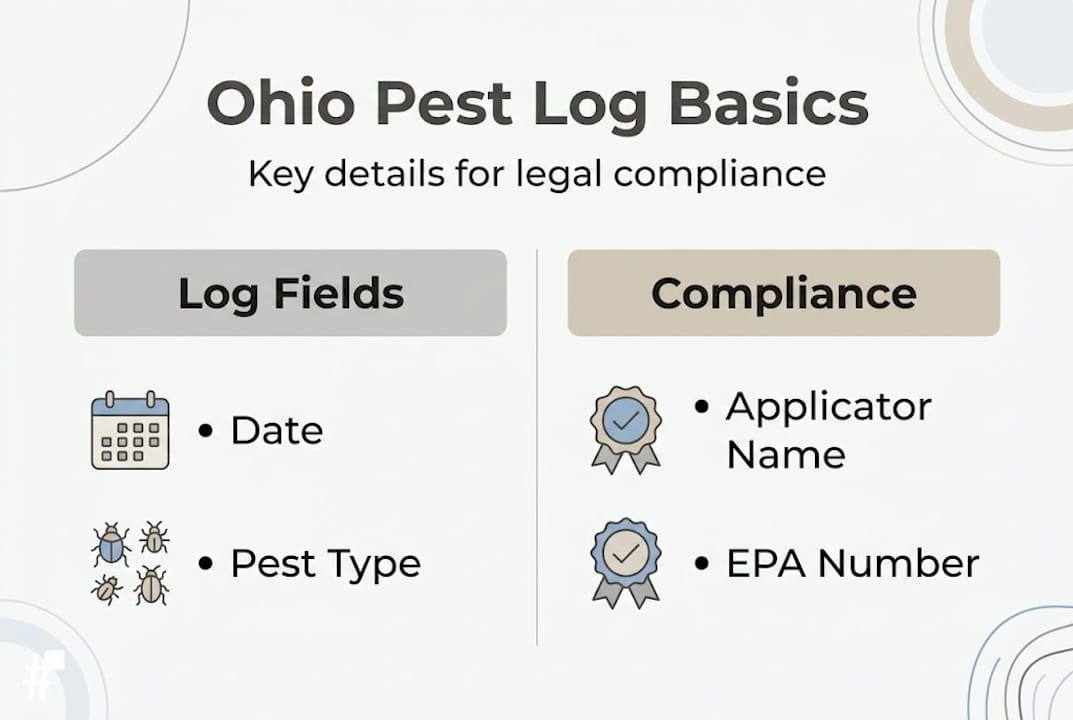
A pest log typically records the following information for each entry:
| Field | What to record |
|---|---|
| Date | Day and time of sighting or treatment |
| Pest type | Species or description of pest observed |
| Location | Specific room, zone, or area of the property |
| Action taken | Treatment method, product name, or inspection notes |
| Applicator | Name and license number if applicable |
| Follow-up | Next inspection date or monitoring plan |
This kind of organized recordkeeping serves two very different purposes. For licensed commercial applicators in Ohio, detailed pesticide application records are a legal obligation, not a choice. For homeowners and property managers who are not licensed applicators, pest logs are a best practice that pays dividends far beyond regulatory requirements.
The practical benefits of keeping a pest log go well beyond compliance. First, logs give you a paper trail that can protect you in disputes with tenants, neighbors, or inspectors. Second, they help you spot trends. If you notice cockroach sightings clustering around the kitchen drain every October, you can act before the infestation peaks. Third, pest logs make your conversations with pest control professionals more productive. Instead of guessing when the last treatment happened or which product was used, you hand over a clear record.
“A pest log is not about paperwork. It’s about memory. Pests follow patterns. Your log captures those patterns before they cost you money.”
Strong IPM strategies depend on this kind of systematic data. Integrated Pest Management, which is an approach that uses monitoring, prevention, and targeted treatment rather than blanket pesticide applications, simply does not work without records. You cannot monitor effectively if you have no baseline to compare against. Pest control professionals who use professional pest control documentation consistently report faster resolution times and fewer repeat treatments because the data guides every decision.
The bottom line: pest logs are not bureaucratic overhead. They are a management tool that helps you spend less money, resolve problems faster, and protect yourself legally.
Ohio law: What pest logs must include for compliance
Ohio commercial applicators are legally required to keep logs for a minimum of three years. That is not a recommendation. It is state law enforced through the Ohio Department of Agriculture. If you hire a licensed pest control company, they are responsible for maintaining those records. However, if you manage a property or operate a business where pest control is a recurring service, you need to understand what those records look like and whether you have the right to copies.
Here is what a compliant Ohio pest log must contain for commercial applicators:
- Full name and license number of the applicator
- Date and time of application
- Name and address of the customer or property treated
- Pest target and location treated
- Product name and EPA registration number
- Amount of pesticide used
- Equipment used to apply the product
- Weather conditions at the time of application
These are not suggestions. Each item is required for a log to be considered compliant under Ohio law.
The rules get more nuanced depending on your situation. Here is how different property types compare:
| Property type | Legal log requirement | Recommended practice |
|---|---|---|
| Licensed commercial applicators | Mandatory, 3-year retention | Full compliant records |
| Commercial property managers | Notification and record rules apply | Detailed internal logs |
| Schools and childcare facilities | Strict notification rules | IPM logs plus parent notification |
| Residential homeowners (non-commercial) | Not legally required | Strongly recommended |
Non-commercial homeowners are not required to keep pest logs for general pesticide use, but property managers and schools face additional record and notification obligations that can create liability if ignored. Ohio schools, for example, operate under stricter rules that require advance notification to parents before pesticide applications, and good records support that process.
Even if your situation falls outside the legal mandate, the argument for keeping your own pest log is strong. If a tenant complains about pests six months after your treatment, what do you have to show? If an inspector visits and asks when the property was last serviced, can you answer with confidence? Pest control solutions for property managers increasingly include recordkeeping support precisely because professionals understand that gaps in documentation create liability even when the actual pest management was done correctly.
Keep in mind that IPM-based approaches also come with their own documentation recommendations. Ohio’s guidance on IPM encourages property managers to record monitoring results and decision thresholds, not just treatments. This creates a richer record that shows you were actively managing pests, not just reacting to complaints.
How pest logs help in resolving disputes and liability
Beyond legal compliance, pest logs serve another essential role: protecting you in the event of costly disputes.
Property managers and landlords use pest logs as evidence in disagreements over who is responsible for an infestation, documenting sightings, complaints made by tenants, and the responses taken. Without that documentation, a dispute often comes down to one person’s word against another’s. With a detailed log, you can show exactly what happened, when it happened, and what you did about it.

Here is a real-world scenario. A tenant moves out and claims the property had a rat infestation that made it uninhabitable. They want their security deposit back and are threatening legal action. If you have a pest log showing monthly inspections, no rodent activity reported for the past year, and immediate treatment within 48 hours of a complaint filed three months ago, you have a strong defense. If you have nothing, you are starting from zero.
Here are three concrete steps to make sure your pest log can hold up in a dispute:
- Record every complaint immediately. The date a tenant reports a pest sighting should appear in your log the same day. Note the tenant’s name, the pest described, and the location in the unit. Delayed entries look unreliable.
- Document your response with equal detail. Record when you contacted a pest control company, what instructions you gave, and when the service was completed. Attach invoices or service reports as supporting evidence.
- Note outcomes and follow-up actions. After treatment, record whether the problem was resolved, whether a follow-up inspection was scheduled, and any additional measures taken, such as sealing gaps or improving sanitation.
Pro Tip: Switch to a digital log rather than paper. A shared spreadsheet or a simple app allows you to add entries from your phone in real time, share access with your pest control provider instantly, and search records by date or location in seconds. Digital entries also create automatic timestamps that are harder to dispute than handwritten dates.
Strong external defenses also matter. Proactive steps like preventing pest entry at the structure level reduce sightings in the first place and show documented intent to maintain the property. That combination of prevention and documentation is the gold standard for liability protection. For multi-unit properties, consistent documentation through apartment pest control programs keeps every unit covered and every record centralized.
Best practices: Creating and using effective pest logs
Having seen the power of pest logs for compliance and protection, here is how to quickly set up a system that actually makes a difference.
The first decision is format. You have three realistic options: a physical notebook, a spreadsheet, or a dedicated pest management app. Each works, but they are not equally convenient.
- Notebook: Simple, costs nothing, and always available. The downside is that paper records can be lost, damaged, or difficult to search through quickly during a dispute.
- Spreadsheet: Free with Google Sheets or Excel. Easy to organize by date, location, or pest type. Can be shared with your pest control provider and backed up automatically to the cloud.
- Pest management app: Some apps are specifically designed for property managers and licensed applicators. They include reminders, attach photos, and generate reports. Worth considering if you manage multiple units.
Applicators must log for legal protection, but homeowners and property managers benefit voluntarily because consistent records improve the quality of every decision they make about pest control.
What you record matters as much as how you record it. Here is what every entry in your pest log should include:
- Date and time of the observation or treatment
- Pest type observed or treated (be specific: “German cockroach” is more useful than “bug”)
- Exact location (room, corner, entry point)
- Action taken: did you call a professional, apply a product yourself, or simply monitor?
- Product name and amount if a treatment was applied
- Conditions noted: any structural issues, moisture, or entry points observed?
- Follow-up date or planned next step
Two things make the difference between a log that sits in a drawer and one that actually improves your pest management results. The first is timeliness. Record entries within 24 hours. Memory fades fast, and delayed entries lose their credibility. The second is specificity. Vague entries like “saw a bug near the kitchen” give you nothing useful to act on. “Two German cockroaches observed near the base of the dishwasher, 7:30 a.m., no product applied, called Apex Pest Control for same-week service” gives you a complete picture.
Integrate your log with monthly pest prevention routines. Once a month, spend ten minutes reviewing your last 30 days of entries. Are sightings increasing or decreasing? Are they concentrated in one area? Has the same treatment been applied twice without success? That review turns your log from a record into a decision-making tool.
Pro Tip: Share your log with your pest control provider before each service visit. A good technician will use that information to focus their inspection, select the right treatment approach, and flag patterns you might have missed. For a deeper look at how this fits into a whole-property approach, explore IPM for homes to see how monitoring and recordkeeping work together in practice.
Why most Ohio property owners underestimate pest logs (and how to avoid their traps)
Here is the uncomfortable truth we have observed over more than 50 years of pest management in Ohio: most property owners do not skip pest logs because they think the logs are useless. They skip them because pest problems do not feel urgent until they already are.
A pest sighting gets handled. Life moves on. Nobody writes anything down because everything seems fine. Then six months later, the same pest shows up in the same spot, and nobody can remember whether they treated it before, what product was used, or whether the issue was ever fully resolved. The infestation has been quietly growing the whole time.
The real cost of ignoring logs shows up in three ways. First, recurring infestations that could have been intercepted early based on seasonal patterns. Second, lost evidence when disputes arise with tenants or inspectors. Third, wasted money on treatments that repeat mistakes because nobody recorded what worked or did not work the first time.
We challenge you to try one month of consistent logging. Set a reminder on your phone every Monday morning to record any pest activity from the past week. After 30 days, look at what you have collected. Most property owners are surprised by how much information they had been letting slip through the cracks. Strong client cooperation in pest management starts with this kind of proactive engagement, and it consistently produces better outcomes than reactive treatment alone.
The few minutes you invest in a pest log each month are almost always worth less than the cost of one missed infestation.
Take pest management to the next level with local expertise
Ready to make pest management and recordkeeping effortless? Working with an experienced local pest control team changes the equation entirely. At Apex Pest Control, we have been helping Ohio homeowners and property managers stay ahead of pest problems since 1969. We do not just treat pests; we document everything, share records with you, and build service plans based on real data from your property.
Whether you want to compare Ohio pest solutions for your home or rental units, or you are ready to put a professional system in place today, we are here to help. Contact our local pest experts for a free quote and find out how easy it is to protect your property, stay compliant, and leave the guesswork behind.
Frequently asked questions
Are pest logs legally required in all Ohio homes?
No, they are only legally required for commercial applicators, property managers, and schools, but non-commercial homeowners are not mandated to keep them for general pesticide use, though doing so is strongly recommended as a best practice.
What details should be included in a compliant Ohio pest log?
A compliant log must include the applicator name, customer details, date, location, pest targeted, product name and EPA number, amount applied, equipment used, and weather conditions at the time of application.
How do pest logs help in landlord-tenant disputes?
They provide documented evidence of sightings, complaints, and actions taken, and property managers use pest logs to clearly establish timelines that show who was responsible and what steps were taken in response.
Can pest logs improve pest control results?
Yes, tracking sightings and treatment outcomes over time lets you identify seasonal patterns, spot recurring hotspots, and share actionable data with your pest control provider so each visit is more targeted and effective.
Are digital pest logs acceptable in Ohio?
Yes, Ohio law requires detailed records but does not specify paper or digital format, so a well-maintained digital log in a spreadsheet or app is fully acceptable as long as it contains all legally required information.