



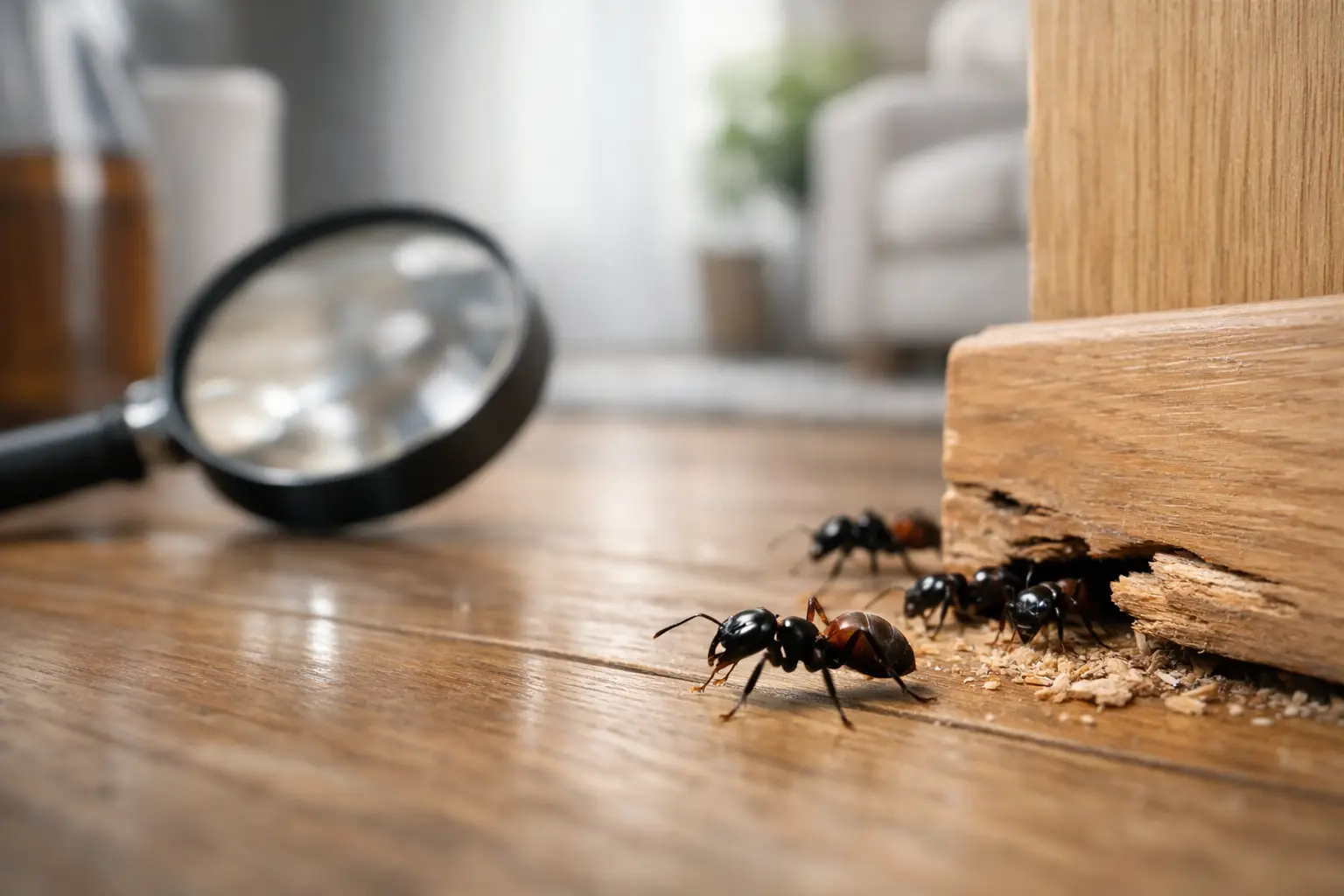
A large black ant crossing a kitchen counter can be unsettling, but it does not automatically mean your home has a carpenter ant infestation. To identify carpenter ants accurately, look beyond a single insect. Their size, body shape, activity patterns, and the condition of nearby wood provide much more reliable answers.
Carpenter ants are among the most common structural pests in Ohio. Unlike termites, they do not eat wood. They excavate it to create smooth tunnels and nesting areas, usually where moisture, decay, or an existing opening has made the material easier to work. Left unaddressed, an established colony can expand through wall voids, window frames, rooflines, decks, and other vulnerable areas.
What Carpenter Ants Look Like
Carpenter ants are noticeably larger than many household ants. Workers commonly range from about one-quarter inch to one-half inch long, although the same colony may have workers of different sizes. In Ohio, they are often black, but some species appear black and reddish-brown or dark brown.
Color alone is not enough for identification. Several other ants can be dark-colored, and different types of carpenter ants may be present around the same property. Focus on these physical traits:
- A large, segmented body with a narrow, pinched waist
- Elbowed antennae that bend distinctly rather than appearing straight
- A rounded upper thorax, meaning the section behind the head has an even, curved profile
- Six legs and, in reproductive ants, two pairs of wings
The rounded thorax is especially useful when distinguishing carpenter ants from termites. Termites have straight antennae, a thicker waist, and wings that are similar in size. Winged carpenter ants have a noticeably narrow waist and front wings that are longer than their rear wings.
Carpenter Ants vs. Termites: Why the Difference Matters
Homeowners often find discarded wings near windows, doors, or light fixtures and immediately fear termites. That concern is understandable, but winged ants and termite swarmers are not the same pest. The treatment approach depends on a correct identification.
Carpenter ants remove wood to make room for their galleries but do not use it as food. Their tunnels tend to look clean and smooth, almost as if the wood has been sanded. Termites consume cellulose within wood and often leave damaged material that looks layered, muddy, or hollowed out.
Neither pest should be ignored. Carpenter ant activity can point to moisture damage that needs repair, while termite activity may signal a different and potentially serious structural concern. A trained inspection determines what is active, where the insects are traveling, and whether conditions are supporting a hidden nest.
Signs You May Have Carpenter Ants Indoors
Seeing one carpenter ant inside does not always mean the colony is nesting in your home. Ants can enter while foraging for food or water, particularly in spring and summer. Repeated sightings, especially of large ants, deserve closer attention.
The strongest clue is a consistent trail. Carpenter ants commonly travel along plumbing lines, electrical wires, tree branches, foundation edges, and gaps around windows. You may see them in kitchens, bathrooms, laundry rooms, basements, or near pet food. They are most active after dark, so a daytime inspection may not reveal the full extent of activity.
Another sign is frass, a coarse, sawdust-like material pushed out of nesting galleries. Carpenter ant frass may contain tiny wood fragments, dead insect parts, and bits of insulation. It is often found below a small opening in wood, around baseboards, beneath window sills, in an attic, or near damaged trim.
Some property owners hear faint rustling inside a wall or hollow door. While this is not a reliable identification method by itself, it can support other evidence of activity. Soft, water-damaged wood around a shower, chimney, roof leak, or exterior door is a more meaningful warning sign.
Where Carpenter Ants Nest Around Ohio Properties
Carpenter ants favor damp or damaged wood, but a colony does not need a major leak to become established. A small, recurring moisture source can be enough. Outside, nests may occur in old stumps, firewood piles, landscape timbers, hollow trees, porch structures, deck posts, and wood that stays wet after rain.
Inside, carpenter ants often use voids rather than exposed lumber. They may nest behind siding, beneath insulation, around window and door frames, inside crawl spaces, near rooflines, or in areas affected by plumbing leaks. One colony can also maintain satellite nests. That means eliminating ants visible in one room may not reach the main nest or stop future activity.
Commercial facilities face similar risks, especially where there are loading docks, roof penetrations, utility rooms, moisture-prone mechanical spaces, wood pallets, or landscaping that contacts the building. For property managers, recurring carpenter ant reports should be documented and inspected promptly rather than handled as isolated sightings.
What Not to Mistake for Carpenter Ants
Many common ants are smaller than carpenter ants and have different nesting habits. Pavement ants are usually much smaller and are often seen near cracks in sidewalks, driveways, and foundations. Odorous house ants are also smaller and may release a strong, unpleasant smell when crushed. Acrobat ants can be mistaken for carpenter ants, but they tend to raise their heart-shaped abdomen when disturbed.
Large insects with wings can cause confusion as well. A winged carpenter ant is a reproductive ant, not necessarily proof that a colony is established indoors. However, finding several winged carpenter ants inside, particularly in late winter or spring, is a strong reason to schedule an inspection. It may indicate that a mature colony is nesting within the structure or very close to it.
Avoid relying on internet photos alone. Lighting, size perspective, and regional species differences make visual comparisons unreliable. If possible, collect a specimen in a sealed container or take a clear photo next to a coin for scale. A pest professional can use that evidence to make a more confident identification.
Why Store-Bought Sprays Often Fall Short
Spraying visible ants may kill the workers you see, but it rarely resolves the reason they are present. Foraging carpenter ants can travel far from the nest, and a surface treatment may not reach galleries inside walls, under flooring, or in concealed exterior wood.
Some sprays can also disrupt the ants’ movement and cause them to relocate, making the colony harder to track. Baits may be useful in certain circumstances, but results depend on the species, food preference, colony size, placement, and whether competing food or moisture sources are available. A treatment that works for a small outdoor trail may not be appropriate for a hidden structural nest.
The more dependable approach starts with inspection. Professionals look for entry points, moisture conditions, foraging routes, conducive vegetation, damaged wood, and evidence of primary or satellite nests. Treatment can then be targeted to the actual activity, with recommendations for repairs and prevention that reduce the chance of a return.
Steps to Take When You Find Suspected Carpenter Ants
Start by noting where and when you see the ants. Repeated activity near one window, wall, sink, or exterior feature is valuable information. Check for obvious moisture issues, including dripping pipes, clogged gutters, roof leaks, wet insulation, and wood that touches soil.
Keep firewood, lumber, and yard debris away from the foundation. Trim branches and shrubs so they do not provide a direct bridge to siding or roof areas. Seal accessible gaps around utility lines, window frames, and doors once the source of activity has been assessed. Sealing alone will not eliminate an established colony, but it supports long-term exclusion.
Do not tear into walls or spray heavily into hidden voids without knowing what is present. This can create unnecessary damage and may make a professional inspection less clear. If you are seeing large ants repeatedly, finding frass, or noticing activity around wet or damaged wood, arrange a prompt inspection.
Professional Carpenter Ant Control Protects More Than Wood
Carpenter ants are often a symptom as well as a pest problem. Their presence can reveal water intrusion, decaying trim, poor drainage, or exterior conditions that invite repeated infestations. Addressing both the ants and the contributing conditions protects the property more effectively than a temporary knockdown.
Apex Pest Control provides focused inspections and customized treatment plans for homes and commercial properties. Our trained professionals identify the pest, locate the conditions that support activity, and recommend practical steps that protect people, pets, property, and daily operations.
If large ants keep appearing where they should not, treat the pattern as useful information. Early identification and a thorough inspection can stop a small concern from becoming hidden damage and ongoing stress.