



Not all ant control services deliver the same results, and finding a trustworthy provider near you can feel overwhelming. Ohio homeowners and property managers face persistent ant infestations that disrupt daily life and damage property. The difference between a quick fix and lasting relief often comes down to choosing a service that understands local ant species, uses proven methods, and stands behind their work. This guide walks you through everything you need to know about selecting effective ant control services in your area, from identifying common Ohio ant problems to evaluating local providers and maintaining a pest-free property long term.
Table of Contents
- Key takeaways
- Common ant species and challenges in Ohio
- Types of ant control services available near me
- How to choose the best ant control service near me in Ohio
- Preventing ant infestations after treatment
- Protect your Ohio property with expert ant control services
- Frequently asked questions
Key Takeaways
| Point | Details |
|---|---|
| Local expertise matters | Choosing a provider who understands Ohio ant species improves treatment effectiveness. |
| Accurate species ID | Accurate identification of the invading ant species guides the chosen treatment strategy. |
| Know treatment options | Understanding baiting, residual treatments, and non chemical methods helps set realistic expectations. |
| Ongoing prevention matters | Long term management depends on ongoing prevention and property maintenance. |
| Tailored Ohio solutions | Licensed professionals tailor plans to the specific Ohio property and ant species. |
Common ant species and challenges in Ohio
Ohio properties deal with several ant species, each presenting unique challenges that affect how you should approach control. Odorous house ants create trails through kitchens and bathrooms, attracted to sweet foods and moisture. Carpenter ants tunnel through wood structures, causing serious damage that worsens over time. Pavement ants nest under concrete slabs and sidewalks, emerging in large numbers during warm months.
Each species exhibits distinct nesting and foraging behaviors that directly impact treatment effectiveness. Carpenter ants require specialized attention because they excavate galleries in wood, compromising structural integrity. Various ant species in Ohio require different treatment strategies for effective control. Odorous house ants establish multiple satellite colonies, making elimination more complex than surface spraying alone can handle. Pavement ants create extensive underground networks that standard treatments often miss.
Identifying the specific ant species infesting your property is the foundation of successful control. Many homeowners waste money on generic products that fail because they target the wrong species or miss hidden nests. Professional services begin with accurate identification to match treatment methods to ant biology and behavior.
Misidentification delays effective treatment and allows infestations to spread. What works for odorous house ants may prove useless against carpenter ants. Understanding these differences helps you evaluate whether a service provider truly knows Ohio ant problems or offers one-size-fits-all solutions that rarely work.
Common identification challenges include:
- Distinguishing carpenter ants from other large black ant species
- Recognizing odorous house ant trails versus other small ant types
- Locating hidden nests that fuel recurring infestations
- Understanding seasonal patterns that affect ant activity
Types of ant control services available near me
Local ant control providers in Ohio offer several service approaches, each with specific advantages and limitations. Understanding these options helps you choose treatments aligned with your situation and preferences.
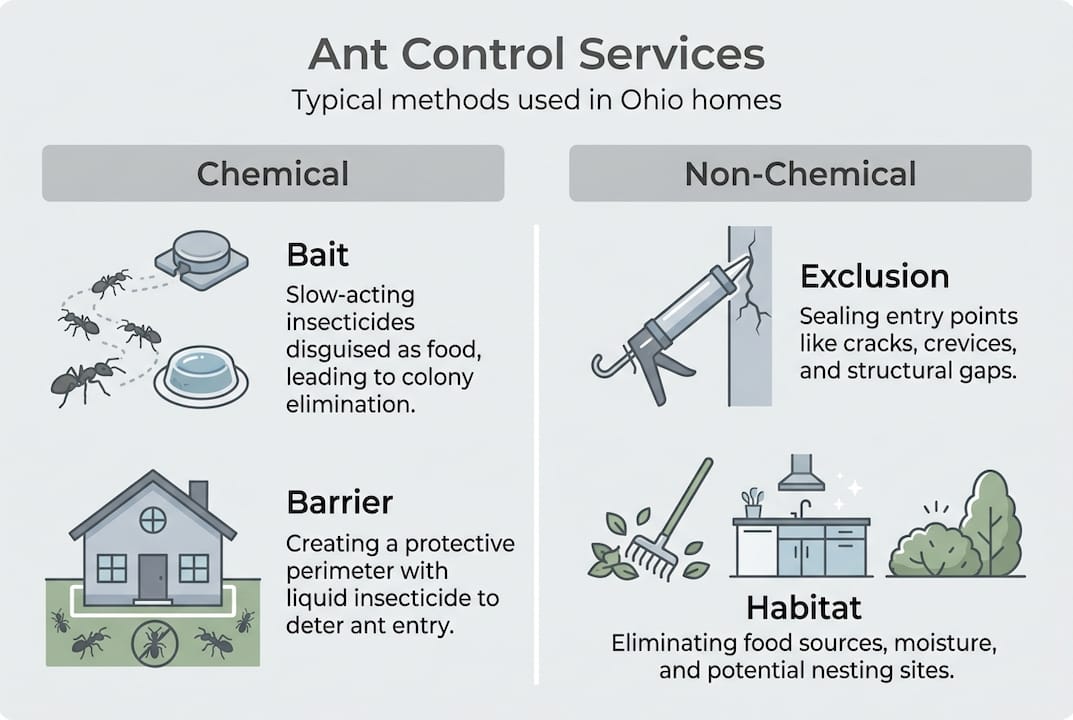
Baiting systems use attractive food sources mixed with slow-acting insecticides. Worker ants carry bait back to colonies, spreading it throughout the nest and eventually reaching the queen. This method takes longer but eliminates entire colonies rather than just visible ants. Residual insecticides create barrier treatments around your property, killing ants on contact and preventing new entries for weeks or months. These work faster for immediate relief but require reapplication.
Non-chemical methods include physical exclusion, habitat modification, and natural deterrents. Both chemical and non-chemical control methods are widely used and often combined for best results. Heat treatments, diatomaceous earth, and botanical insecticides offer alternatives for those seeking lower toxicity options. However, severe infestations typically require conventional treatments for complete elimination.
Integrated Pest Management combines multiple approaches for safer, more effective control. IPM prioritizes prevention and monitoring, using chemical treatments only when necessary and targeting them precisely. This strategy reduces environmental impact while maintaining effectiveness.
Service frequency varies based on infestation severity and property needs:
- One-time treatments address active infestations with follow-up visits as needed
- Monthly services provide ongoing monitoring and prevention
- Seasonal treatments target peak ant activity periods
- Emergency services respond to sudden severe infestations
Costs differ significantly across service types and providers. One-time treatments typically range from basic inspections to comprehensive colony elimination. Monthly maintenance programs spread costs over time while preventing new problems. Environmental impact also varies, with IPM approaches generally creating less ecological disruption than broad-spectrum chemical applications.
| Service Type | Best For | Typical Timeline | Environmental Impact |
|---|---|---|---|
| Baiting | Colony elimination | 1-3 weeks | Low to moderate |
| Residual barriers | Immediate relief | Days to weeks | Moderate |
| IPM programs | Long-term management | Ongoing | Low |
| Heat treatment | Chemical-free needs | Single visit | Very low |
Pro Tip: Ask providers which methods they use for your specific ant species. Generic answers suggest they may not tailor treatments to Ohio’s common ant problems.
Selecting the right service depends on your property type, infestation severity, budget, and personal preferences regarding chemical use. Residential properties often benefit from different approaches than commercial facilities with food handling or sensitive equipment.
How to choose the best ant control service near me in Ohio
Evaluating local ant control companies requires examining several key factors that separate reliable providers from those offering substandard results.
Start by verifying company licenses and certifications for Ohio pest control. Licensed technicians receive training on safe, effective application methods and stay current with regulations. Checking local licenses, reviews, and treatment guarantees helps ensure quality results. Unlicensed operators may use improper methods that endanger your family or fail to eliminate infestations.

Customer reviews and references provide insight into real-world performance. Look for patterns in feedback rather than isolated complaints. Multiple customers reporting recurring infestations or poor communication signals problems. Ask companies for local references you can contact directly about their experiences.
Confirm the service scope includes ant species common to Ohio properties. Providers specializing in termites or bed bugs may lack expertise with carpenter ants or odorous house ants. Ask specifically about their experience treating your ant type and request details about their approach.
Follow these steps to evaluate potential providers:
- Request detailed written estimates from at least three companies
- Ask about their inspection process and how they identify ant species
- Inquire about treatment methods they’ll use and why those fit your situation
- Confirm whether initial treatments include follow-up visits
- Review service guarantees and understand what triggers retreatment
- Check online reviews on multiple platforms for consistency
Service guarantees demonstrate provider confidence in their work. Quality companies offer retreatment if ants return within a specified period. Understand guarantee terms clearly, including any requirements you must meet for coverage to remain valid.
Pricing transparency matters significantly. Reputable providers explain costs clearly and itemize services rather than offering vague estimates. Be cautious of prices dramatically lower than competitors, which often indicate rushed work or inferior products. Conversely, the highest price doesn’t guarantee the best service.
Environmentally friendly or low-toxicity options appeal to many property owners, especially those with children, pets, or chemical sensitivities. Ask about calling an exterminator near you before it gets worse and what alternatives they offer. Quality providers can explain tradeoffs between different treatment approaches honestly.
Pro Tip: During initial consultations, note whether technicians ask detailed questions about your ant problems or immediately push treatments. Thorough professionals gather information before recommending solutions.
Communication quality throughout the selection process often predicts service quality. Companies that respond promptly, answer questions clearly, and explain their process thoroughly typically deliver better results than those rushing through consultations.
Preventing ant infestations after treatment
Professional treatment eliminates existing ant colonies, but long-term success requires ongoing prevention to keep new infestations from developing. Your actions between service visits significantly impact how long you stay ant-free.
Maintaining cleanliness removes food sources that attract foraging ants. Wipe counters thoroughly after meal preparation, sweep floors regularly, and store food in sealed containers. Even small crumbs or spills create trails that bring hundreds of ants indoors within hours. Pet food bowls left out overnight become major attractants.
Water access draws ants as reliably as food. Fix leaky pipes, eliminate standing water, and ensure proper drainage around your foundation. Carpenter ants particularly seek moisture-damaged wood, so addressing humidity problems in crawl spaces and attics prevents serious structural issues.
Sealing entry points around your property blocks new ant invasions. Ongoing prevention like sanitation and maintenance significantly reduces risk of re-infestation. Inspect your foundation, windows, doors, and utility penetrations for gaps. Apply weatherstripping, caulk cracks, and seal openings around pipes and wires. Even tiny gaps allow ant entry.
Landscape management reduces nesting sites near structures:
- Trim tree branches and shrubs away from your home
- Remove wood piles, leaf litter, and debris from around the foundation
- Maintain a vegetation-free zone of at least 12 inches around your property
- Ensure mulch stays at least 6 inches from siding
- Address drainage issues that create moist soil conditions
Schedule regular inspections and follow-up treatments as recommended by your service provider. Many companies offer maintenance programs that catch new ant activity before it becomes a full infestation. These visits cost less than treating recurring major problems.
Monitor for early signs of ant activity to address issues quickly. Seeing a few scout ants doesn’t necessarily mean you have an infestation, but it warrants attention. Note where you see ants, what time of day, and whether numbers increase. This information helps professionals target treatments effectively if intervention becomes necessary.
“Prevention is always more cost-effective than treatment. Property owners who maintain vigilance between professional visits experience far fewer recurring ant problems and save significantly over time.”
Establishing prevention habits takes initial effort but becomes routine quickly. The payoff comes in avoiding the frustration, expense, and property damage that recurring ant infestations create.
Protect your Ohio property with expert ant control services
Finding reliable ant control near you doesn’t have to be complicated when you work with experienced professionals who understand Ohio’s unique pest challenges. Apex Pest Control has served residential and commercial clients since 1969, developing proven solutions for carpenter ants, odorous house ants, and other species common to the region.
Our tailored approach begins with thorough inspection and accurate species identification, ensuring treatments match your specific situation. Whether you need immediate relief from an active infestation or ongoing prevention to maintain a pest-free property, we offer flexible service options designed around your needs and preferences.
Explore our top residential pest solutions comparison to find the right fit for your home, or review our best commercial pest control services for business properties. Ready to get started? Contact us today for a free consultation and quote.
Frequently asked questions
How quickly can a professional ant control service near me eliminate infestations?
Most professional services begin reducing visible ant activity within 2 to 5 days of initial treatment. Complete colony elimination typically takes 1 to 2 weeks, depending on infestation severity and ant species. Carpenter ants often require longer because their colonies spread through wood structures. Follow-up treatments ensure any surviving ants or satellite colonies get addressed before they rebuild populations.
Are ant control treatments safe for pets and children?
Licensed professionals use EPA-approved products and apply them according to strict safety protocols that minimize risks to people and pets. Most treatments allow safe re-entry within hours of application once surfaces dry. Communicate any specific concerns about children, pets, or sensitivities during your consultation so technicians can adjust methods accordingly. Following post-treatment instructions your provider gives ensures maximum safety.
Can I prevent ants myself, or should I always hire professional services?
DIY prevention measures like sanitation, sealing entry points, and removing attractants help significantly and should be part of your routine maintenance. However, established infestations with active colonies typically require professional treatment for complete elimination. The most effective approach combines professional services to eliminate existing problems with your ongoing prevention efforts to maintain results. Check out these ant removal Ohio tips for practical prevention strategies.
What factors influence the cost of ant control services near me?
Infestation severity directly impacts cost, as larger colonies require more product and labor. Property size determines treatment area and time required. Treatment type affects pricing, with specialized methods like heat treatment typically costing more than conventional approaches. Service frequency matters too, with one-time treatments priced differently than monthly maintenance programs. Request detailed quotes from multiple local providers to compare pricing for your specific situation and understand exactly what each estimate includes.