



TL;DR:
- Effective bird control in Oakwood involves comprehensive site assessments, combining humane deterrents with physical exclusions to prevent pest infestations. Regular maintenance and monitoring are essential to ensure long-term success, especially before nesting seasons. Working with licensed professionals helps navigate legal regulations and implement environmentally responsible, durable solutions.
Pigeons on your roofline, starlings packed under your eaves, sparrows nesting in your HVAC vents. If you manage a property in Oakwood, Ohio, you know this isn’t a minor inconvenience. Effective bird control strategies protect your building, your tenants, and your bottom line. Bird droppings accelerate surface corrosion, create slip hazards on walkways, and carry pathogens that put people at risk. This guide walks you through a complete approach, from initial property assessment to long-term maintenance, so you can take real control of your bird pest management challenges before they get expensive.
Table of Contents
- Key Takeaways
- Effective bird control strategies start with a property assessment
- Humane bird control methods that actually reshape behavior
- Physical exclusion techniques for Oakwood buildings
- Maintenance, monitoring, and seasonal planning
- Legal and environmental considerations in Oakwood, Ohio
- My take on bird control after years of Ohio properties
- Get professional bird control help in Oakwood
- FAQ
Key Takeaways
| Point | Details |
|---|---|
| Start with a site assessment | Map every landing zone, roost, and structural gap before selecting any deterrent. |
| Humane deterrents reshape behavior | Consistent mild discomfort systems reduce repeat infestations more effectively than scare tactics. |
| Physical exclusion seals the gaps | Netting, spikes, and micro-gap sealing are non-negotiable for older Oakwood buildings. |
| Seasonal timing matters | Install exclusion measures before Ohio’s spring nesting season to block birds early. |
| Multi-method programs win long term | Combining multiple control methods tailored to your property and bird species delivers the best results. |
Effective bird control strategies start with a property assessment
Before you spend money on any product or service, you need to understand what you are actually dealing with. The most common mistake Oakwood property owners make is treating bird control like a one-size solution. It is not.
Walk your entire property and document the following:
- Roosting zones: Roof ledges, HVAC units, gutters, and parapets where birds congregate
- Nesting sites: Eaves, soffits, vents, and attic gaps common in Oakwood’s older residential neighborhoods near Schantz Park
- Landing patterns: Where birds perch repeatedly during different times of day
- Structural vulnerabilities: Open rafters in commercial warehouses, gaps in brick facades, deteriorated caulking on older homes
Oakwood has a mix of post-war brick ranch homes, two-story colonials, and commercial strips along Far Hills Avenue. Each building type creates different access points. A commercial building with flat roofing and exposed ductwork faces completely different risks than a 1950s residential home with open soffits and wide eaves.
Understanding bird behavior is just as critical as scanning the structure. Pigeons are creatures of habit. They return to the same ledges daily. Starlings prefer cavities. House sparrows are aggressive about nesting inside enclosed spaces like vents and attic soffits. Knowing which species you are dealing with directly determines which deterrents will actually work.
Surveying building vulnerabilities like roof gaps, vents, and ledges is critical for matching deterrents to your site layout. A deterrent covering only visible ledges while leaving vents and eave gaps open is a deterrent that will fail.
Pro Tip: Take photos during your assessment and create a simple site map. This becomes your baseline document for tracking deterrent performance over time and identifying where problems reappear.
Humane bird control methods that actually reshape behavior
The pest control industry has moved well past spinning reflective tape and fake owls. Modern best practices for bird control focus on reshaping bird behavior rather than simply startling birds away temporarily.
Traditional scare tactics like visual deterrents and sound devices have a fundamental flaw. Birds quickly habituate to predictable stimuli when they learn there is no real threat. A fake owl that never moves becomes invisible to pigeons within days. Recorded predator calls lose their effect within a week. Property owners across Oakwood have learned this lesson the hard way after investing in devices that worked briefly and then stopped.
Humane deterrence works differently. Rather than triggering a fear response that fades, it makes sites feel physically unstable or uncomfortable on a continuous basis. Electromagnetic pulse systems like those in the Symterra Pulse category operate on this principle. They create ongoing mild discomfort that conditions birds to associate your property with an unpleasant experience without injuring them.
The benefits of humane bird control methods go beyond ethics:
- Reduced cleaning costs from droppings on walkways, vehicles, and building facades
- Lower risk of bird-borne pathogens like histoplasmosis from accumulated waste
- Consistent deterrence rather than periodic spikes in effectiveness
- Positive reputation for commercial properties where visible harm to wildlife is a concern
Humane deterrents that provide consistent mild discomfort reshape bird behavior by making sites feel unstable, reducing the likelihood that birds treat your property as a regular territory. This is the mechanism that separates modern bird control from old-school scare tactics.
For Oakwood businesses along Stroop Road or commercial plazas near Bigger Road, where foot traffic and tenant experience matter, non-lethal behavior-based deterrence is also the safest public-facing approach. You get results without alarming customers or drawing complaints.

Pro Tip: Pair behavior-based deterrents with at least one physical exclusion method. A system that makes birds uncomfortable while also blocking their preferred access points closes the loop that single-method approaches leave open.
Physical exclusion techniques for Oakwood buildings
Physical barriers are the backbone of any serious bird exclusion strategy. They do not rely on bird behavior. They simply block access. When installed correctly, they work indefinitely.
Here is how the main exclusion options compare:
| Method | Best use case | Key limitation |
|---|---|---|
| Bird netting | Large open areas, rafters, HVAC enclosures | Can trap birds or degrade if not maintained |
| Bird spikes | Ledges, window sills, signage, parapets | Birds may nest between spike strips if spacing is wrong |
| Anti-roosting wire | Thin ledges, cables, and light fixtures | Less effective on wide flat surfaces |
| Slope panels | Aesthetic-priority ledges and facades | Higher upfront cost, limited to certain angles |
| Micro-gap sealing | Vents, eaves, soffits, deteriorated mortar joints | Requires regular inspection to stay effective |
Sealing micro-gaps such as vents, eaves, and soffits is non-negotiable, especially in older Oakwood homes where decades of settling have opened new entry points. Hardware cloth, metal vent covers, and foam-backed caulking are the standard materials for this work.
Bird netting works exceptionally well for covering open rafters in commercial properties, parking garages, and loading dock areas. However, netting can trap birds or degrade over time if not monitored. A trapped bird creates a new problem. Degraded netting creates gaps that invite birds back in while giving you false confidence that the area is protected.
Spikes are misunderstood as cruel, but they work through simple geometry. Birds cannot land comfortably. The limitation is installation spacing. Spikes placed too far apart or only on primary ledges leave secondary perches available, and birds will find them. For Oakwood commercial properties with horizontal facade elements and decorative stonework, this matters.
For the best long-term outcomes, combine exclusion materials with behavior-based deterrents. Physical barriers block primary access. Humane deterrents address remaining areas where full exclusion is not practical. Together, they cover the gaps that either approach would leave on its own.
You can explore bird control options for Ohio homes that address the specific challenges of soffits, eaves, and complex rooflines typical of this region.
Maintenance, monitoring, and seasonal planning
Installing deterrents and walking away is how bird problems come back. Sustained bird pest management requires a maintenance schedule and a willingness to adapt when conditions change.
Follow this inspection routine for best results:
- Pre-nesting check (February to March): Inspect all exclusion materials before Ohio’s spring nesting season begins. Oakwood’s seasonal weather drives bird activity patterns, and the window between late winter and early spring is your best opportunity to seal new gaps before birds claim them.
- Post-winter inspection (April): Look for freeze-thaw damage to caulking, netting anchors, and spike adhesive. Ohio winters are hard on materials.
- Mid-summer audit (July): Check for nesting attempts in secondary areas, degraded deterrent components, and any new structural openings created by maintenance or storm damage.
- Fall review (October): Assess performance before migratory species arrive and before temperatures drop, since cold weather makes installation harder.
Regular maintenance, inspection, and monitoring are critical to catching weak points before birds reestablish nesting. Modern monitoring systems can flag deterrent failures in real time, letting you act before a new infestation cycle starts.
The most common failure pattern in commercial bird control is partial coverage. A facility manager installs netting over the main loading dock but leaves the secondary entrance unaddressed. Birds shift to the secondary entrance. Within weeks, the dock is affected again because the birds are already on site.
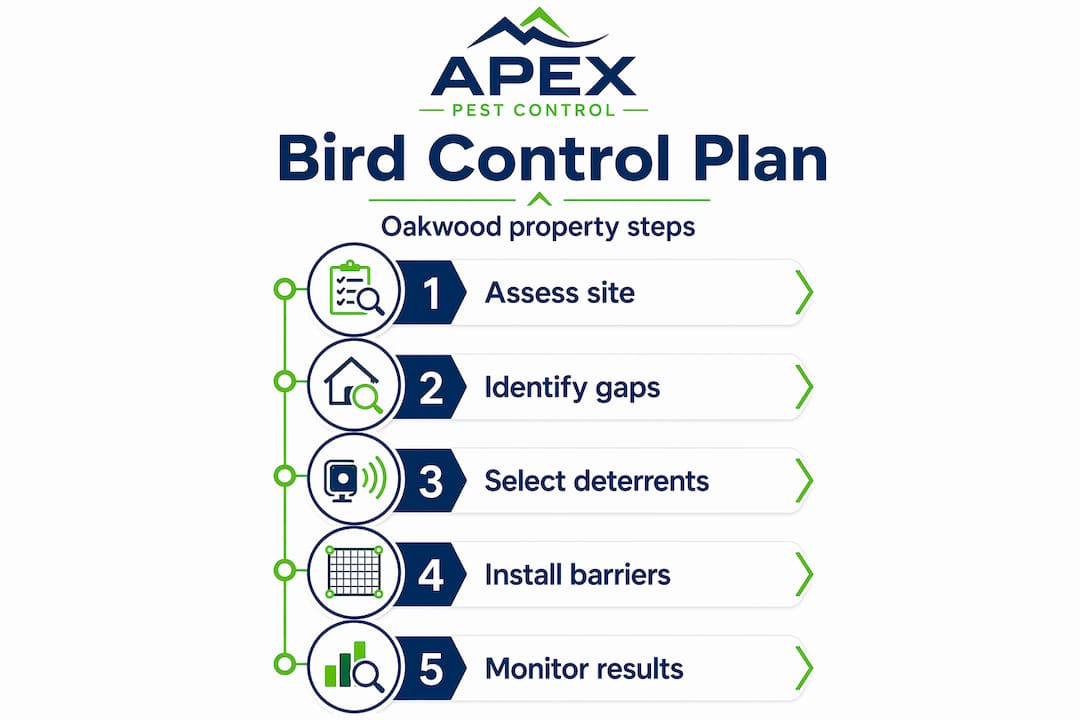
Pro Tip: Assign one staff member or vendor contact the specific responsibility of logging bird activity monthly. A simple photo log takes ten minutes and gives you the early warning system that prevents large-scale reinfestation.
Legal and environmental considerations in Oakwood, Ohio
Bird control in Ohio is not just a property management issue. It operates inside a legal framework that you need to respect.
Key regulations and responsibilities include:
- The Migratory Bird Treaty Act protects most wild bird species in the United States, including starlings and house sparrows in some interpretations. Work with a licensed professional who understands the current legal boundaries for your specific situation.
- Removal of active nests with eggs or young birds is restricted for protected species. Timing exclusion work before nesting begins is both the legal and practical approach.
- Bird droppings are classified as a biohazard in occupational health guidelines. Remediation requires appropriate protective equipment and disposal protocols.
- Local Oakwood ordinances may address noise ordinances relevant to sound-based deterrent devices, particularly in residential zones.
Choosing environmentally friendly bird control methods is not just good ethics. It protects you from liability, keeps you compliant with state and federal law, and reduces the secondary risks that lethal or aggressive methods can create on your property.
Permanent exclusion is preferred over scare tactics for high-risk environments, and humane deterrence reduces slip hazards, contamination risk, and cleaning frequency across your property. These are not just environmental wins. They are direct operational benefits.
My take on bird control after years of Ohio properties
I have seen a lot of bird control programs in Ohio. Residential clients in Oakwood, commercial facility managers near the Dayton-Montgomery County border, industrial properties. The pattern that causes the most long-term pain is the same everywhere: people treat bird control as a one-time fix rather than an ongoing management system.
Someone installs spikes on the main parapet ledge. Pigeons shift to the HVAC enclosure two months later. The property owner assumes the spikes failed. They did not fail. The site assessment just missed a secondary zone. Partial coverage always creates this outcome.
What I have found actually works is treating bird control the same way you treat any building system. You design it comprehensively, you document it, and you inspect it on a schedule. The best results come from integrating humane deterrents and physical exclusion together, matched to the species you are dealing with and the building’s actual geometry.
I also think the industry underestimates how much behavior retraining matters. A system that simply annoys birds for a few weeks does not produce lasting results. A system that consistently makes a site feel unstable over months actually rewires the association birds have with your property. That is the difference between a deterrent that holds and one that fades.
The best thing you can do as a property owner in Oakwood is get a professional assessment before buying anything. The wrong product installed in the right place is still money wasted.
— Dushan
Get professional bird control help in Oakwood
If you have read this far, you already know that effective bird control takes more than a trip to the hardware store. It takes site-specific planning, the right combination of materials, and a maintenance commitment. Apexpestcontrol has been serving Ohio residential and commercial clients since 1969, and the team understands the specific structural challenges that Oakwood properties present.
Whether you need a full pest exclusion assessment for a commercial facility or targeted exclusion work on a residential property, Apexpestcontrol brings licensed expertise and environmentally responsible methods to every job. You can also explore residential pest control options tailored to Ohio homes. Call 1-800-684-2284 for a free quote and get a plan that actually fits your property.
FAQ
What are the most effective bird control strategies for Ohio properties?
The most effective approach combines physical exclusion, such as netting and gap sealing, with continuous humane deterrents that reshape bird behavior over time. A professional site assessment is the necessary starting point to identify which methods fit your specific building layout and bird species.
How do humane bird control methods work?
Humane methods create consistent mild discomfort that conditions birds to avoid a site without injuring them. Unlike scare devices that birds learn to ignore, systems based on continuous deterrence reduce the likelihood that birds return to your property as a regular territory.
When is the best time to install bird exclusion in Oakwood?
The window between February and early April, before Ohio’s spring nesting season, is the most effective time for exclusion installations. Acting during this period blocks access before birds establish nests, which avoids both legal complications and the difficulty of removing active nesting activity.
Why do bird spikes and netting sometimes stop working?
Spikes fail when installed with improper spacing or only on primary ledges, leaving secondary perches available. Netting loses effectiveness when it degrades or develops gaps. Both require regular inspection and prompt repair to maintain their function as part of a complete bird management program.
Do I need a licensed professional for commercial bird control in Oakwood?
Yes. Federal law under the Migratory Bird Treaty Act regulates how certain species can be managed, and improper removal of active nests carries legal penalties. Licensed pest professionals understand current regulations, carry the right equipment for safe remediation, and can design compliant programs for both residential and commercial properties.