




TL;DR:
- Stored product pests infest dry foods like flour and spices, often originating from pre-infested store-bought goods in Ohio homes. Effective prevention includes airtight storage, regular pantry inspections, and sealing entry points, while quick control relies on sanitation, freezing, heat treatment, or professional pest control. Monitoring and physical exclusion are essential to break the pest cycle, especially during Ohio’s warm months when infestations spread rapidly.
Stored product pests, the industry term for what homeowners commonly call common product pests in homes, are insects and mites that infest dry goods like flour, cereal, spices, and pet food, contaminating them and triggering significant food waste if left unchecked. Ohio homeowners face a specific challenge: the state’s humid summers and cold winters create seasonal pressure points where pantry pests thrive indoors. Species like Indian meal moths, red and confused flour beetles, and drugstore beetles are the most frequent offenders in residential kitchens across Solon, Bedford, and Maple Heights. Knowing how to spot them early and respond correctly is the difference between a minor inconvenience and a full pantry overhaul.
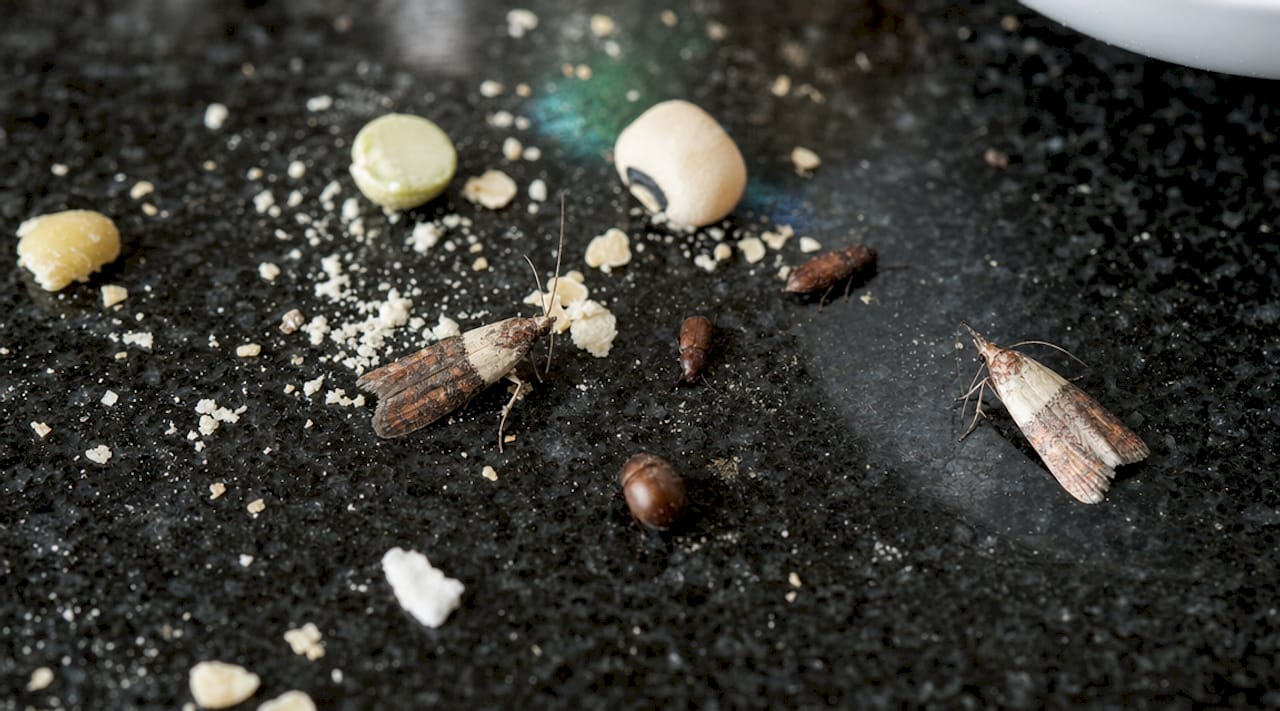
1. Common product pests found in Ohio pantries
Stored product pests primarily target low-moisture, carbohydrate-rich dry goods including flour, cereal, whole grains, spices, dried fruits, and pet food. The eggs are often invisible to the naked eye and arrive inside store-bought packaging, developing into adults within weeks. Here are the species Ohio homeowners encounter most often.
Indian meal moths are the most recognizable pantry pest in Ohio homes. Adults have a distinctive two-toned wing pattern: copper-red on the outer half and gray near the body. The larvae, not the adults, do the actual damage by spinning silky webbing inside food containers. You will find this webbing matted across the surface of cornmeal, birdseed, or dried fruit.
Red and confused flour beetles are small, reddish-brown beetles roughly 3 to 4 millimeters long. The two species look nearly identical, but both infest flour, cake mixes, and dried pasta. They do not bite and they do not fly well, but they reproduce rapidly. A single unnoticed bag of old flour can seed an entire pantry shelf within a month.
Drugstore beetles are round, brown beetles about 2 to 3 millimeters long with a humped appearance. They earned their name from infesting old apothecary supplies, but today they target spices, dried herbs, and even prescription medications. Their ability to chew through cardboard and thin plastic makes them harder to contain than most pantry pests.
Sawtoothed grain beetles are flat, narrow beetles with six saw-like projections on each side of the thorax. Their flat body allows them to squeeze into packaging that appears sealed. Cigarette beetles are similar in size to drugstore beetles but prefer tobacco products, dried herbs, and paprika. Grain mites are microscopic and often go undetected until a fine, grayish dust appears on pantry shelves. That dust is the mites themselves.
Key signs of infestation to watch for:
- Small live beetles or moths flying near light sources in the kitchen
- Silky webbing in products or across container openings
- Fine powdery frass (insect waste) collecting at the bottom of bags or boxes
- Pin-sized holes in cardboard or thin plastic packaging
- A musty or unpleasant odor coming from stored goods
2. How product pests get into Ohio homes and spread
Understanding the entry pathways is the fastest route to stopping an infestation before it takes hold. Most homeowners assume a dirty kitchen is the cause, but most infestations originate from pre-infested products purchased at grocery stores, warehouse clubs, or farm supply retailers. The infestation may not become visible until weeks after the item sits in your pantry.
Here is how the spread typically unfolds in an Ohio home:
- A single infested package enters the home. Flour, birdseed, or pet food from retail stores is the most common origin point. Larvae are already present inside the packaging when you buy it.
- Larvae migrate to adjacent containers. Within weeks, larvae chew through thin plastic or cardboard and move to neighboring packages on the same shelf.
- Adults emerge and scatter. Adult Indian meal moths, for example, fly toward light sources and lay eggs in new food sources throughout the kitchen.
- Seasonal conditions accelerate reproduction. Ohio’s warm, humid summers between June and September speed up insect development cycles, meaning a small problem in May can become a serious infestation by July.
- Structural gaps and open windows allow additional entry. Adult pests attracted to light can enter through torn window screens or gaps around utility lines, adding outdoor pressure to an already active indoor infestation.
Older homes in Bedford Heights and Maple Heights, many built before 1970, tend to have more structural gaps around pipes and window frames, making exclusion work especially relevant for those neighborhoods.
3. Effective prevention strategies for Ohio homeowners
Prevention is far less costly than treatment. The core principle is simple: deny pests access to food and entry into the home. The specific tactics below are calibrated for Ohio’s housing stock and seasonal patterns.
- Switch to airtight containers. Store all dry goods in glass jars, metal tins, or thick polypropylene containers with locking lids. Standard cardboard boxes and thin plastic bags offer no real barrier to flour beetles or sawtoothed grain beetles.
- Freeze or heat-treat bulk purchases. Heat treatment at 140°F for at least 30 minutes or freezing below 0°F for 3 to 4 days kills all insect life stages in newly purchased dry goods. This is especially useful for bulk birdseed, cornmeal, and whole grains bought in large quantities.
- Inspect groceries before storing them. Check package seams, corners, and any existing tears before placing items in your pantry. A quick visual check takes 30 seconds and can prevent weeks of cleanup.
- Run a monthly pantry audit. Pull everything off the shelves, wipe down surfaces with soap and water, and check expiration dates. Items sitting unused for more than six months are prime infestation sites.
- Seal structural entry points. Install or replace weatherstripping on exterior doors, repair torn window screens, and caulk gaps around utility pipes. The Ohio pest entry point guide from Apexpestcontrol covers the most common gaps found in Ohio residential construction.
- Switch outdoor lighting. Replace white incandescent or fluorescent bulbs near entry points with LED or yellow-spectrum bulbs, which attract fewer flying insects.
Pro Tip: Try “diagnostic incubation” with any suspect package. Place it in a sealed glass jar for five to seven days. If insects appear inside the jar, the package is infested and should be discarded immediately before it contaminates the rest of your pantry.
Monitoring during Ohio’s warmer months is especially critical. Pest activity peaks between late spring and early fall, so increasing inspection frequency from monthly to biweekly between May and September gives you a meaningful early warning advantage.
4. How to control and eliminate an active infestation
Once you confirm an infestation, speed matters. The longer you wait, the more containers become compromised. The table below compares the most practical control methods available to Ohio homeowners.
| Method | Best for | Effectiveness | Chemical-free? |
|---|---|---|---|
| Remove and discard infested items | Heavily infested packages | High | Yes |
| Vacuum and deep-clean shelves | Eggs and larvae in cracks | High | Yes |
| Pheromone traps | Monitoring adult moths and beetles | Moderate (monitoring) | Yes |
| Heat treatment (140°F / 30 min) | Lightly infested salvageable goods | High | Yes |
| Freezing (below 0°F / 3 to 4 days) | Lightly infested salvageable goods | High | Yes |
| Professional pest control | Persistent or widespread infestations | Very high | Varies |
Sanitation is the primary control strategy: remove infested items, vacuum pantry surfaces and cracks, clean with soap and water, and transfer all remaining dry goods into airtight containers. Vacuuming is particularly important because it removes eggs and larvae that survive in shelf cracks and corners, which are the spots most homeowners miss.
Pheromone traps, available at hardware stores and online, attract and capture adult moths and beetles using synthetic sex attractants. They do not eliminate an infestation on their own, but they tell you which species you are dealing with and whether your cleanup efforts are working. Place them on pantry shelves and check them weekly.
Persistent pantry pest issues often trace back to overlooked reservoirs: dried floral arrangements, seldom-used bulk spices, or decorative corn stored in a back cabinet. If you have cleaned thoroughly and traps are still catching adults after two weeks, search beyond the obvious food storage areas.
When a professional is the right call: if the infestation has spread to multiple rooms, if you cannot locate the source after a thorough inspection, or if repeated self-treatment has not resolved the problem within three to four weeks, contact a licensed pest control company. Ohio homes with finished basements or attached garages often have secondary infestation sites that require professional-grade inspection equipment to locate.
For a structured approach to ongoing prevention, the monthly pest maintenance guide from Apexpestcontrol outlines a practical inspection schedule built around Ohio’s seasonal pest cycles.
Key takeaways
Stored product pests enter Ohio homes through infested store-bought goods, spread rapidly in warm months, and require both thorough sanitation and airtight storage to control effectively.
| Point | Details |
|---|---|
| Infestation origin | Most infestations start with a single pre-infested package, not a dirty kitchen. |
| Top Ohio species | Indian meal moths, flour beetles, and drugstore beetles are the most common offenders. |
| Prevention priority | Airtight containers and monthly pantry audits stop most infestations before they start. |
| Non-chemical control | Heat at 140°F or freezing below 0°F for 3 to 4 days kills all life stages in salvageable goods. |
| When to call a pro | Persistent infestations spanning multiple areas require professional inspection and treatment. |
What I’ve learned after years of Ohio pantry pest calls
After seeing hundreds of pantry pest situations across Solon, Bedford, and Maple Heights, the pattern that surprises homeowners most is this: the cleanest kitchens get infested too. Cleanliness is not the variable. The infested bag of organic quinoa from the health food store is just as likely to carry Indian meal moth eggs as the generic flour from a discount retailer.
The second mistake I see constantly is treating pheromone traps as the solution rather than the diagnostic tool. Homeowners buy a moth trap, catch a few adults, and assume the problem is solved. The trap tells you the pest is present. It does not tell you where the larvae are feeding, and larvae are what you need to eliminate.
Ohio’s housing stock adds a layer of complexity that generic pest control advice ignores. Homes in Bedford built in the 1950s and 1960s often have pantry shelving with gaps behind the boards where larvae can pupate undisturbed. A surface clean does not reach those spaces. You need to pull the shelving away from the wall, vacuum the wall cavity, and seal the gaps before reinstalling.
The integrated pest management approach is the framework I recommend to every homeowner. It combines inspection, sanitation, physical exclusion, and targeted treatment in a sequence that actually breaks the pest cycle rather than just suppressing visible adults temporarily.
— Dushan
How Apexpestcontrol helps Ohio homeowners get ahead of pantry pests
Apexpestcontrol has served Ohio residential clients since 1969, and stored product pest inspections are a core part of that work. If you have cleaned your pantry, discarded infested items, and the problem keeps returning, a professional inspection will locate the hidden source. Apexpestcontrol’s technicians know the structural quirks of Ohio homes, from older split-levels in Solon to brick colonials in Bedford Heights, and they bring the tools to find what a DIY inspection misses. Review the residential pest control options available for Ohio homeowners, or contact Apexpestcontrol directly for a free quote and get a clear plan for your specific situation.
FAQ
What is a stored product pest?
A stored product pest is any insect or mite that infests dry food goods such as flour, cereal, spices, or pet food. Common species include Indian meal moths, flour beetles, and drugstore beetles.
Are pantry pests dangerous to my health?
Pantry pests do not transmit human diseases, but they contaminate food with webbing, feces, and body fragments. The primary concern is food waste and the contamination itself, not illness.
How do I know if I have a pantry pest infestation?
Look for small live beetles or moths near food, silky webbing inside containers, fine powdery frass at the bottom of bags, and pin-sized holes in packaging. Pheromone traps confirm which species is present.
Can I save food that has been lightly infested?
Yes. Freezing below 0°F for 3 to 4 days or heating to 140°F for 30 minutes kills all insect life stages in lightly infested goods, making them safe to use after treatment.
How long does it take to get rid of a pantry pest infestation?
A thorough cleanup combined with airtight storage typically resolves a contained infestation within two to four weeks. Widespread infestations or those with hidden reservoirs may require professional treatment to eliminate fully.