



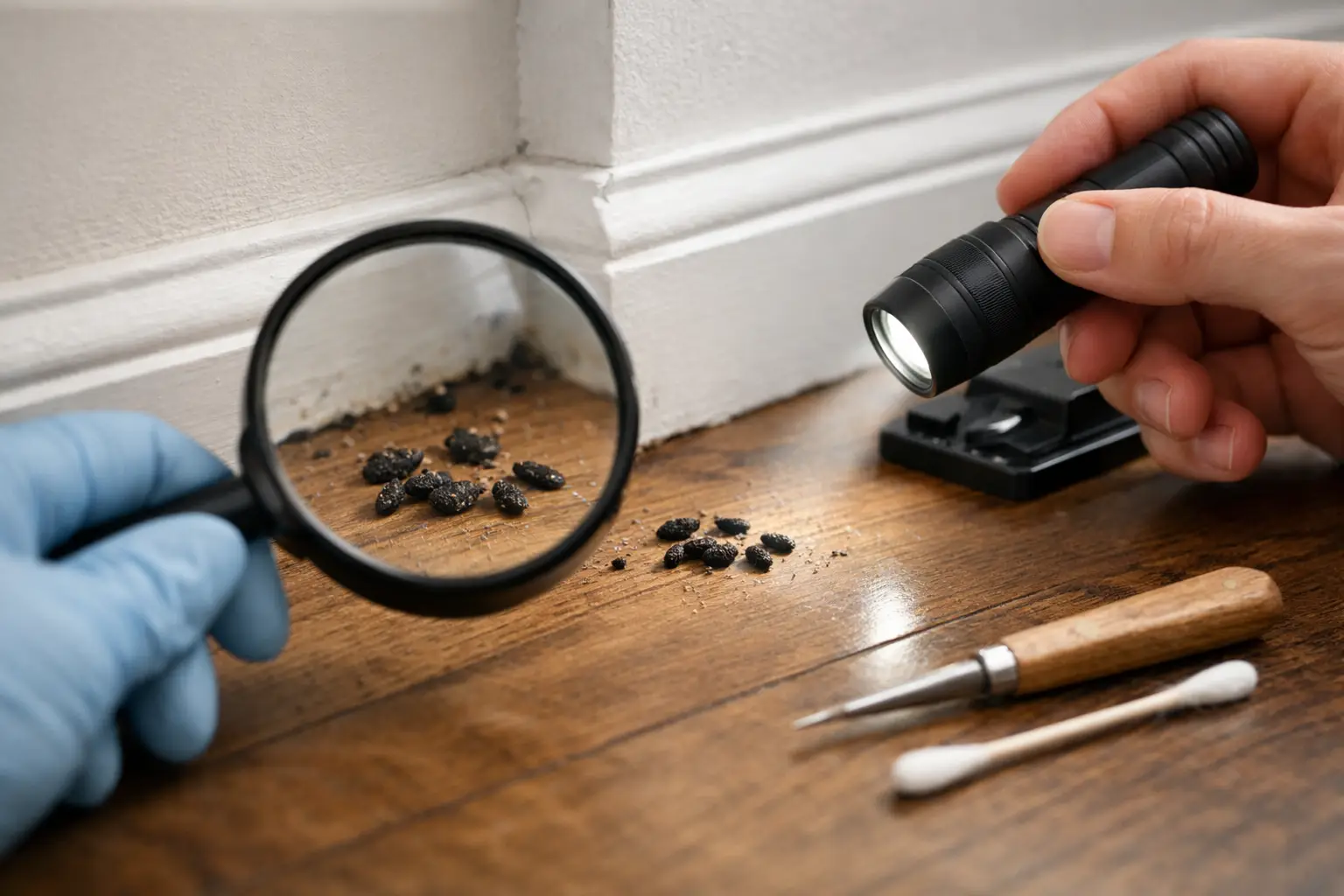
A few dark pellets behind the stove can be the first visible sign of a much larger rodent problem. Knowing how to inspect rodent droppings helps you respond quickly, protect your family or employees, and avoid spreading contamination while you investigate.
Rodent droppings are not simply a housekeeping issue. They can contaminate food, preparation surfaces, storage areas, insulation, and equipment. They also reveal where rodents are traveling, feeding, and nesting. A careful inspection gives you useful information, but safety comes first: never sweep or vacuum dry droppings.
Start by Inspecting Safely
Before you inspect a suspected area, keep children, pets, and unprotected staff away from it. Wear disposable gloves. If you are entering a dusty attic, crawl space, utility room, or area with a significant amount of droppings, use appropriate respiratory protection and consider calling a pest professional rather than disturbing the space yourself.
Dry sweeping and vacuuming can send contaminated dust into the air. Instead, ventilate the area if possible, then thoroughly wet droppings and nearby surfaces with a household disinfectant. Let the product sit according to its label directions before using paper towels to pick up the material. Place the towels and gloves into a sealed bag before disposal, then wash your hands thoroughly.
For a small, isolated finding, this process is manageable for many homeowners. The situation changes when droppings are widespread, repeatedly appearing, or found in a space that is difficult to access. Heavy accumulation can indicate long-term activity and may require professional cleanup as well as rodent control.
How to Inspect Rodent Droppings by Size and Shape
Look closely without handling the droppings directly. Their size, form, location, and freshness can help narrow down the likely pest, though no single clue is enough to confirm a species.
Mouse droppings
House mouse droppings are generally small, about one-eighth to one-quarter inch long. They are often shaped like dark grains of rice with pointed ends. You may find them in clusters along walls, inside kitchen drawers, behind appliances, beneath sinks, in pantry cabinets, or near stored pet food.
Mice tend to leave frequent droppings because they travel often and can fit through openings as small as a dime. Fresh mouse droppings are usually dark and may look slightly soft or shiny. Older droppings fade to gray or brown and become dry and crumbly.
Rat droppings
Rat droppings are larger and more substantial than mouse droppings. Norway rat droppings are often blunt at both ends and can be roughly one-half to three-quarters of an inch long. Roof rat droppings are more likely to have pointed ends and may be slightly smaller.
In homes, rats commonly leave evidence in basements, garages, crawl spaces, attics, near trash areas, and along exterior foundations. In commercial properties, inspect receiving areas, dumpster pads, food storage rooms, floor drains, utility penetrations, and false ceilings. A rat problem deserves immediate attention because rats can damage wiring, insulation, pipes, inventory, and building materials.
Do not rely on droppings alone
Other pests can leave small dark debris that resembles rodent droppings. Cockroach droppings may look like black pepper, coffee grounds, or tiny specks. Bat droppings can resemble mouse droppings but are often shinier and may crumble into insect fragments. Lizard and bird droppings are also distinct but can cause confusion in garages, sheds, and outbuildings.
If the identification is unclear, avoid guessing. A trained technician can assess the evidence, identify the likely pest, and determine whether the problem is active.
Check the Location for a Rodent Travel Pattern
Rodents rarely leave droppings at random. They prefer protected edges and predictable travel routes, which makes the location just as useful as the droppings themselves.
Inside a home, begin with the kitchen, pantry, laundry room, basement, garage, attic, and utility areas. Use a flashlight to inspect behind refrigerators, stoves, washers, dryers, water heaters, and stored boxes. Check the back corners of cabinets, under sinks where plumbing enters the wall, and around pet-food stations.
Rodents often follow walls because they feel protected. Look along baseboards, behind furniture, near floor penetrations, and inside closets that share a wall with a garage or exterior area. In an attic, inspect insulation near the perimeter, around HVAC equipment, and along wiring or plumbing runs.
At a business, the inspection should extend beyond the break room. Rodent activity often begins where food, moisture, clutter, and access points overlap. Loading docks, storage rooms, mechanical spaces, trash handling areas, and employee lockers deserve regular attention. One small cluster of droppings may point to an entry point that threatens a much larger portion of the facility.
Look for Signs That the Activity Is Current
Fresh droppings are a concern, but an active infestation typically produces more than one sign. Look for gnaw marks on food packages, wood, plastic, wiring, or insulation. Check for shredded paper, fabric, plant matter, or insulation that may be used for nesting.
You may also see greasy rub marks along walls, pipes, and baseboards. These marks develop as rodents repeatedly travel the same route. Scratching or movement sounds in walls, ceilings, or attics after dark are another warning sign, especially if droppings continue to appear in the same places after cleaning.
A practical way to monitor activity is to clean and disinfect the area safely, then recheck it after a day or two. New droppings indicate ongoing movement. Do not use this monitoring period as a reason to delay treatment, particularly if droppings are near food, bedding, children’s areas, or sensitive commercial operations.
Inspect for the Entry Point, Not Just the Mess
Cleaning droppings removes contamination, but it does not stop rodents from returning. Once you have identified where droppings are concentrated, inspect nearby access points. Mice can enter through remarkably small gaps, while rats can exploit damaged vents, open utility lines, gaps around doors, and foundation openings.
Outside, examine the lower exterior of the structure, including garage door seals, dryer vents, pipe penetrations, crawl-space vents, window wells, roofline openings, and damaged siding. Indoors, inspect where cables, plumbing, and HVAC lines pass through walls or floors. A gap behind a kitchen cabinet or utility appliance can connect directly to an exterior opening.
Sealing entry points is essential, but timing matters. Closing a route without addressing rodents already inside can trap them in wall voids or push them into new areas of the building. Effective rodent control combines exclusion with trapping, sanitation, monitoring, and follow-up inspections.
When Droppings Require Professional Rodent Control
Call for professional service when droppings are widespread, when you see them in food areas, or when they return after cleanup. Prompt help is also warranted if you hear rodents in walls or ceilings, notice chewed wiring, find a nest, or suspect activity in an attic, crawl space, commercial kitchen, warehouse, or multi-unit property.
For businesses, a professional inspection provides more than removal. It creates a documented plan for identifying entry points, reducing attractants, monitoring activity, and maintaining audit-ready conditions. This is especially valuable for food service, healthcare, hospitality, manufacturing, property management, and any operation where pest evidence can disrupt service or compliance.
Apex Pest Control builds rodent treatment plans around the property, the evidence found, and the conditions allowing activity to continue. That may include targeted removal, exclusion recommendations, sanitation guidance, and ongoing monitoring designed to protect people, pets, inventory, and the building itself.
Rodent droppings are a clear signal to act, not a problem to cover up or ignore. Clean the area safely, document where you found the evidence, and get qualified help before a small trail behind an appliance becomes a larger infestation behind the walls.