



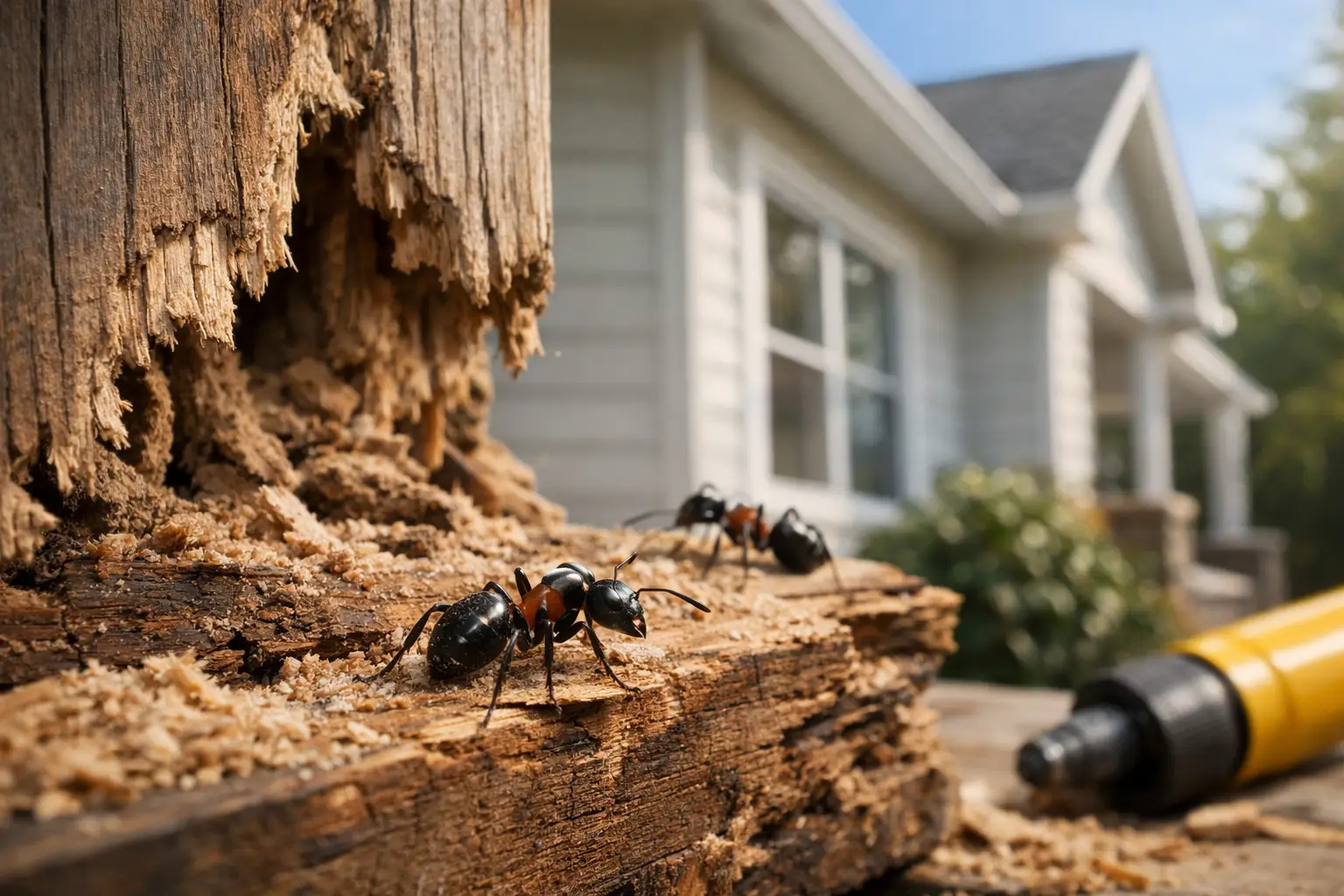
A few large black ants near a window may look like a minor nuisance. In Ohio, they can also be an early warning that damp or damaged wood is giving carpenter ants a place to nest. Knowing how to prevent carpenter ants means removing the conditions that attract them before they establish a colony inside a wall, window frame, deck, garage, or other vulnerable area.
Carpenter ants do not eat wood as termites do. They excavate it to create smooth tunnels for nesting, especially where moisture, decay, or previous damage has softened the material. That distinction matters: prevention is less about spraying every ant you see and more about protecting the building from moisture and access.
Start With Moisture Control
Moisture is one of the strongest carpenter ant attractants around a home or commercial building. A carpenter ant colony may nest outdoors in a wet stump, landscape timber, or fallen branch, then send workers indoors to search for food. In other cases, ants move directly into water-damaged framing, trim, insulation, or siding.
Inspect areas that stay wet or dry slowly after rain. Pay close attention to roof leaks, overflowing gutters, clogged downspouts, loose flashing, plumbing leaks, condensation around HVAC equipment, and water staining near windows or doors. A small leak behind a wall can create an ideal nesting area long before it produces obvious interior damage.
Repair active leaks promptly, and make sure gutters move water away from the foundation. Downspout extensions should discharge away from the building rather than soaking the soil next to it. In basements, crawl spaces, and utility rooms, address excess humidity with proper ventilation or a dehumidifier where appropriate.
This is particularly valuable for older Ohio homes, where aging wood trim, foundation drainage issues, and seasonal freeze-thaw cycles can create small openings and recurring moisture problems. Treating ants without correcting the moisture source may reduce activity temporarily, but it does not make the structure less attractive to a future colony.
How to Prevent Carpenter Ants by Sealing Access Points
Carpenter ants can enter through surprisingly narrow gaps. They commonly travel along utility lines, tree limbs, fences, siding edges, and foundation cracks, then find openings around pipes, vents, windows, doors, and rooflines.
Walk the exterior slowly and look for gaps where different building materials meet. Seal cracks around utility penetrations, repair damaged weatherstripping, and replace worn caulk around windows and doors. Screen vents that need protection, but do not block airflow that helps control moisture. The right repair should keep insects out without trapping damp air inside.
Doors and garage doors deserve extra attention. A visible gap under a door is an open route for ants and other pests. Replace damaged sweeps and confirm the door closes evenly. For commercial properties, inspect loading docks, receiving doors, utility rooms, and exterior service penetrations. These areas receive heavy use and can become recurring entry points if exclusion repairs are not maintained.
Sealing is most effective when combined with habitat changes outside. If tree branches, vines, or stacked materials touch the building, ants may use them as protected travel routes that bypass exposed ground.
Keep Wood, Vegetation, and Mulch Away From the Structure
The landscape around a building can either support prevention or create a direct path to a nest site. Carpenter ants favor damp wood and sheltered outdoor areas, so reduce the places where colonies can establish close to the structure.
Keep firewood stacked off the ground and well away from the home, garage, or business. Do not store lumber, old boards, rotting landscape timbers, or piles of yard debris against the building. Remove dead stumps and decaying logs when practical, especially if you have noticed large black ants nearby.
Trim branches and shrubs so they do not touch siding, roof edges, or windows. Vegetation should have enough clearance to allow airflow and give you a clear view of the foundation and exterior walls. Thick ground cover pressed against siding holds moisture and conceals insect activity.
Mulch is not automatically a carpenter ant problem, but a deep, constantly damp layer against the foundation can create favorable conditions. Keep mulch pulled back from siding and use a conservative depth. If a landscape bed stays wet, improve drainage before adding more mulch or decorative material.
Eliminate Food Sources That Keep Workers Coming Back
Carpenter ants need carbohydrates and protein. Outdoors, they may feed on insects, honeydew produced by aphids, fruit, and other natural food sources. Indoors, workers are drawn to spills, pet food, grease, sweet residues, and accessible trash.
Clean kitchen surfaces regularly, especially beneath small appliances and around recycling containers. Store pantry foods in sealed containers, wipe up sticky spills promptly, and avoid leaving pet food out overnight when possible. Rinse bottles and cans before placing them in indoor recycling.
Outside, keep trash containers closed and clean residue from the lids and surrounding area. Manage aphids and other honeydew-producing pests on shrubs or trees near the building. These steps will not correct a nest hidden in damaged wood, but they can make the property less rewarding for foraging workers.
Know the Signs Before the Colony Expands
Prevention includes early detection. Carpenter ants are often most active at night, and workers may travel some distance from their nest. Seeing one ant outdoors does not prove an infestation. Repeated indoor sightings, especially of large black ants in kitchens, bathrooms, basements, or near windows, deserve closer attention.
Watch for coarse, sawdust-like material called frass near trim, wall voids, decks, or wood features. Carpenter ant frass may contain bits of wood, insect parts, or insulation material pushed from a nest. You may also hear faint rustling within a wall during quiet periods, although this is not always present.
Winged ants indoors can signal that a mature colony is nearby. They are sometimes confused with termite swarmers, but carpenter ants have narrow waists, elbowed antennae, and differently sized wing pairs. Because the distinction can affect the treatment plan, avoid assuming the insect type based on appearance alone.
A careful inspection is especially important when activity occurs near a known leak, soft window trim, a chimney chase, a deck attached to the house, or a bathroom wall. Those conditions increase the likelihood that ants have found a protected nesting site.
Avoid the Most Common DIY Mistake
The most common mistake is spraying visible carpenter ants and assuming the issue is resolved. Contact sprays may kill foraging workers, but they often do not reach the colony, satellite nests, or the conditions that allowed the infestation to begin. In some situations, indiscriminate spraying can disrupt ant trails and make it harder to locate the source.
Baits can be useful under the right conditions, but results depend on correct identification, placement, timing, and the colony’s changing food preferences. A bait ignored in one season may be attractive at another time. More product is not necessarily better, particularly in homes with children or pets and in facilities with food safety or compliance requirements.
For a single outdoor sighting, focus first on sanitation, moisture correction, and exclusion. For persistent indoor activity or suspected structural nesting, professional inspection is the more reliable next step. The goal is to identify the species, locate likely nesting zones, and use a targeted plan rather than relying on a temporary surface treatment.
When Professional Carpenter Ant Prevention Makes Sense
Professional pest management is appropriate when carpenter ants keep returning, appear in multiple rooms, emerge from a wall or ceiling, or show up around visibly damaged wood. It is also a sound choice for property managers and commercial operators who need documented inspections, consistent prevention, and fast response across one or more locations.
A qualified technician can inspect exterior harborage areas, moisture-prone sections, likely entry points, and interior activity patterns. Treatment may involve targeted applications, baiting, exclusion recommendations, and follow-up monitoring based on the property and the level of activity. The most effective programs combine treatment with practical repairs, because pests will continue to exploit unresolved conditions.
Apex Pest Control builds carpenter ant service around that layered approach: inspection, targeted control, and prevention recommendations designed to protect people, pets, property, and daily operations. Whether the concern is a family home, apartment community, office, or facility, a customized plan provides more confidence than repeated guesswork.
Carpenter ants are easiest to stop when their first scouts have little to find: no wet wood, no easy openings, no sheltered path to the structure, and no dependable food source. Address those conditions now, and call for expert evaluation if the activity continues or the building shows signs of damage.