



A rodent scurries across the storage floor, and one incident threatens the entire inventory. For managers in Northeast Ohio, pest problems quickly become compliance headaches and put safety at risk. Systematic pest monitoring procedures are not optional in the modern warehouse setting—they are essential for safeguarding goods and maintaining regulatory standards. This guide outlines how proactive pest control measures protect products, support compliance, and help create a safer work environment.
Table of Contents
- What Pest Control Means For Warehouses
- Common Warehouse Pests And Infestation Risks
- Key Strategies For Effective Pest Prevention
- Legal Standards And Regulatory Compliance
- Costly Mistakes And How To Avoid Them
- When To Call Professional Pest Experts
Key Takeaways
| Point | Details |
|---|---|
| Importance of Proactive Pest Control | Implementing systematic monitoring and comprehensive sanitation measures is crucial for warehouse pest management to prevent contamination and maintain inventory integrity. |
| Common Warehouse Pests | Understanding the variety of pests and their specific risks is key to developing targeted prevention strategies that mitigate potential infestations. |
| Regulatory Compliance | Adhering to federal guidelines and maintaining thorough documentation is essential to avoid penalties and ensure operational integrity in pest management practices. |
| Engaging Professional Help | Recognizing when to call pest control experts can prevent costly infestations and ensure effective, specialized intervention for compliance and safety. |
What Pest Control Means for Warehouses
Pest control in warehouses represents far more than simple bug elimination. It’s a comprehensive strategy designed to protect inventory, maintain regulatory compliance, and ensure operational safety. Systematic pest monitoring procedures are critical for preventing contamination and preserving product integrity.
At its core, warehouse pest control involves several essential components:
- Continuous monitoring of facility spaces
- Weekly trap inspections and documentation
- Immediate reporting and response protocols
- Comprehensive sanitation management
- Employee training on pest identification
The primary objectives extend beyond merely removing pests. Warehouses must create robust systems that prevent infestations, track potential risks, and maintain stringent documentation. Inventory protection becomes paramount, as a single pest incident could compromise thousands of dollars in goods.
Effective pest control requires a proactive, multilayered approach. This means establishing clear protocols for trap placement, implementing regular inspection schedules, and training staff to recognize early warning signs. Warehouse managers must develop comprehensive strategies that address potential entry points, eliminate attractive environmental conditions, and create systematic response mechanisms.
Catching pests early prevents widespread contamination and reduces potential regulatory compliance issues.
Pro tip: Develop a detailed pest tracking log that records every inspection, trap placement, and potential pest sighting to maintain comprehensive documentation and demonstrate proactive management.
Common Warehouse Pests and Infestation Risks
Warehouse environments are particularly vulnerable to a complex ecosystem of destructive pests that can rapidly compromise inventory and operational integrity. Diverse stored product pests pose significant risks to warehouse operations, ranging from minor nuisances to potential total inventory loss.
The most common warehouse pests include:
- Warehouse beetles
- Grain beetles
- Moth species
- Rodent populations
- Mite infestations
These pests are particularly dangerous because they can enter facilities through multiple pathways. Product contamination becomes a critical concern, as these organisms can migrate through packaging, infiltrate storage systems, and reproduce quickly in ideal warehouse conditions. Stored product pest diversity demonstrates how complex and challenging pest management can become for warehouse managers.
Each pest category presents unique challenges. Beetles and moths typically target dry goods like grains, seeds, and processed foods, while rodents can cause extensive structural damage and contaminate entire product batches. The economic implications are substantial – a single undetected infestation can lead to thousands of dollars in potential inventory losses and potential regulatory compliance issues.

Here’s a summary of how common warehouse pests pose unique risks and require targeted approaches:
| Pest Type | Main Risk | Common Targets | Detection Challenge |
|---|---|---|---|
| Warehouse beetles | Contamination of food | Grains, processed food | Small size, hidden larvae |
| Grain beetles | Spoilage and loss | Cereals, seeds | Rapid multiplication |
| Moths | Webbing and odor | Dried goods | Difficult to spot eggs |
| Rodents | Structural and product damage | All stored goods | Nocturnal, elusive habits |
| Mites | Infestation of bulk stocks | Dried foods, seeds | Nearly invisible to naked eye |
Early detection and systematic monitoring are the most effective strategies for preventing widespread pest infestations.
Pro tip: Implement a quarterly comprehensive pest inspection schedule that includes detailed documentation of all potential entry points and existing pest activity to proactively manage warehouse biosecurity risks.
Key Strategies for Effective Pest Prevention
Successful pest prevention in warehouses demands a comprehensive and strategic approach that goes beyond simple reactive measures. Integrated Pest Management (IPM) programs provide a systematic framework for protecting inventory and maintaining operational integrity.
Key strategies for effective pest prevention include:
- Regular facility inspections
- Comprehensive sanitation protocols
- Structural exclusion techniques
- Targeted pest identification
- Ongoing monitoring systems
Preventative maintenance is crucial in warehouse environments. Each strategy works synergistically to create multiple layers of defense against potential pest invasions. The goal is not just elimination but creating an environment that naturally discourages pest establishment. Proper identification of potential entry points, food sources, and breeding conditions allows warehouse managers to develop proactive control measures.
Implementing these strategies requires a multifaceted approach. This means sealing potential entry points, maintaining strict cleaning standards, managing waste efficiently, and creating inhospitable conditions for pest survival. Warehouse teams must develop detailed documentation and tracking systems to monitor pest activity, ensuring quick and targeted responses to any potential infestations.
Compare proactive pest control strategies to solely reactive approaches:
| Approach | Cost Impact | Risk Reduction | Regulatory Compliance |
|---|---|---|---|
| Proactive | Lower long-term costs | Prevents infestations | Exceeds documentation needs |
| Reactive | High emergency expenses | Relies on crisis action | Typically lags requirements |
Systematic prevention is always more cost-effective than dealing with large-scale pest infestations.
Pro tip: Develop a comprehensive digital tracking system that logs all pest prevention activities, inspection results, and corrective actions to create a proactive and transparent pest management approach.
Legal Standards and Regulatory Compliance
Warehouse managers must navigate a complex landscape of federal regulations designed to protect inventory, worker safety, and public health. U.S. food safety regulations establish rigorous standards for pest control and contamination prevention in storage facilities.
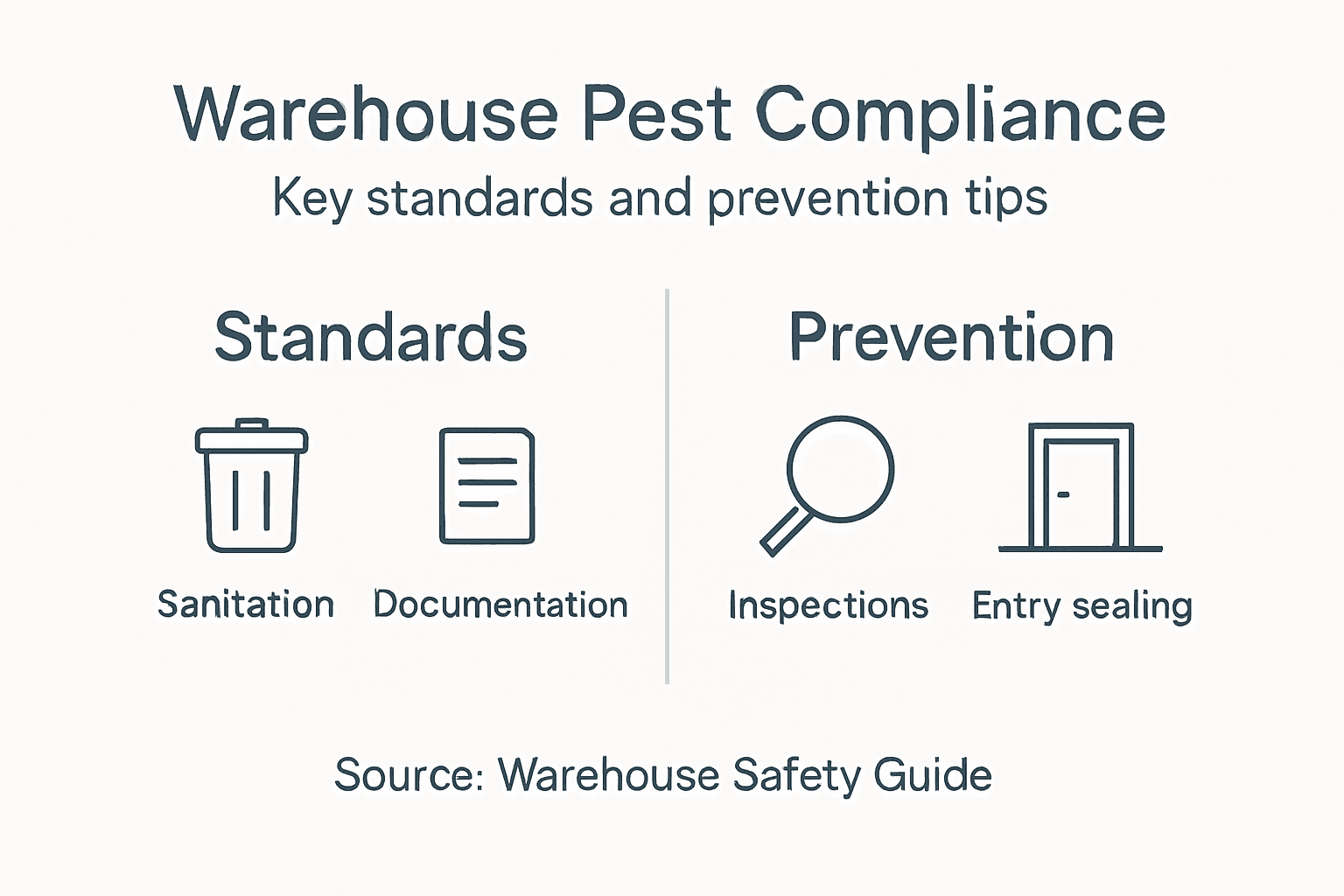
Key regulatory compliance requirements include:
- Food and Drug Administration (FDA) standards
- Federal Insecticide, Fungicide, and Rodenticide Act (FIFRA) guidelines
- Mandatory pest monitoring documentation
- Proper pesticide application protocols
- Detailed record-keeping requirements
Regulatory compliance extends far beyond simple paperwork. Warehouses must implement comprehensive pest management strategies that demonstrate proactive risk mitigation. Pesticide application regulations require precise documentation of every pest control intervention, including applicator certifications, product usage, and treatment outcomes.
Non-compliance can result in severe consequences, including significant financial penalties, product recalls, and potential facility shutdowns. Warehouse managers must develop robust systems that not only meet but exceed regulatory requirements. This means creating detailed tracking mechanisms, maintaining comprehensive training records, and ensuring all pest control activities align with federal and state guidelines.
Regulatory compliance is not just a legal obligation, but a critical component of maintaining operational integrity and protecting public health.
Pro tip: Create a digital compliance management system that centralizes all pest control documentation, certification records, and inspection reports to streamline regulatory reporting and demonstrate proactive risk management.
Costly Mistakes and How to Avoid Them
Warehouse pest control is fraught with potential missteps that can lead to significant financial and operational consequences. Common pest control mistakes can transform a manageable situation into a costly nightmare for warehouse managers.
The most critical errors warehouses frequently encounter include:
- Improper pest identification
- Relying exclusively on chemical treatments
- Neglecting routine monitoring
- Using unapproved pesticide applications
- Ignoring preventative sanitation practices
Misguided pest management often stems from a lack of comprehensive understanding. Selecting qualified pest control services requires careful evaluation of contractor expertise, approach, and compliance standards. Warehouse managers must recognize that effective pest control transcends simple extermination and demands a holistic, strategic approach.
Each mistake carries substantial risks. Improper pesticide use can contaminate inventory, lead to regulatory violations, and create resistant pest populations. Neglecting sanitation creates environments that naturally attract pests, while over-relying on chemical treatments can mask underlying structural or environmental issues that continue to drive pest infestations.
Prevention is exponentially less expensive than dealing with large-scale pest contamination.
Pro tip: Develop a comprehensive pest management audit checklist that includes detailed protocols for identification, prevention, treatment, and documentation to systematically eliminate potential management vulnerabilities.
When to Call Professional Pest Experts
Warehouse managers face complex decisions when determining the right moment to engage professional pest control services. Professional pest management strategies become critical when internal prevention methods prove insufficient.
Critical scenarios requiring professional intervention include:
- Large-scale or persistent infestations
- Specialized pest species detection
- Potential product contamination risks
- Complex regulatory compliance requirements
- Severe structural damage potential
Expertise matters significantly in pest management. Challenging pest control scenarios demand specialized knowledge that goes beyond standard extermination techniques. Professional experts bring comprehensive understanding of pest behavior, regulatory standards, and targeted elimination strategies that internal teams might lack.
Recognizing the right time to call experts can prevent catastrophic inventory losses and potential regulatory violations. Professionals provide not just treatment, but strategic assessments that identify root causes, potential entry points, and long-term prevention strategies. Their intervention becomes particularly crucial when pests pose direct threats to product safety, employee health, or operational continuity.
Proactive professional intervention is always more cost-effective than reactive damage control.
Pro tip: Develop a standardized escalation protocol that clearly defines trigger points for professional pest control engagement, ensuring swift and strategic responses to emerging pest management challenges.
Protect Your Warehouse Inventory with Expert Pest Management
Managing pest threats in warehouses requires more than just quick fixes. With challenges like preventing infestations, maintaining regulatory compliance, and safeguarding high-value inventory, businesses need a comprehensive and proactive pest control partner. Apex Pest Control understands these unique needs and offers tailored solutions that include continuous monitoring, thorough sanitation protocols, and detailed documentation—all crucial steps highlighted in the industry best practices discussed here.
If you want to build a robust pest prevention strategy that avoids costly mistakes and potential regulatory fines, our licensed technicians provide reliable, family-safe treatments designed for commercial environments. Don’t wait until pests jeopardize your products or your compliance status. Visit our Uncategorized Archives – Apex Pest Control to explore relevant insights and then contact us directly for a free quote. Take control of your warehouse’s pest management today and protect your inventory with proven local expertise.
Frequently Asked Questions
What are the essential components of pest control in warehouses?
Effective pest control in warehouses involves continuous monitoring, weekly trap inspections, immediate reporting protocols, comprehensive sanitation management, and employee training on pest identification.
How can warehouse managers prevent pest infestations?
Warehouse managers can prevent infestations by implementing regular facility inspections, maintaining comprehensive sanitation protocols, using structural exclusion techniques, and developing ongoing monitoring systems to deter pests from entering the environment.
What are the most common pests found in warehouses?
Common warehouse pests include warehouse beetles, grain beetles, moth species, rodent populations, and mite infestations, each posing unique risks to inventory and requiring targeted management approaches.
When should warehouse managers call professional pest control services?
Warehouse managers should call professional pest control services when facing large-scale or persistent infestations, specialized pest species detections, potential product contamination risks, complex regulatory compliance requirements, or severe structural damage potentials.