



TL;DR:
- A simple, consistent pest management workflow helps Ohio retail stores prevent infestations, ensure compliance, and protect customer trust. Regular inspections, staff logs, targeted treatments, and structural repairs are key to maintaining a pest-free environment year-round. Simplifying processes enhances staff adherence and reduces treatment costs while minimizing store disruptions.
A single pest sighting on your store floor can cost you more than a negative review. It can trigger a health inspection, drive away loyal customers, and, in worst-case scenarios, force a temporary closure. Ohio retail stores face a specific combination of pressures: high foot traffic, seasonal pest surges tied to the state’s humidity and cold winters, and the constant challenge of keeping food products, stockrooms, and customer areas clean. A structured pest management workflow cuts through the chaos, giving your team a repeatable system that prevents infestations before they start and keeps your store compliant and customer-ready all year.
Table of Contents
- Identifying pest risks and assessment in retail stores
- Tools, materials, and resources needed for pest management
- Step-by-step pest management workflow for stores
- Verifying results and continuous improvement
- Why simple, consistent workflows outperform complex pest management strategies
- Professional pest control solutions for Ohio retail stores
- Frequently asked questions
Key Takeaways
| Point | Details |
|---|---|
| Identify risks early | Spotting pest threats early prevents costly disruptions and protects your store’s reputation. |
| Organize tools and team | Having the right tools and staff roles streamlines your pest management workflow and speeds up response. |
| Follow clear workflow steps | A structured approach ensures no tasks are missed and keeps your Ohio store compliant and safe. |
| Verify and improve | Track results and tweak your workflow to maintain consistent pest-free conditions. |
| Get expert support | Professional pest control partners help tackle tough infestations and offer peace of mind. |
Identifying pest risks and assessment in retail stores
Before you can build a workflow, you need a clear picture of what you are actually up against. Ohio retail stores are vulnerable to a fairly predictable cast of pests, and knowing which ones are most likely in your environment shapes every decision downstream.
Rodents are the top threat for most retail locations, particularly those carrying food inventory or sharing a building with a restaurant or grocery tenant. Mice can squeeze through a gap as small as a quarter-inch, making entry point control critical. Cockroaches thrive in warm, humid areas like break rooms, stockrooms, and under display counters. Ants, especially odorous house ants and pavement ants, are relentless in spring and summer and often enter through foundation cracks and door gaps. Bed bugs are an increasingly serious concern for clothing retailers and stores with high-volume fitting rooms.
| Pest type | Primary risk area | Threat level | Seasonal peak |
|---|---|---|---|
| Rodents | Stockrooms, storage areas | High | Fall and winter |
| Cockroaches | Break rooms, food prep zones | High | Summer |
| Ants | Checkout areas, entry points | Medium | Spring and summer |
| Bed bugs | Fitting rooms, upholstered displays | Medium to high | Year-round |
Risk factors that accelerate infestation include improper food storage, cluttered stockrooms with lots of cardboard, aging building infrastructure with gaps in walls or floors, and loading docks that stay open for extended periods. Ohio’s humid summers and cold winters push pests indoors more aggressively than in many other states, so seasonal timing matters.
An assessment checklist should include:
- Entry points: Check all doors, windows, utility penetrations, and loading areas monthly
- Moisture sources: Look under sinks, around plumbing, and near HVAC units
- Droppings and gnaw marks: Inspect corners, along walls, and behind shelving units
- Odor indicators: A musty or ammonia-like smell can signal rodent activity before a sighting occurs
- Pest pathways: Look for grease trails, ant lines, and shed skins near baseboards
Looking at integrated pest management examples can help managers understand how a risk-based, layered approach works before a single trap is placed.
Pro Tip: Set up a simple staff logbook, either a shared digital document or a physical binder at the service desk, where any team member can log pest sightings with the date, location, and description. Even a single entry gives your pest control partner critical data when they visit.
Tools, materials, and resources needed for pest management
Once you have identified the potential pest risks, the next step is knowing what materials and resources are essential for a successful pest management workflow.
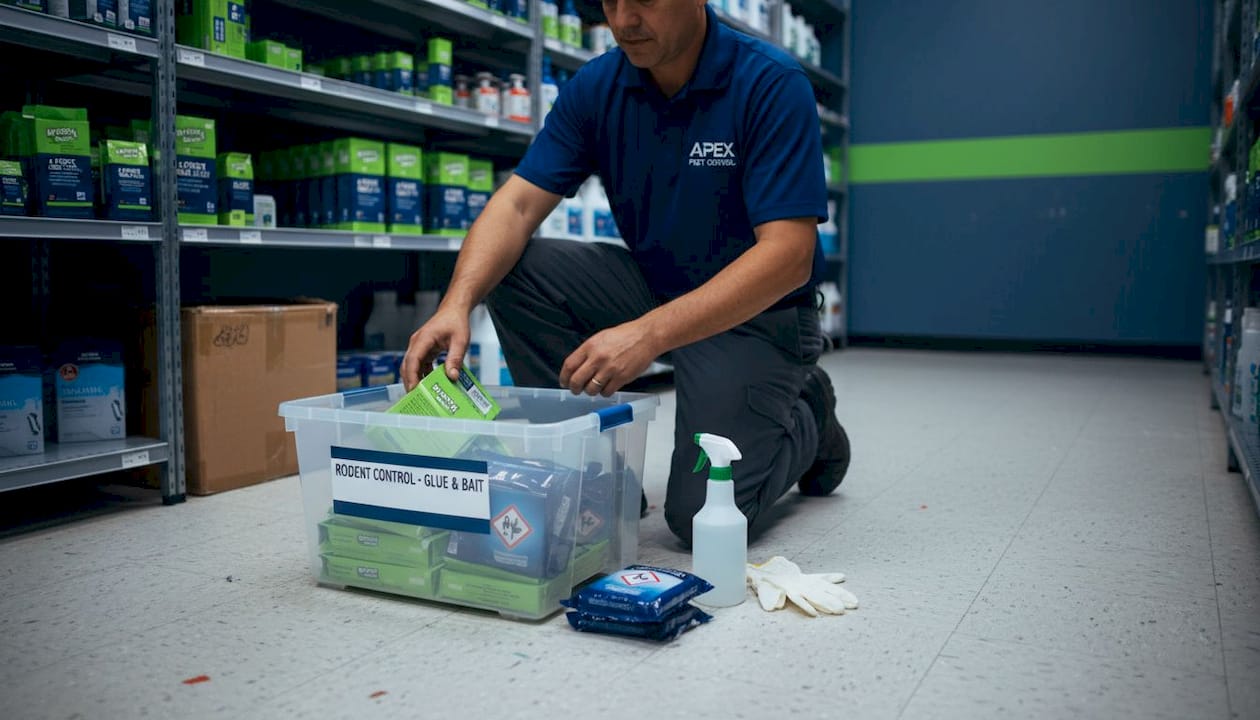
A well-equipped retail pest management program does not require a warehouse full of supplies. It requires the right tools, clearly assigned roles, and a plan for how everything works together.
| Tool or resource | Purpose | Supplier tip |
|---|---|---|
| Glue boards and snap traps | Rodent monitoring and capture | Place near walls and entry points, replace monthly |
| Pheromone traps | Monitor moth and beetle activity in food products | Stock several sizes for different aisle types |
| Digital temperature and humidity monitors | Track conditions that attract pests | Affordable options available at hardware stores |
| Sanitation supplies (sealed bins, liners) | Eliminate food and harborage sources | Use lidded bins in all break rooms and stockrooms |
| Inspection log sheets | Document findings and actions taken | Keep at each zone inspection station |
| Flashlights and inspection mirrors | Access hard-to-see areas | Long-handled mirrors help in tight stockroom corners |
Staff roles matter just as much as physical tools. A typical retail pest management team structure looks like this:
- Store manager: Oversees the entire workflow, reviews logs weekly, coordinates with the pest control partner, and makes final decisions on escalation
- Department leads or shift supervisors: Responsible for daily visual checks in their zones and logging any observations
- Maintenance staff: Handle structural repairs like sealing gaps, fixing leaky pipes, and replacing door sweeps
- External pest control partner: Conducts scheduled professional inspections, applies treatments, and provides compliance documentation
You can find solid preparation principles in a residential pest control guide that translate directly to commercial settings, particularly around sanitation and entry point management. A full store pest control workflow gives you a framework that can be layered over your current cleaning and operations schedule.
Preparation steps before your workflow launches:
- Brief all staff on their specific inspection responsibilities and show them what pest signs look like
- Divide your store into defined zones (sales floor, stockroom, break room, receiving area) for organized tracking
- Set up the logbook system and assign accountability for each zone
- Confirm your pest control partner’s schedule and establish a communication channel for urgent issues
- Stock all sanitation supplies and ensure traps and monitors are in place before the first inspection cycle
Step-by-step pest management workflow for stores
With your tools and team ready, it’s time to move into executing each pest management workflow step within your store.
A workflow is only valuable if it is followed consistently. The steps below are designed to be repeatable and clear enough that any trained staff member can execute them without confusion.
- Daily visual check: Each shift supervisor completes a quick walk-through of their assigned zone, looking for droppings, gnaw damage, unusual odors, or live pests. Findings go directly into the logbook with time, location, and description.
- Weekly trap and monitor inspection: A designated staff member checks all glue boards, snap traps, and pheromone traps. Replace or reset any that have been triggered. Log results, even when traps are empty, because a pattern of zero captures is meaningful data too.
- Monthly deep inspection and cleaning: Schedule a more thorough review of high-risk areas: behind shelving units, inside stockroom corners, under display counters, and around all plumbing. This is also the time to deep-clean break rooms, dumpster areas, and receiving zones.
- Immediate response protocol: When a pest is detected, isolate the affected area if possible, document the exact location with photos if practical, notify your manager and pest control partner, and pull any product that may be compromised. Do not wait for the next scheduled visit.
- Targeted treatment application: Work with your pest control partner to apply the most specific and least invasive treatment for the pest identified. Eco-friendly or low-toxicity options are available for most common store pests and are worth requesting explicitly.
- Post-treatment follow-up: Within a week of any treatment, re-inspect the treated area and document whether activity has decreased. If not, escalate the response.
Following a monthly pest maintenance guide keeps your cycles on track without relying on memory, and reviewing a preventative pest treatment overview helps you understand what options are available before an infestation takes hold in your Ohio store.
Maintaining compliance with Ohio’s food safety and retail health codes is not optional. Pest activity logs and treatment records are often the first documents a health inspector requests. Keep all records organized, dated, and accessible.
Pro Tip: Schedule your monthly deep cleaning on the same day each month, such as the first Tuesday, and link it directly to your pest log review. Combining both tasks reduces scheduling friction and increases the chance your team actually follows through.
Common mistakes to avoid include skipping inspections during busy retail seasons (holidays and back-to-school periods are exactly when pest pressure spikes because of increased deliveries and customer traffic), failing to log negative findings (empty traps still tell a story), and delaying treatment because “we’ll watch it a little longer.”
Verifying results and continuous improvement
Once your workflow is operational, verifying effectiveness and making adjustments is key to ongoing success.
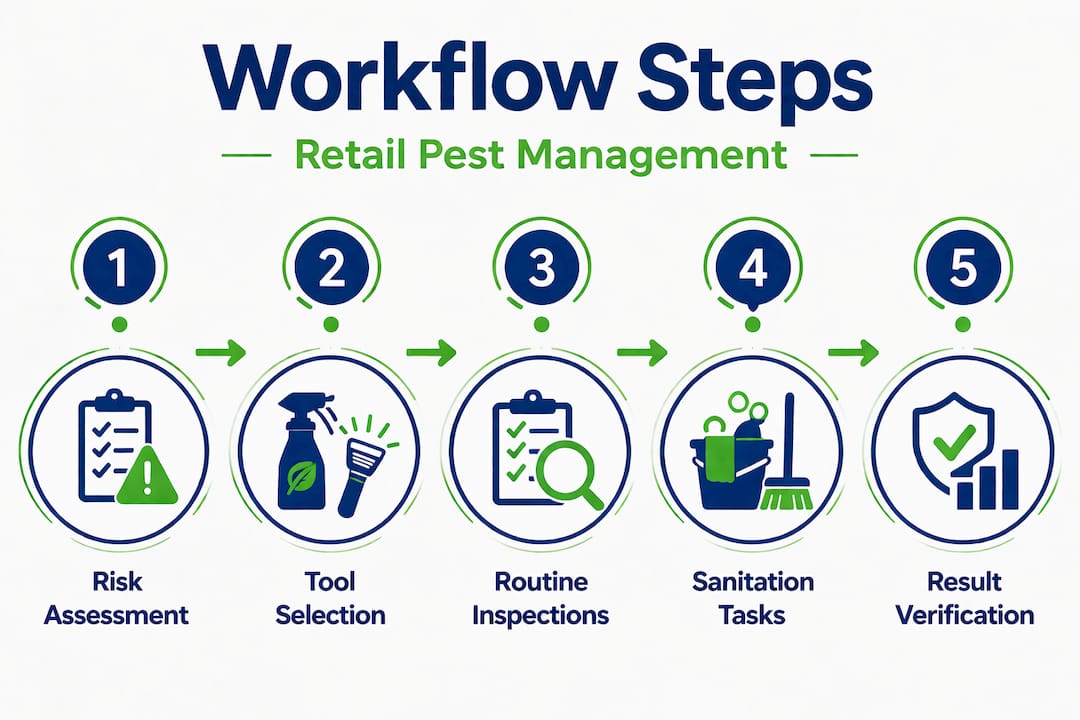
Measuring results does not need to be complicated. The simplest and most reliable approach is comparing pest activity before and after your workflow was implemented, using your logbook data as the baseline.
| Metric | Without a defined workflow | With a structured workflow |
|---|---|---|
| Average pest sightings per month | 6 to 10 logged events | 1 to 2 or fewer |
| Time to respond after detection | 3 to 7 days | Same day or within 24 hours |
| Health code compliance rate | Inconsistent documentation | Consistent, audit-ready records |
| Staff confidence in reporting | Low, unclear process | High, defined roles and tools |
| Treatment cost over time | Reactive, higher per incident | Proactive, lower annual cost |
The data pattern from your logbooks will tell you where the workflow is working and where it needs adjustment. For example, if your receiving area keeps showing rodent activity despite regular trap placement, the root cause may be a structural gap that needs sealing rather than more traps.
Integration of feedback from two sources is critical:
- Staff reports: Your team sees the store daily and will often notice early signs of pest activity before any trap captures. Create a low-friction reporting culture where no sighting is too small to log.
- Professional assessments: Your pest control partner’s quarterly written reports should identify trends, recommend workflow adjustments, and flag any new risk factors they observed.
Understanding the commercial pest control differences between residential and commercial environments helps you ask better questions during those professional assessments. Additionally, learning the role of exclusion pest management gives you and your maintenance team a concrete tool for reducing entry points as a long-term improvement.
Tips for fine-tuning and scaling your workflow:
- Review your logbook quarterly and identify the top three recurring problem areas
- Rotate trap placements every 60 to 90 days to capture pests that have learned to avoid fixed locations
- Update your onboarding process so new staff are trained on pest reporting from their first week
- Add seasonal adjustments to your inspection frequency during high-risk Ohio seasons like early spring and late fall
- Request written reports from your pest control partner after every service visit to build a documentation trail
Why simple, consistent workflows outperform complex pest management strategies
Many retail managers assume that a more elaborate pest management program means better results. More vendors, more products, more steps, more technology. After decades of working with Ohio businesses, we have seen the opposite play out consistently.
Complexity does not protect your store. It creates gaps. When a workflow has twelve steps and involves three different contractors, the odds of a missed inspection or a miscommunicated sighting go up dramatically. Staff stop logging because the process feels overwhelming. Managers stop reviewing because the reports are too dense to act on quickly.
The stores that maintain the cleanest pest records year after year are the ones running the simplest systems. One logbook. One weekly check. One designated point of contact for the pest control partner. One clear escalation path when something is found. That’s it.
Simplicity also makes effective pest control workflows easier to sustain through staff turnover, which is a real and ongoing challenge in retail environments. When a new shift supervisor starts, a simple workflow can be communicated in fifteen minutes. A complicated one takes weeks and still gets followed inconsistently.
The real-world payoff of a clean, simple system is measurable: less downtime from reactive responses, fewer compliance headaches during health inspections, lower treatment costs because problems are caught early, and a safer environment for both your staff and your customers.
Professional pest control solutions for Ohio retail stores
Running a retail store in Ohio means juggling enough priorities without adding pest management complexity on top. When your internal workflow flags an issue that goes beyond basic monitoring, whether it’s a confirmed rodent infestation, a cockroach problem in your stockroom, or a bed bug concern in a fitting room, that is exactly when professional backup earns its value. At Apex Pest Control, we have been supporting Ohio businesses since 1969, and our commercial team understands the compliance pressure, the customer-facing stakes, and the need for treatments that work without disrupting your operations. Start with our commercial pest control checklist to see what a professional-grade program covers, then contact us for a free quote tailored to your store’s size and risk profile.
Frequently asked questions
How often should pest inspections be conducted in retail stores?
Pest inspections should be conducted at least once per month by a professional, with daily or weekly staff-led visual checks built into your internal workflow to catch activity between scheduled visits.
What is the most common pest issue for Ohio retail stores?
Rodent infestations are the leading concern for Ohio retail locations, particularly in stores that carry food products, receive frequent shipments, or have aging building infrastructure with unsealed entry points.
Is professional pest control necessary for every infestation?
Not every minor sighting requires professional treatment, but recurring activity, confirmed infestations, or any pest issue that puts you at risk of health code violations should always involve a licensed pest control professional.
Can pest management workflows be integrated with store cleaning procedures?
Yes, and they should be. Coordinating daily sanitation, weekly trap checks, and monthly deep-cleaning tasks as part of one unified staff schedule is the most effective way to ensure nothing gets skipped.
Are eco-friendly pest control options available for retail stores?
Eco-friendly formulations and targeted application methods are available for most common retail pests and can be specifically requested when working with a commercial pest control partner to minimize product exposure on your sales floor.