



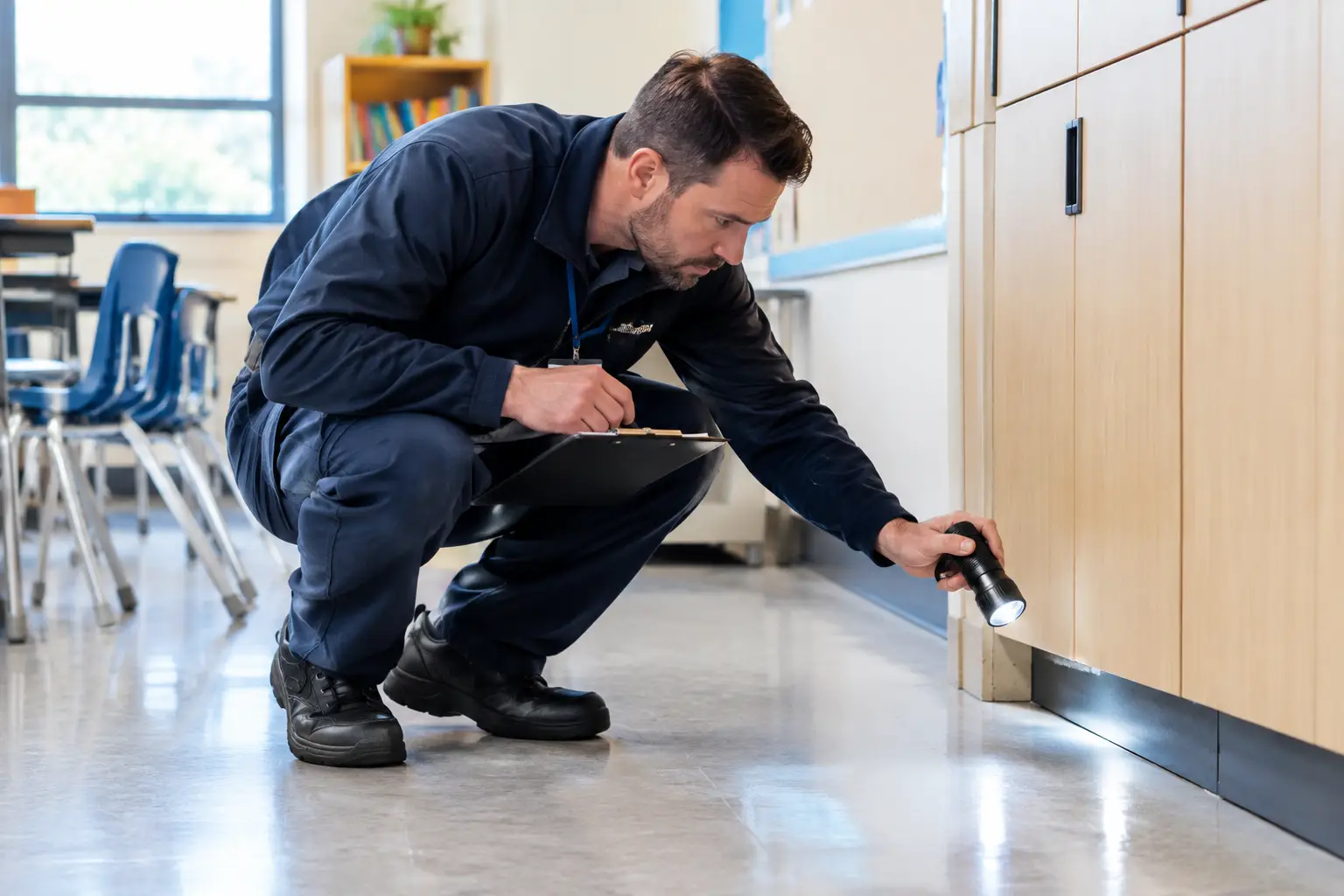
A school pest audit example should do more than confirm whether insects or rodents were seen that day. It should show where pest pressure is developing, why conditions are allowing it, what immediate corrections are needed, and who is responsible for completing them. For school administrators and facility teams, that documentation is the difference between a reactive extermination call and a prevention program that protects students, staff, food areas, and the building itself.
A useful audit is not a pass-or-fail exercise. Schools are active environments with cafeteria deliveries, backpack traffic, athletic equipment, floor drains, dumpsters, older utility spaces, and long breaks when routine activity changes. A careful inspection accounts for those realities and creates a clear, practical plan for correction.
What a School Pest Audit Should Cover
A professional school audit examines pest activity, pest-conducive conditions, structural vulnerabilities, sanitation practices, and the records that show whether prior recommendations were completed. The goal is to identify risk before a small issue reaches a classroom, kitchen, storage room, or parent complaint.
The inspection normally begins outside. Technicians review the building perimeter, doors, windows, rooflines, landscaping, drains, trash areas, loading docks, and utility penetrations. Rodents can use gaps around pipes and damaged door sweeps. Ants may follow moisture near foundations or enter through cracks. Stinging insects may establish nests near playgrounds, roof overhangs, or outdoor equipment.
Inside, the audit should cover areas that support food, moisture, harborage, or hidden travel routes. Cafeterias, kitchens, dry-goods storage, custodial closets, nurse offices, locker rooms, mechanical rooms, science classrooms, staff lounges, and trash staging areas all deserve attention. The inspector should also assess monitoring devices, review service records, and speak with staff members who have observed recurring activity.
Finding no live pest during an inspection does not automatically mean there is no risk. Droppings, gnaw marks, webbing in stored products, insect cast skins, grease trails, damaged weatherstripping, moisture stains, and overfilled exterior containers can all point to conditions that need correction.
School Pest Audit Example: Sample Findings and Actions
The following school pest audit example shows the level of detail an effective report should provide. It is not a universal checklist. A preschool kitchen, high school campus, and district warehouse each require an audit tailored to their layout, occupancy, and food-handling practices.
Facility profile
Site: Public elementary school
Inspection date: September 12
Areas reviewed: Exterior perimeter, main kitchen, cafeteria, dry storage, custodial rooms, classrooms, gym locker rooms, boiler room, loading dock, dumpster enclosure, and playground perimeter.
Pest pressure noted: Low active rodent evidence near the loading dock; occasional ants reported in two first-floor classrooms; drain-fly activity reported in a locker room floor drain; old paper wasps’ nests observed beneath an unused exterior awning.
Finding 1: Rodent access at loading dock
The inspector noted a quarter-inch gap beneath the loading dock service door, worn sweep material, and several rodent droppings along the interior wall near stored beverage cases. Two monitoring stations in the area had activity. No evidence was found in the food preparation area.
Risk level: High. The location is adjacent to food deliveries and creates a direct route into the facility.
Corrective action: Replace the door sweep with a properly fitted, rodent-resistant sweep within 48 hours. Remove beverage-case clutter from the wall to allow cleaning and inspection. Increase monitoring at the dock and inspect daily until activity stops. Review delivery-door practices with receiving staff so the door is not held open longer than necessary.
Verification: Facility manager photographs completed door repair. Pest management technician documents two consecutive service visits with no new droppings or monitor activity.
This finding demonstrates why an audit must connect evidence to a specific cause and a measurable correction. Simply writing “treat for rodents” would not close the entry point.
Finding 2: Ant activity near classroom windows
Small ants were reported in Rooms 104 and 106 after heavy rain. The audit found mulch placed directly against the foundation, vegetation contacting the exterior wall, and minor caulk failure around two window frames. Staff had also stored open snack containers in a classroom cabinet.
Risk level: Moderate. The activity was limited, but food and moisture sources could support repeat sightings.
Corrective action: Pull mulch back from the foundation, trim vegetation away from the building, and reseal gaps around affected windows. Require snacks to be kept in sealed containers and remove crumbs through end-of-day cleaning. Targeted treatment may be appropriate if monitoring confirms active indoor trails, but exclusion and sanitation should come first.
Verification: Teacher or building custodian confirms food-storage correction. Maintenance work order confirms exterior repairs. Follow-up inspection confirms whether ant activity has stopped.
The right response depends on the source. When ants are entering from a nearby exterior nesting area, repeated indoor spraying alone may deliver short-lived results.
Finding 3: Drain flies in locker room
Staff reported small flying insects around a floor drain near the showers. The drain had visible organic buildup, and the room was humid after athletic practices.
Risk level: Moderate. Drain flies are usually more of a sanitation and moisture signal than a major health threat, but persistent activity can affect confidence in facility cleanliness.
Corrective action: Mechanically clean the drain and surrounding channel to remove buildup, then follow a scheduled drain-maintenance program. Confirm that the drain trap holds water and that ventilation is working properly. Avoid relying on surface insecticide applications, which do not remove the breeding material inside the drain.
Verification: Custodial log documents cleaning dates. Follow-up inspection notes reduced adult fly activity and no visible sludge.
Finding 4: Wasp nesting sites near playground access
Inactive paper-wasp nests were found under an awning by a side entrance used during recess. Although the nests were old, the sheltered location was likely to be reused during warm weather.
Risk level: Moderate to high during nesting season because of the proximity to children.
Corrective action: Remove inactive nests safely, inspect the overhang before spring and summer activity increases, and seal small voids that could support nesting. Active nest removal should be scheduled outside student traffic periods and handled by trained professionals using methods appropriate for the location.
Verification: Service report records nest removal and seasonal inspection dates.
How to Make Audit Reports Useful
A report is only valuable when it leads to accountability. Each finding should identify the location, evidence, risk level, recommended action, responsible party, target completion date, and follow-up status. Photos are especially useful for damaged door sweeps, overflowing dumpsters, gaps around utility lines, water leaks, and sanitation concerns that may be difficult to describe consistently.
Avoid vague language such as “monitor situation” or “clean area.” A better recommendation is: “Remove cardboard storage from boiler room north wall by Friday, clean behind shelving, and maintain an 18-inch inspection space.” Specific direction allows facility teams to act quickly and gives administrators a clear record of correction.
Trend data also matters. A single cockroach in a delivery carton may be an isolated introduction. Repeated findings in the same kitchen equipment void, however, suggest a developing harborage issue. Monitoring-device maps, complaint logs, service reports, and maintenance records help distinguish one-time events from patterns that need stronger action.
Safety and Treatment Decisions in Schools
Schools require a cautious, integrated approach. The first line of defense is sanitation, exclusion, moisture control, waste management, and monitoring. When treatment is needed, it should be targeted to the pest, location, and level of risk rather than applied broadly out of convenience.
That does not mean treatment should be delayed when a serious concern is found. Rodent evidence near food storage, bed bug reports, stinging insect nests by student entrances, or cockroach activity in a kitchen deserve prompt professional attention. The right program balances rapid eradication with careful communication, documented service, and preventive repairs that reduce the chance of recurrence.
A qualified pest management partner can also help a school set inspection frequency. Many facilities benefit from routine scheduled audits, with added inspections before the school year begins, after extended breaks, following construction, and during seasonal pest pressure. Large districts and multi-building campuses may need standardized reporting so leadership can compare conditions across locations.
Turn Findings Into Prevention
The strongest school pest program is shared by administrators, custodians, food-service teams, teachers, maintenance staff, and a professional pest management provider. Staff do not need to be pest experts, but they should know how to report sightings promptly, protect food from exposure, and recognize conditions such as leaks, gaps, clutter, and damaged screens.
For Ohio schools, seasonal changes make consistency especially valuable. Rodents seek indoor shelter as temperatures drop, ants become more visible during wet spring conditions, and stinging insects create concerns around outdoor activity in warmer months. A documented audit gives facility teams a practical starting point before those issues disrupt learning.
Apex Pest Control develops customized commercial audit and service programs that turn inspection findings into clear corrective action, reliable documentation, and proven prevention. When a school knows what to repair, clean, monitor, and treat, pest control becomes one less urgent problem competing for the attention of its staff.