


TL;DR:
- Ohio property managers are legally responsible for pest control in multi-family units under strict regulations.
- Implementing integrated pest management and resident education is essential for long-term pest prevention.
- Prompt professional treatment and documentation prevent escalation, legal issues, and recurring infestations.
Pest outbreaks in multi-family housing don’t just annoy tenants. They trigger lease terminations, generate legal liability, and spread between units faster than most property managers expect. One cockroach sighting in apartment 3B can become a building-wide crisis within weeks if you rely on outdated spot-spraying. Ohio property managers carry real legal responsibility here, and the stakes, including tenant satisfaction, rental income, and code compliance, are all on the line. The good news is that modern, proven pest management strategies exist and work far better than what most buildings still practice today.
Table of Contents
- Understand Ohio’s pest control laws for multi-family housing
- Adopt Integrated Pest Management (IPM): The gold standard
- Prevention is key: Resident education and prevention habits
- When and how to act fast: Treatment and professional support
- Ohio multi-family pest control: What most guides miss
- Take the next step with Ohio pest experts
- Frequently asked questions
Key Takeaways
| Point | Details |
|---|---|
| Know Ohio law | Property managers must ensure pest-free units to comply with state requirements. |
| Choose IPM strategies | Integrated Pest Management delivers better results and safer living environments. |
| Engage residents | Education and preventive habits are vital for stopping infestations before they start. |
| Act promptly and document | Respond quickly to pest sightings and keep thorough treatment records. |
Understand Ohio’s pest control laws for multi-family housing
Before you can tackle pests effectively, you need to know where you stand legally. Ohio doesn’t leave much to interpretation on this issue. Ohio landlords and property managers are legally responsible for pest control in multi-family units to maintain habitability under Ohio Revised Code §5321.04. That’s not a suggestion. It’s a statutory obligation.
Understanding your Ohio pest control obligations as a property manager starts with knowing what triggers your duty to act. The law draws a clear line: if a pest problem originates from the structure itself, shared spaces, or spreads across multiple units, the responsibility falls squarely on you, not the tenant. Tenant-caused infestations, such as a resident who hoards garbage or brings in infested furniture, can shift some liability, but you still have to manage the outcome.
Here are your core legal responsibilities under Ohio law:
- Maintain habitable conditions by keeping all units free of pest infestations that affect health and safety
- Use licensed pest control applicators when professional treatment is required, not unlicensed contractors or DIY-only solutions
- Provide adequate notice to tenants before any pest treatment, typically 24 hours in most standard lease agreements
- Document every pest complaint and treatment with dates, unit numbers, and corrective actions taken
- Respond promptly to written complaints, because delays can be used as evidence of negligence
Non-compliance carries real financial consequences. Tenants in Ohio can withhold rent, file complaints with local housing authorities, or take legal action if habitability conditions are not corrected. Courts have sided with tenants in cases where property managers delayed response or failed to document their actions. A single unresolved infestation complaint can escalate into a formal housing code violation and fines that far exceed the cost of proper treatment.
“Failing to act on pest complaints in multi-family housing isn’t just a service issue. It’s a legal exposure that Ohio courts take seriously.”
Pro Tip: Start using pest logs from day one. Record every complaint, inspection date, findings, treatment performed, and follow-up result. This paper trail protects you legally and helps you spot patterns across units before small issues become building-wide problems.
With legal requirements in mind, let’s move into practical prevention strategies that actually work.
Adopt Integrated Pest Management (IPM): The gold standard
If your current pest strategy is “spray when someone complains,” you’re already behind. IPM is the gold standard for multi-family housing, combining prevention, monitoring, targeted treatments, and resident education over blanket spraying. The approach is built on logic: instead of flooding apartments with chemicals on a schedule, you identify where pests enter, why they stay, and what targeted actions will eliminate them most efficiently.
IPM stands for Integrated Pest Management. It’s a multi-pronged framework used by professional pest control operators across the country, and it’s especially powerful in multi-family buildings because it addresses the connected nature of the environment. Pests don’t stay in one unit. Neither should your strategy.
Here’s how to implement IPM in a multi-family property, step by step:
- Educate residents and staff on what pests look like, where they hide, and how to report them immediately. A well-informed tenant is one of your best early-warning systems.
- Conduct regular building inspections of common areas, mechanical rooms, laundry facilities, trash areas, and unit interiors at least quarterly. Look for signs of entry points, moisture, and harborage spots.
- Prioritize sanitation at the property level by managing dumpster areas, fixing leaking pipes immediately, eliminating standing water, and sealing gaps around utility lines and plumbing.
- Apply targeted treatments only where monitoring confirms pest activity. Use baits, dusts, and traps placed precisely rather than broadcasting pesticides throughout unaffected areas.
- Evaluate and adjust after each treatment cycle. Track which units are repeatedly affected, which seasons drive the most activity, and which treatment methods produce the best results.
The long-term payoff of IPM is significant. Buildings that switch from reactive spraying to IPM see fewer callbacks, reduced chemical exposure for residents, and lower overall treatment costs over time. That matters to tenants with allergies, children, or pets, and it matters to your budget.
“Blanket spraying may feel like you’re doing something, but it often drives pests deeper into walls and neighboring units rather than eliminating them.”
You can review IPM examples to see how the approach plays out across different pest types and building configurations. For property managers looking for a complete framework, property manager pest strategies can help you build a program that scales across multiple units or properties.
Pro Tip: When a pest is confirmed in one unit, treat the adjacent units on either side and directly above and below as a preventive step. Pests move through shared walls, plumbing chases, and electrical conduits. Treating only the confirmed unit is almost always a temporary fix.
Now that you know the best overall strategy, let’s look at specific prevention habits that keep infestations from starting in the first place.
Prevention is key: Resident education and prevention habits
The most effective pest control happens before pests arrive. That requires changing behavior, and in a multi-family building, that means working with your residents. Research consistently shows that resident buy-in through education around habits like securing garbage and avoiding dumpster items is foundational to preventing infestations. No treatment plan can overcome a building where residents consistently create conditions that attract pests.
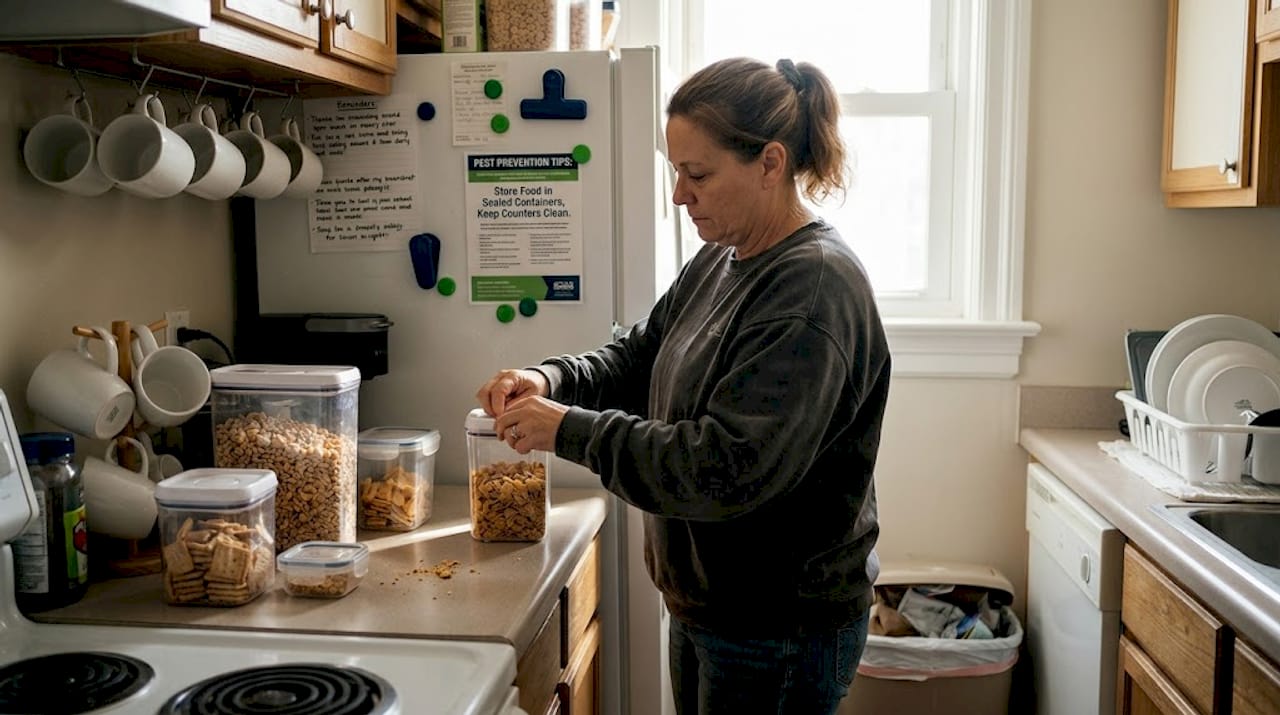
The good news is that most tenants want to live in a pest-free environment. They just need clear, simple guidance. Your job as a property manager is to provide it consistently and make it easy to follow.
Here are the daily habits every tenant should follow:
- Secure all trash in sealed containers and take bags to the dumpster promptly, not left in hallways overnight
- Store food in sealed containers and clean up crumbs and spills immediately, especially in kitchens
- Report leaks and moisture problems as soon as they appear, since standing water and damp areas draw cockroaches, silverfish, and rodents
- Avoid bringing in second-hand furniture without inspecting it first, because used couches and mattresses are among the top sources of bed bug introductions in apartment buildings
- Keep clutter low in storage areas and closets, since piles of boxes and bags give pests shelter and make inspections harder
Effective education doesn’t have to be expensive or elaborate. Flyers placed in mailrooms and laundry rooms, short reminders in monthly newsletters, and simple signage near dumpsters all reinforce the right habits. A 15-minute resident orientation session when new tenants move in can pay off for years. If you manage a large property, consider a brief annual pest awareness meeting that also covers how to report issues.
| Resident habit | Impact on pest risk |
|---|---|
| Sealing food in containers | High reduction in cockroach and rodent activity |
| Taking out trash daily | Major reduction in fly and rodent attraction |
| Reporting leaks quickly | Prevents moisture-loving pests like silverfish and ants |
| Avoiding second-hand furniture | Directly reduces bed bug introduction risk |
| Reducing clutter in units | Lowers harborage and breeding opportunities |
The long-term value of education far outweighs reactive treatment costs. A building where residents understand their role in pest prevention requires fewer emergency treatments, produces fewer formal complaints, and has better tenant retention. For apartment communities navigating pest management, reviewing an apartment pest control guide built for Ohio conditions can sharpen your education program and align it with local pest pressures.
Education and prevention reduce outbreaks, but when pests do appear, prompt professional action is the only appropriate response.
When and how to act fast: Treatment and professional support
Speed matters enormously when pests appear in a multi-family building. Every day you wait, the infestation can spread to adjacent units, become harder to treat, and create grounds for tenant complaints or legal action. Knowing when to call in professionals and how to act decisively is what separates effective property managers from those constantly playing catch-up.
Treating adjacent units prophylactically in multi-family settings to prevent spread is a core principle of responsible pest management, and it’s one that most do-it-yourself approaches simply cannot execute properly. Here’s how to respond the moment a pest is confirmed:
- Document the report immediately with the date, unit number, pest type, and the resident’s description of what they saw and where.
- Schedule a professional inspection within 24 to 48 hours to confirm the scope of the problem and identify entry points or harborage areas.
- Notify adjacent units and schedule preventive treatment at the same time as the primary treatment. Don’t wait for complaints from neighbors.
- Provide residents with written preparation instructions before treatment so the service can be effective, such as clearing under sinks, bagging food, and arranging for pets.
- Follow up within two weeks to confirm the treatment worked and check adjacent units again for any signs of activity.
DIY vs. professional pest control in multi-family buildings
| Factor | DIY approach | Professional service |
|---|---|---|
| Treatment effectiveness | Limited, often surface-level | Targeted, evidence-based |
| Legal compliance | Rarely documented properly | Documented and defensible |
| Adjacent unit coverage | Almost never addressed | Standard practice |
| Chemical safety | Risk of misapplication | Licensed applicators, correct products |
| Long-term results | Requires constant repetition | Fewer callbacks, better outcomes |
| Cost over time | Lower upfront, higher long-term | Higher upfront, lower long-term |
The financial case for professional intervention is strong. Rapid professional response reduces infestation severity, which directly lowers treatment costs and prevents the tenant turnover that results from unresolved pest problems. Losing a single tenant to a pest issue can cost more in lost rent, turnover expenses, and re-leasing than an entire year of professional pest management service.
Understanding the advantages of professional pest services in a multi-family context goes beyond treatment quality. Licensed professionals provide documentation that satisfies Ohio’s legal requirements, know which products are appropriate for occupied buildings, and carry liability insurance. Before you consider any chemical treatment option on your own, reviewing the pros and cons of pest sprays for Ohio homes and multi-family settings will help you make an informed decision.
Ohio multi-family pest control: What most guides miss
After decades of working with Ohio property managers, one pattern stands out clearly. The buildings with the worst recurring pest problems almost never have inferior products or equipment. They have a culture problem. Management either treats pest control as an embarrassing emergency to be handled quietly, or relies so heavily on chemical intervention that residents become desensitized to the process and stop cooperating.
Heavy chemical spraying in shared buildings doesn’t just create health concerns for sensitive residents. It pushes pest populations into walls and neighboring units, breeds chemical resistance in cockroach and rodent populations, and ultimately costs more money for worse results. The buildings that maintain genuinely pest-free environments over years do it through consistency, documentation, and trust.
The environmental impact of pest control choices matters more in multi-family settings than in single-family homes, because the exposure is concentrated and shared. Residents breathe the same air and share the same walls. That responsibility demands a thoughtful approach.
The property managers who truly get this right treat pest management as a partnership with their residents, not a service performed on them. They communicate openly about what was found, what was done, and what residents should watch for. They maintain organized records without being asked. They bring in qualified professionals proactively rather than reactively.
“The best pest control isn’t the most aggressive. It’s the most consistent, the most transparent, and the most cooperative.”
That combination of professionalism and resident partnership is what creates safe, satisfied communities over the long term. Technology, gadgets, and new chemical formulations can help at the margins, but they don’t replace the fundamentals.
Take the next step with Ohio pest experts
Managing pest control across multiple units is one of the most demanding responsibilities you carry as a property owner or manager in Ohio. The legal obligations, tenant communication, treatment coordination, and documentation requirements all require a partner who knows what they’re doing. Apex Pest Control has served Ohio property managers and owners since 1969 with professional, licensed, and environmentally responsible pest management.
Whether you’re dealing with active rodent activity, need rodent extermination services for your building, or want to implement a full IPM program for safer homes and common areas, Apex brings the expertise to handle it correctly. Start with a no-obligation consultation and get a free quote tailored to your property’s size and pest pressures. Your tenants will notice the difference.
Frequently asked questions
Who is responsible for pest control in Ohio multi-family housing?
Ohio law holds property managers and landlords responsible for pest control in multi-family dwellings, particularly for building-wide or structural issues, under Ohio Revised Code §5321.04. Tenants may share responsibility only when their specific behavior caused the infestation.
What pest control method is most effective in apartments?
IPM is the gold standard in multi-family buildings because it combines prevention, monitoring, targeted treatments, and resident education rather than relying solely on chemical application. It produces better long-term results with lower overall chemical exposure.
Should adjacent apartments be treated when a pest is found?
Yes, because adjacent unit treatment prevents pests from simply relocating through shared walls or plumbing lines and re-establishing in neighboring units. Treating only the confirmed unit almost always results in a recurring problem within weeks.
What habits can residents follow to prevent pests?
Residents reduce pest risk significantly by sealing food in containers, securing and promptly removing trash, reporting leaks immediately, and avoiding second-hand furniture that hasn’t been inspected for bed bugs or other hitchhiker pests.
How should property managers document pest treatments?
Property managers should maintain a detailed pest log for each incident that includes the date of the report, the unit or area affected, the pest type identified, the treatment performed, the name of the applicator, and the follow-up inspection results. This documentation protects you legally and helps identify recurring problem areas across the property.