



TL;DR:
- Effective commercial pest management in Oakwood requires species-specific identification, prevention, and exclusion strategies. Controlling pests like rodents, cockroaches, and stored-product insects involves targeted efforts and ongoing monitoring to prevent reinfestation. Building proactive, zone-based programs significantly reduces long-term pest pressure and operational disruptions.
If you manage a commercial property in Oakwood, Ohio, you already know that pest problems cost far more than an exterminator’s invoice. The types of commercial pests showing up in your facility can trigger health code violations, damage inventory, drive away customers, and create liability you never anticipated. Yet most business owners treat every pest the same way, calling for a general spray and hoping for the best. That reactive approach almost always fails. Knowing what you are dealing with, down to the species and behavior, is what separates a managed pest program from an endless cycle of reinfestation.
Table of Contents
- Key takeaways
- 1. The types of commercial pests business owners need to know
- 2. Rodents: the most damaging commercial pest in Oakwood
- 3. Cockroaches and their commercial impact
- 4. Stored-product pests in food and warehouse businesses
- 5. Ants invading Oakwood commercial properties
- 6. Flies and their role as industrial pest types in commercial spaces
- 7. Termites as a structural commercial pest
- 8. Spiders, birds, and other facility nuisance pests
- 9. Bed bugs in commercial and retail settings
- 10. Multi-tenant buildings and pest migration challenges
- My take on commercial pest management in Ohio
- How Apexpestcontrol helps Oakwood businesses stay pest-free
- FAQ
Key takeaways
| Point | Details |
|---|---|
| Identification drives control | Knowing your specific pest species determines the most effective and targeted treatment method. |
| Rodents top the risk list | Rats and mice in Oakwood commercial spaces pose serious contamination and regulatory risks. |
| Stored-product pests need separate strategy | Beetles, moths, and weevils entering with raw materials require containment approaches distinct from general insect control. |
| IPM beats reactive spraying | Prevention, exclusion, and monitoring reduce long-term pest pressure without over-relying on chemicals. |
| Local conditions shape pest behavior | Oakwood’s Ohio climate, older building stock, and seasonal shifts create unique commercial pest challenges each year. |
1. The types of commercial pests business owners need to know
Understanding common pests in businesses starts with accepting one fact: not all pests behave the same, respond to the same treatments, or enter your building the same way. A cockroach infestation in a restaurant kitchen has almost nothing in common with a stored-product beetle problem in a distribution warehouse, even if both show up in the same Oakwood industrial corridor.
Commercial pest identification is not about memorizing textbooks. It is about recognizing what type of pest is present, what is attracting it, and what structural or operational factor is letting it stay. That is the foundation every effective pest program is built on.
2. Rodents: the most damaging commercial pest in Oakwood
Rats and mice are the number one threat to Oakwood commercial properties for one simple reason: they do not just cause nuisance. They contaminate. Rodent droppings and urine can trigger product recalls, fail health inspections, and expose your business to serious liability. Rodents are a zero-tolerance issue in food facilities, and that standard is spreading to retail, healthcare, and office environments too.
In Oakwood’s older commercial buildings near major arterials and service roads, rodents find easy access through aging foundations, loading dock gaps, and utility penetrations. Norway rats prefer ground-level harborage near dumpsters and drainage systems. Roof rats favor higher entry points like roof vents and cable runs.
Key signs of a rodent problem include:
- Gnaw marks on packaging, wiring, and structural wood
- Droppings along walls and in cabinet interiors
- Grease marks on baseboards from repeated travel paths
- Nesting material such as shredded paper or insulation in hidden corners
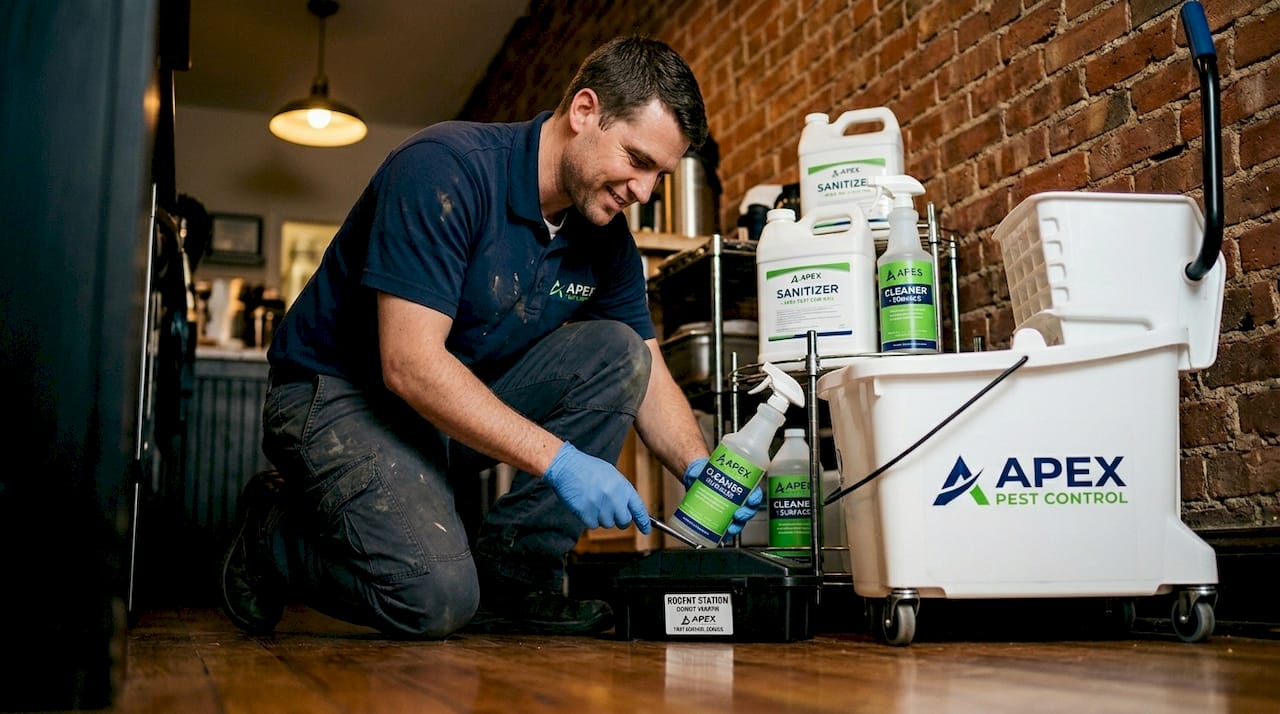
IPM-focused exclusion combined with interior mechanical traps and perimeter monitoring stations gives the best long-term results. Zone-based monitoring, covering receiving, storage, processing, and waste areas separately, targets rodent activity where it actually occurs rather than applying blanket treatments.
Pro Tip: In sensitive zones like food prep areas, ultrasonic deterrent devices can reduce rodent activity without chemicals, making them a smart complement to mechanical traps in kitchens and processing lines.
3. Cockroaches and their commercial impact
Cockroaches rank among the most difficult commercial pest identification challenges because they hide so effectively and reproduce so fast. German cockroaches are the primary species in Oakwood commercial kitchens, restaurant supply areas, and food processing facilities. American cockroaches appear more often in basements, utility corridors, and older warehouse spaces.
What makes cockroaches especially serious in commercial settings is their dual threat: they contaminate food surfaces and produce allergens that affect employees and customers. Cockroach resilience against many treatments means that spraying alone rarely solves the problem. Populations develop resistance quickly, and egg cases survive many chemical applications.
Effective control depends on:
- Eliminating harborage by sealing cracks in walls, under equipment, and around pipes
- Reducing moisture in areas like dishwashing stations, mop closets, and drain sumps
- Using targeted gel baiting placed where cockroaches travel, not broadcast spraying
- Scheduling regular sanitation audits of hard-to-reach equipment interiors
A cockroach sighting during business hours almost always means a large hidden population. One visible roach is not a minor issue.
4. Stored-product pests in food and warehouse businesses
Stored-product pests are a category many Oakwood business owners overlook until a shipment is already compromised. These are the beetles, moths, and weevils that enter facilities through raw materials, packaging, and incoming shipments rather than through building gaps like most other pests.
Managing them requires a fundamentally different approach from general flying insect control. The source is almost always an infested incoming product, not a structural failure. That shifts the focus to receiving inspection, packaging integrity, and containment within storage zones.
| Pest type | Primary entry point | Best control method |
|---|---|---|
| Indian meal moth | Infested grain, nuts, or dried fruit | Pheromone traps, stock rotation |
| Grain weevils | Bulk cereal and flour shipments | Inspection at receiving, sealed storage |
| Flour beetles | Processed grain products | Sanitation, temperature management |
| Cigarette beetles | Spices, dried herbs, tobacco | Exclusion packaging, monitoring traps |
Stored-product pest management must be treated as its own program with dedicated monitoring, stock rotation protocols, and supplier inspections. Lumping these pests into your general pest service almost always results in recurring infestations.
Pro Tip: Place pheromone monitoring traps in your receiving area, storage aisles, and near bulk ingredient bins. Check them weekly. An early trap catch prevents a warehouse-wide infestation.
5. Ants invading Oakwood commercial properties
Ants are among the most common pests in businesses across Oakwood, and they are also among the most mishandled. Odorous house ants and pavement ants are the species facility managers encounter most often, particularly during Ohio’s warmer months from April through October.
Odorous house ants are attracted to sugary food residues and moisture. They nest inside wall voids, under flooring, and along electrical conduits. Pavement ants establish colonies beneath sidewalks and concrete slabs, then forage inside through foundation cracks and utility entry points.
Signs and control priorities include:
- Trailing ant lines along baseboards, counters, and window frames
- Entry points at plumbing penetrations and door sweeps
- Interior nests behind outlet covers and inside insulation cavities
Ant control success depends on pairing exterior crack sealing with slow-acting bait stations. Spraying trailing ants without locating the colony only disperses the colony into multiple satellite nests, making the problem harder to resolve.
Pro Tip: Do not apply repellent sprays along ant trails before baiting. Repellent products scatter colonies and make bait acceptance far less likely. Let the bait work first.
6. Flies and their role as industrial pest types in commercial spaces
Flies are underestimated as an industrial pest type, but they present serious health risks in any business handling food, waste, or organic materials. House flies and blow flies breed in organic waste and spread pathogens across food preparation surfaces. Fruit flies establish in floor drains, bar mats, and around overripe produce. Phorid flies often indicate a deeper plumbing issue, breeding in pipe breaks beneath slab floors.
Preventing pests in commercial spaces starts with addressing the breeding site, not just the adult flies. Drain cleaning, waste management schedules, and door exclusion devices reduce fly pressure more effectively than light traps alone.
7. Termites as a structural commercial pest
Termites represent a longer-term but significant threat to Oakwood’s older commercial buildings, particularly wood-framed retail centers and mixed-use structures near older residential zones. Eastern subterranean termites are the species to watch in Ohio. They build mud tubes along foundation walls and enter through soil contact with structural wood.
The challenge with termites in commercial buildings is detection lag. By the time visible damage appears, colonies may have been active for years inside wall framing and floor joists. Annual termite inspections for older commercial structures are not optional, they are a liability management necessity.
8. Spiders, birds, and other facility nuisance pests
Spiders, birds, and additional pests each carry distinct risks that deserve individual attention rather than being lumped into a generic “other” category.
Spiders in commercial facilities signal a larger prey insect population. A building with spider activity almost always has an underlying flying insect or crawling insect problem feeding them. Black widow spiders are an occasional find in Oakwood warehouses and storage areas, and they present genuine safety concerns for workers.
Birds, particularly pigeons and starlings, create structural damage through nesting debris and acidic droppings that degrade roofing materials and HVAC equipment. Bird presence also introduces secondary pests like bird mites and carpet beetles into a facility. Commercial property restoration costs from bird-related structural damage can far exceed standard pest control budgets.
9. Bed bugs in commercial and retail settings
Bed bugs are no longer confined to hospitality. Retail stores, medical waiting rooms, laundromats, and office buildings in Oakwood now see bed bug introductions through employee belongings, customer traffic, and used furniture. They are not a hygiene issue. They are a traffic issue.
Early commercial pest identification for bed bugs focuses on seams of upholstered furniture, electrical outlet covers, and reception area seating. A single introduction left unaddressed can spread through a multi-unit commercial building in weeks. Pest control for retail environments requires treatment protocols that protect product inventory and customer-facing spaces simultaneously.
10. Multi-tenant buildings and pest migration challenges
One of the least-discussed industrial pest types problem in Oakwood is not any single pest but the migration of multiple pest species between units in shared commercial buildings. In strip malls, office complexes, and mixed-use developments near Oakwood’s commercial corridors, pests migrate through shared utility spaces, pipe chases, and HVAC conduits from one tenant’s space into another.
A restaurant’s cockroach problem becomes a neighboring retailer’s problem within weeks if shared wall penetrations are not sealed. Pest management in multi-tenant buildings requires coordinated monitoring and exclusion across the entire property, not unit-by-unit reactive treatments.
Prevention and exclusion are the front line of any effective commercial pest program. Chemicals play a supporting role, not the leading one.
My take on commercial pest management in Ohio
I have worked with Ohio businesses long enough to say clearly: the biggest mistake facility managers make is treating pest control as a reaction rather than a system. When you call for service only after a customer complaint or a failed inspection, you have already lost weeks of lead time you could have used to intercept the problem.
What I have found actually works is understanding pest biology deeply enough to know where a pest will be before you find it. Ohio’s freeze-thaw cycles in late fall push rodents inside earlier than most managers expect. Oakwood’s mix of older commercial buildings and active food service creates the kind of layered pest pressure that rewards consistent monitoring and punishes inconsistency.
The cases that stuck with me most involved multi-tenant buildings where one tenant had a rigorous pest program and the neighboring unit had none. The pests simply migrated. Pest migration through shared corridors is a genuine reinfestation driver that no single-unit treatment can solve on its own.
My recommendation: build a program around zones, inspection schedules, and exclusion first. Let chemical treatments play the targeted, limited role they are designed for. That mindset change alone will cut your long-term pest pressure significantly.
— Dushan
How Apexpestcontrol helps Oakwood businesses stay pest-free
Apexpestcontrol has been serving Ohio commercial properties since 1969, and the Oakwood area presents exactly the kind of layered pest challenges this team is built to handle. Whether you are managing a food service facility with cockroach pressure, a warehouse tracking stored-product pests, or an older building with recurring rodent pest problems, Apexpestcontrol brings zone-based inspection, targeted treatments, and integrated management strategies that address root causes rather than surface symptoms.
For facility managers who want a program built around their specific building type and pest history, the first step is a site-specific consultation. You can request a free quote to get started, or call 1-800-684-2284 to speak directly with an Ohio-based specialist who knows Oakwood’s commercial pest environment.
FAQ
What are the most common types of commercial pests in Ohio?
The most common types of commercial pests in Ohio include Norway rats, mice, German cockroaches, odorous house ants, stored-product beetles, and flies. Each pest type requires specific identification and a targeted management approach to control effectively.
How do I know if my Oakwood business has a pest problem?
Signs include droppings, gnaw marks, grease trails along baseboards, visible insects during business hours, and unexplained product damage. A professional inspection can confirm species identity and infestation scale before visible signs become a regulatory issue.
Why does commercial pest identification matter for control?
Different pest species respond to different treatments, enter through different pathways, and thrive in different facility zones. Misidentifying a pest leads to the wrong treatment, wasted cost, and recurring infestations that disrupt operations and damage your business’s reputation.
Can pests spread between tenants in a shared commercial building?
Yes. Pests frequently migrate through shared wall voids, pipe chases, and utility corridors in multi-tenant buildings. Coordinated pest management across all units and shared spaces is the only reliable way to prevent reinfestation from neighboring properties.
What is the best way to prevent pests in a commercial space?
Prevention centers on exclusion, sanitation, and monitoring before pests establish. Sealing entry points, managing waste properly, and scheduling regular inspections are far more cost-effective than emergency treatments after an infestation takes hold.