



TL;DR:
- Accurate pest identification is essential because it guides effective treatment, saving money and preventing property damage.
- Misidentifying pests can lead to ineffective treatments, increased costs, health risks, and worsening infestations.
Most Oakwood homeowners reach for a can of spray the moment they spot something crawling across the kitchen floor. It feels like a solution. It rarely is. Why pest identification matters comes down to one uncomfortable truth: treating the wrong pest with the wrong product is worse than doing nothing at all. You waste money, expose your family to unnecessary chemicals, and give the actual pest more time to multiply or cause structural damage. Whether you manage a single-family home near Oakwood’s residential streets or oversee a multi-unit property, knowing exactly what you are dealing with changes every decision that follows.
Table of Contents
- Key Takeaways
- Why pest identification matters in Oakwood homes
- The real cost of getting it wrong
- How to actually identify pests in your home
- From identification to smarter management
- My take on why Oakwood homeowners underestimate this step
- Accurate pest ID leads to better results with Apexpestcontrol
- FAQ
Key Takeaways
| Point | Details |
|---|---|
| Wrong ID wastes money | Misidentifying a pest leads to buying products that simply do not work on the actual species present. |
| IPM depends on accurate ID | Integrated Pest Management strategies only function correctly when the target pest is correctly identified first. |
| Seasonal timing matters | Ohio’s climate creates predictable pest cycles, and knowing your pest lets you act at the right moment. |
| Recordkeeping pays off | Tracking pest species, dates, and locations turns reactive spraying into a proactive prevention system. |
| Professionals fill the gap | When visual ID is unclear, a qualified expert with samples and area knowledge prevents costly errors. |
Why pest identification matters in Oakwood homes
Pest identification is not just putting a name to a bug. Identification is investigative, often requiring photos, physical samples, and a close look at where activity is happening in and around your property. That investigative process is the foundation of Integrated Pest Management, or IPM, the framework that professional pest control services have used for decades to make control decisions based on evidence rather than assumption.
In Oakwood, a suburb of older residential housing with mature trees, established lawns, and a mix of brick ranch homes and larger two-story structures, several pests show up with predictable regularity. The list includes:
- Termites, especially subterranean species that target the older wood framing common in mid-century Oakwood homes
- Rodents like house mice and Norway rats that enter through foundation gaps and utility penetrations as temperatures drop in October and November
- Carpenter ants, which are frequently mistaken for termites and require entirely different control approaches
- Cockroaches, particularly German cockroaches in multi-unit properties near commercial corridors
- Stinging insects such as yellowjackets and paper wasps that nest in soffits and landscaping beds during spring and summer
Scouting and monitoring are what allow you to catch these pests early, before a handful of insects becomes a full infestation. Ohio’s seasonal shifts drive pest activity in very predictable waves. Rodents push indoors in fall. Termite swarmers appear in late spring after warm rains. Ants forage aggressively through summer. If you know which pest you are watching for and when it is most active, you can set monitoring traps at the right time and in the right locations rather than reacting after serious damage is already done.
IPM strategies for Ohio homes work precisely because they start with accurate identification. The pest species determines the control method, the timing of treatment, and whether chemical intervention is even warranted. Without that correct ID, you are guessing.
The real cost of getting it wrong
The consequences of pest misidentification go beyond wasted spray cans. Misidentification wastes time and money and can actively worsen a situation by giving pests more time to establish, breed, or damage property while ineffective treatments are applied.
Consider one of the most common mix-ups: carpenter ants versus termites. Both are found in Oakwood homes, both are associated with wood, and both swarm in spring. But termites consume wood from the inside while carpenter ants excavate galleries without eating it. The control products and strategies for each are completely different. A homeowner who buys ant bait for a termite problem is not just failing to solve it. They are letting structural damage progress while spending money on the wrong product.
Here is what misidentification costs in real terms:
- Wasted product spend. Over-the-counter pesticides are formulated for specific pest categories. Using a roach product on a fruit fly problem, for example, means buying another product when the first one fails.
- Health and environmental exposure. Applying pesticides unnecessarily or using the wrong type adds chemical load to your home without benefit. EPA-designated public health pests like cockroaches and rodents require targeted control, but treating a harmless lookalike with heavy pesticides creates risk with no return.
- Worsened infestations. Many pest reports combine pests, diseases, and environmental stress, meaning what you see may not be what is actually causing the problem. Treating one thing when two are present leaves one untouched.
- Missed damage thresholds. Some pests warrant immediate action while others do not. Acting on the wrong ID means either over-responding to a harmless species or under-responding to a damaging one.
Pro Tip: If you are not certain what you are looking at, place the specimen in a sealed bag or take a clear photo showing multiple angles before contacting a professional. Rushing to treat without that confirmation is where most homeowner pest control budgets disappear.
How to actually identify pests in your home
Effective pest identification is a skill that gets sharper with practice, but even a first-time homeowner can do it well with the right approach.
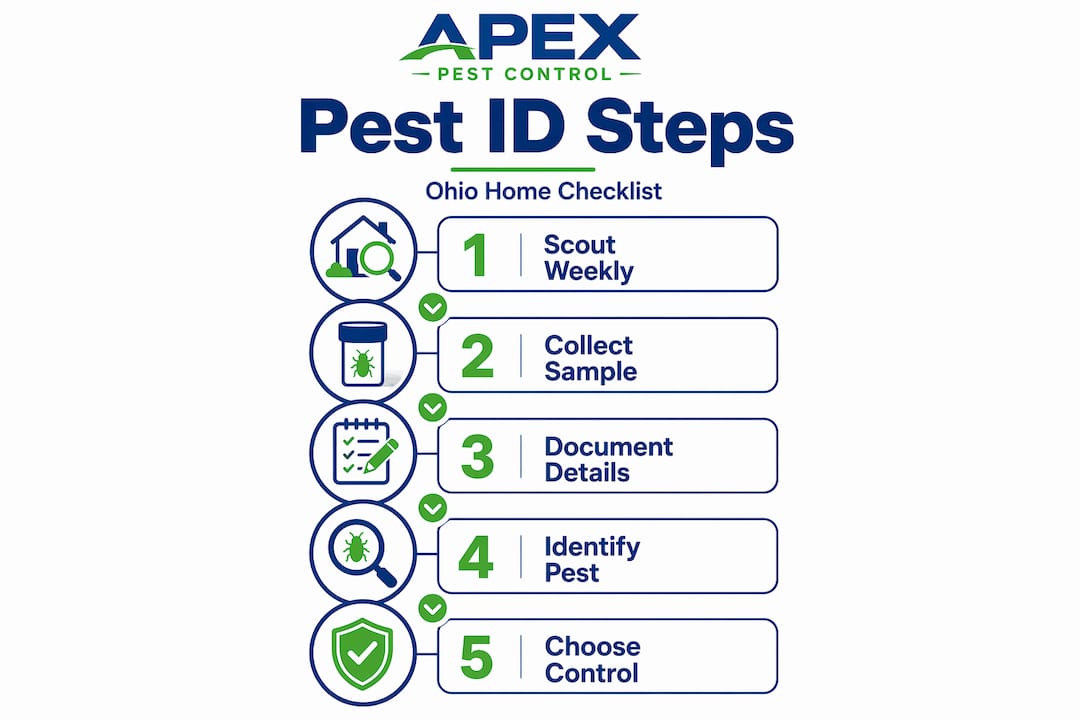
- Observe before you act. Note where you found the pest, what time of day, what it was near, and what the surrounding conditions looked like. Moisture, food sources, and entry points are all clues.
- Record physical characteristics. Size, body shape, color, number of legs, and wing presence all narrow down possibilities quickly. A six-legged insect is not a spider. A soft-bodied pale insect in wood is probably not an ant.
- Use photos and specimens. Correct identification often requires photos or samples with an area examination. A clear photo sent to Ohio State University Extension or a licensed pest professional gives you a reliable ID before you spend a dollar on treatment.
- Check Ohio State Extension resources. OSU Extension offers free identification resources and county-level expertise. Their materials are calibrated to Ohio pest species and seasonal timing, which makes them far more relevant than generic pest ID apps.
- Track what you find. Recordkeeping that tracks pest species, dates, and densities transforms reactive control into pattern recognition. After one or two seasons of notes, you will know exactly when to expect termite swarmers or when rodent pressure peaks in your neighborhood.
- Monitor on a schedule. Scouting one to three times per week during active pest seasons gives you early detection that prevents serious damage and allows you to adjust any treatment plan before it becomes expensive.
Pro Tip: Keep a simple spreadsheet or phone note with the date, pest type, location in the home, and any conditions you noticed. After two seasons, patterns emerge that tell you where and when to be most vigilant, and that information is worth more than any off-the-shelf product.
From identification to smarter management
Correct identification does not just tell you what is in your home. It tells you what to do about it, when to do it, and whether you need to do anything at all. That is the direct connection between the importance of pest identification and choosing the right control path.

Pest identity changes control outcomes by determining whether a pest has reached a damage threshold that warrants intervention and which control category, chemical or nonchemical, fits the situation. Not every pest that appears in your yard or basement needs treatment. But some, like subterranean termites in Oakwood’s older wood-framed homes, need a swift, species-specific response.
The table below shows how identification drives distinct management strategies for pests common to Oakwood:
| Pest | Key identifier | Primary control approach | Timing |
|---|---|---|---|
| Subterranean termite | Mud tubes, pale soft body, no waist | Soil treatment or bait system | Late spring after swarm |
| Norway rat | Large size, blunt nose, small ears | Exclusion and tamper-resistant bait stations | Fall and winter |
| Carpenter ant | Pinched waist, dark body, frass not eaten | Void treatment, moisture elimination | Spring and summer |
| German cockroach | Two dark stripes on pronotum, fast | Gel bait, sanitation, crack and crevice | Year-round |
| Yellowjacket | Yellow and black bands, ground or void nests | Nest treatment at dusk | Late summer |
Understanding a pest’s lifecycle adds another layer. Treating juvenile rodents or immature termites at the right stage of development is far more effective than waiting until adults are visible. Species-specific knowledge for monitoring schedules allows professionals and informed homeowners to target pests when they are most vulnerable to control methods.
Nonchemical options like exclusion, moisture reduction, and habitat modification only work when you know what pest is driving the problem. Sealing foundation gaps stops rodents but does nothing for a termite colony feeding underground. Eliminating standing water disrupts mosquito breeding but does not address a yellowjacket nest in a wall void. Identification makes every nonchemical intervention more precise and more effective.
My take on why Oakwood homeowners underestimate this step
I have walked through hundreds of Oakwood properties over the years. The pattern I see most often is a homeowner who spent three or four months and a couple hundred dollars on store products before calling us. They were not negligent. They were just working without the right information.
What I have learned is that most people treat pest identification as a quick step you get out of the way before the “real” work begins. It is actually the opposite. The identification process is where the real work happens. When I confirm subterranean termites in a home near Oakwood’s older neighborhoods versus carpenter ants, those two findings lead to completely different calls to action, completely different costs, and completely different timelines.
The other thing I have seen pay off over and over is recordkeeping. Clients who note when and where they found pests two or three years in a row start anticipating problems before they escalate. That shift from reactive to proactive is what genuinely long-term pest management looks like.
My honest advice: do not skip the identification step, even when the pest seems obvious. A second set of expert eyes costs you nothing when you get a free inspection, and it can save you from months of frustration. Trust local professionals who know Ohio pests, seasonal timing, and the specific housing stock in Oakwood.
— Dushan
Accurate pest ID leads to better results with Apexpestcontrol
If you are uncertain what pest you are dealing with or you have already tried treating without success, Apexpestcontrol has been serving Ohio homeowners and property managers since 1969. The team brings local knowledge of Oakwood pest pressures, seasonal activity patterns, and the specific vulnerabilities of the region’s housing stock to every inspection. Whether you are concerned about termite damage in an older home, rodents entering through the foundation, or cockroaches in a rental property, a professional ID by Apexpestcontrol’s experienced technicians changes the outcome. Explore their rodent control services for targeted removal and exclusion, or visit safe rodent control steps to learn what effective treatment looks like before you call. Get your free quote at 1-800-684-2284.
FAQ
Why does pest identification matter before treatment?
Correct pest identification ensures the treatment method and product actually match the pest present. Treating the wrong species wastes money and allows the real infestation to worsen.
What are the most misidentified pests in Ohio homes?
Carpenter ants and termites are among the most frequently confused pests in Ohio, particularly in Oakwood’s older homes. They require completely different control strategies, so misidentifying one for the other leads to costly and ineffective treatments.
How often should I scout for pests in my home?
Scouting one to three times weekly during active seasons gives you early detection before populations grow. In Ohio, that means increased monitoring in spring for termites and stinging insects, and in fall for rodents.
Can I identify pests myself or do I need a professional?
You can narrow down possibilities using photos and physical characteristics, but identification often requires samples and area inspection that go beyond a visual check. For pests that cause structural damage or health risks, a professional confirmation is worth the time.
How does pest identification support long-term prevention?
Tracking pest species, dates, and locations over time turns isolated sightings into recognizable patterns. That pattern data allows you to apply preventive measures at the right time and place, reducing the likelihood of recurring infestations.