



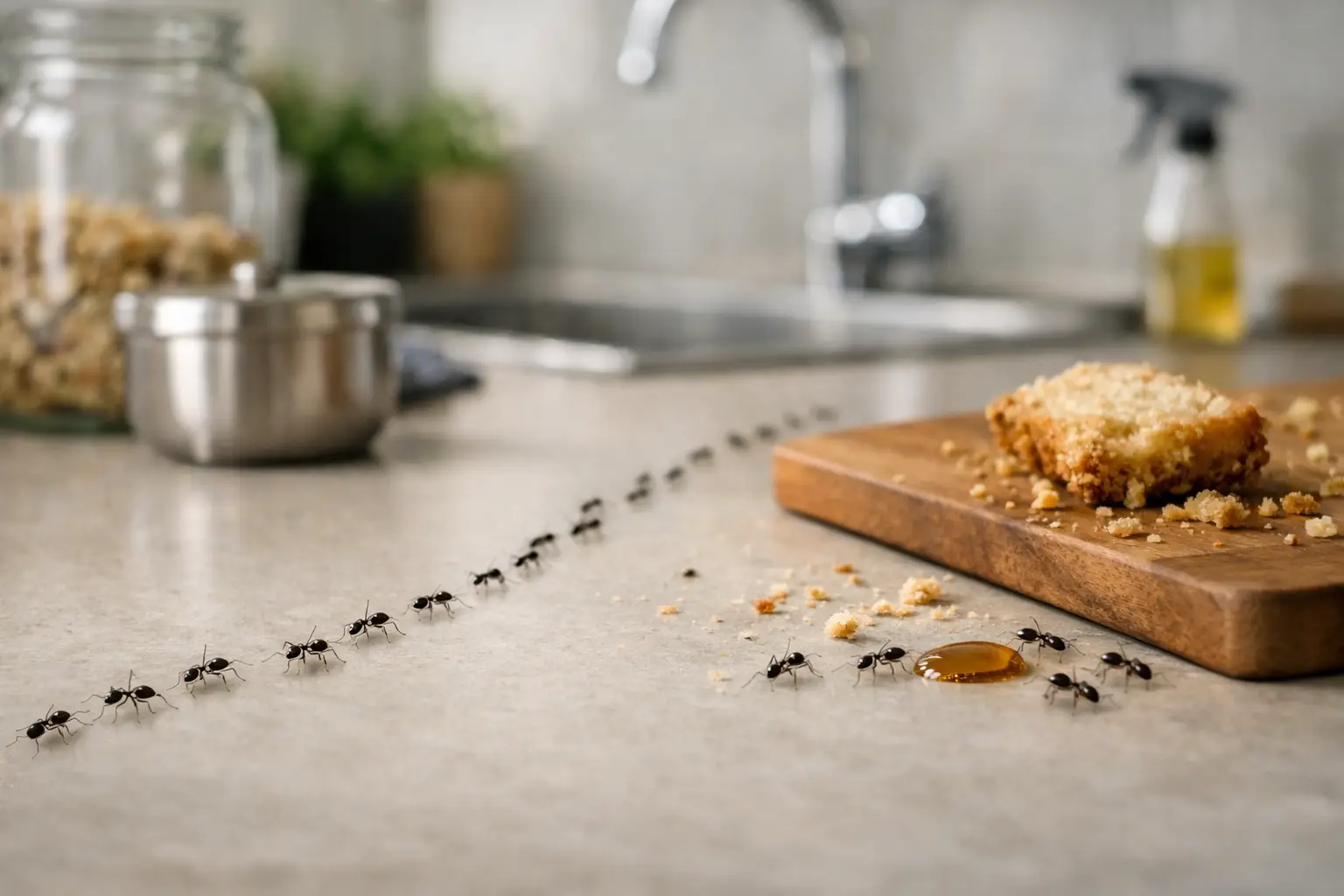
A line of ants crossing a clean counter can feel alarming, especially when you have children, pets, or food nearby. The question, “why are ants in kitchen” spaces, usually has a straightforward answer: ants have found a dependable combination of food, water, shelter, and a way inside. One or two ants may be scouts. A steady trail is a sign that the colony has identified your kitchen as a reliable resource.
Ants are persistent, but their activity is not random. Understanding what brought them in helps you stop the immediate problem and reduce the chance of another trail appearing next week.
Why Are Ants in the Kitchen?
Kitchens offer exactly what foraging ants need. Crumbs under a toaster, a sticky spot near the trash can, pet food left out overnight, or residue around a recycling bin can be enough to attract a scout ant. Once it finds food or moisture, it leaves a scent trail called a pheromone trail. Other ants follow that trail, reinforce it, and quickly create the familiar marching line across a floor, cabinet, or countertop.
Sugar is a common draw, but it is not the only one. Many household ants will feed on grease, protein, fruit, pantry staples, and even tiny food particles hidden in appliance seams. That is why an ant problem can continue even when the obvious cookie crumbs have been wiped away.
Water is equally important. Ants commonly appear near sinks, dishwashers, refrigerators, coffee makers, pet water bowls, and plumbing penetrations under cabinets. A slow leak or ongoing condensation can turn a kitchen into a dependable watering station, particularly during dry weather.
In Ohio, ant activity often becomes more noticeable in spring and summer as colonies expand and workers forage more actively. However, ants can enter year-round when a home provides warmth, moisture, and easy access to food. Cold weather may simply push activity into wall voids, basements, and other protected areas.
The Most Common Entry Points
Ants do not need a visible hole in the wall to get inside. They can move through narrow gaps around windows, doors, utility lines, foundation cracks, and siding. In the kitchen, they may emerge from gaps around plumbing pipes, spaces behind cabinets, cracks at the floor-wall joint, or openings around electrical outlets.
Seeing ants indoors does not always mean the colony is inside your kitchen walls. The nest may be outdoors near the foundation, beneath landscaping materials, in a mulch bed, or under a patio. The workers are entering solely to collect resources. In other cases, especially where moisture is persistent, ants may nest within a wall void, behind cabinets, or near damaged wood.
Carpenter ants deserve particular attention. They do not eat wood, but they excavate it to create nesting galleries. Finding large black ants indoors, especially alongside moisture damage, sawdust-like material, or activity near windows and sinks, calls for a professional inspection. The issue may involve both ant control and a condition that is allowing moisture to affect the structure.
Why Cleaning Alone May Not Stop Ants
A thorough cleaning is an essential first step, but it is rarely the entire answer. If the colony remains active outdoors or within the structure, new workers can continue entering through the same opening. Spraying the ants you see may eliminate a few foragers while leaving the source untouched.
Some over-the-counter sprays can also scatter ants temporarily. Instead of following one obvious trail, workers may begin appearing in several areas as the colony redirects its activity. This can make the infestation seem worse and makes it harder to identify where ants are entering.
The goal is not only to remove visible ants. Effective control addresses the food and moisture that support them, the routes they use, and the colony that keeps sending workers inside. That approach is especially important when ants return repeatedly after cleaning or store-bought treatments.
What to Do When You See Ants in Your Kitchen
Start by removing the immediate food source and disrupting the trail. Wipe counters, cabinet fronts, floors, and the area around appliances with soapy water or a household cleaner. Pay close attention to the underside of small appliances, the edges of the stove, and the space beside the refrigerator. Ants can find residue in places that receive little routine attention.
Next, store food in sealed containers and avoid leaving ripe fruit, snacks, or pet food exposed for long periods. Empty indoor trash regularly, rinse recyclable containers, and clean spills promptly. A clean kitchen does not guarantee that ants will stay away, but it removes the easiest reward for scouting workers.
Check beneath the sink and around the dishwasher for leaks, damp cabinet materials, or standing water. Repairing a small plumbing issue can make a meaningful difference. If you see ants entering around a pipe or other opening, note the location. That information helps identify the route that needs to be sealed after active ant pressure is controlled.
For homes with a few isolated ants, these measures may reduce activity. For a consistent trail, multiple ant locations, or repeated activity after cleaning, professional treatment is the more dependable option. The best method depends on the ant species, nesting location, property conditions, and whether children or pets use the affected area.
How Professional Ant Control Creates Lasting Results
Professional ant control begins with inspection, not guesswork. A trained technician looks for ant activity, entry points, moisture conditions, conducive landscaping, and potential nesting sites. Identifying the species matters because treatment strategies differ. A pavement ant near a foundation, an odorous house ant in a wall void, and a carpenter ant associated with damp wood should not be handled as identical problems.
Treatment may include carefully placed baits, targeted exterior applications, crack-and-crevice treatment, and recommendations for sanitation, moisture correction, and exclusion. Baits can be particularly useful because foraging ants carry the material back to the colony. However, bait selection and placement must be precise. The wrong product or a poorly placed treatment can fail to reach the colony or interfere with its feeding behavior.
Apex Pest Control develops customized plans that account for the ant activity you are seeing and the conditions encouraging it. Treatments are designed with safety in mind for people, pets, property, and the surrounding environment. For recurring pressure, an ongoing pest prevention program provides regular monitoring and a proactive response before a few scout ants become an established indoor trail.
Prevention Steps That Make a Difference
Long-term prevention works best when several small improvements are combined. Keep vegetation and mulch from touching the foundation, since both can provide protected travel routes and retain moisture near the structure. Trim branches away from the home, manage standing water, and keep firewood or stored materials away from exterior walls.
Seal accessible cracks and gaps around utility penetrations, doors, windows, and the foundation. Replace worn weatherstripping and repair damaged screens. Indoors, make a habit of checking the less visible food and moisture zones: behind appliances, beneath sinks, inside pantry corners, and around pet feeding areas.
Commercial kitchens, break rooms, and food-service facilities need the same fundamentals at a larger scale. Regular sanitation, documented inspections, waste management, moisture control, and prompt maintenance are central to preventing ants from becoming a compliance or customer-service concern. A recurring service plan also provides the documentation and consistent oversight many facilities require.
When an Ant Problem Needs Immediate Attention
Call for professional help promptly if you are seeing large black ants, ants with wings indoors, activity near damp or damaged wood, or trails that return after repeated cleaning. It is also time to act when ants appear in several rooms, emerge from wall voids or outlets, or affect a food-storage or food-preparation area.
One scout ant is an early warning. A recurring trail is proof that ants have found a reason to keep coming back. Removing that reason, closing their routes, and treating the colony with a targeted plan protects your kitchen and restores the peace of mind your home should provide.