


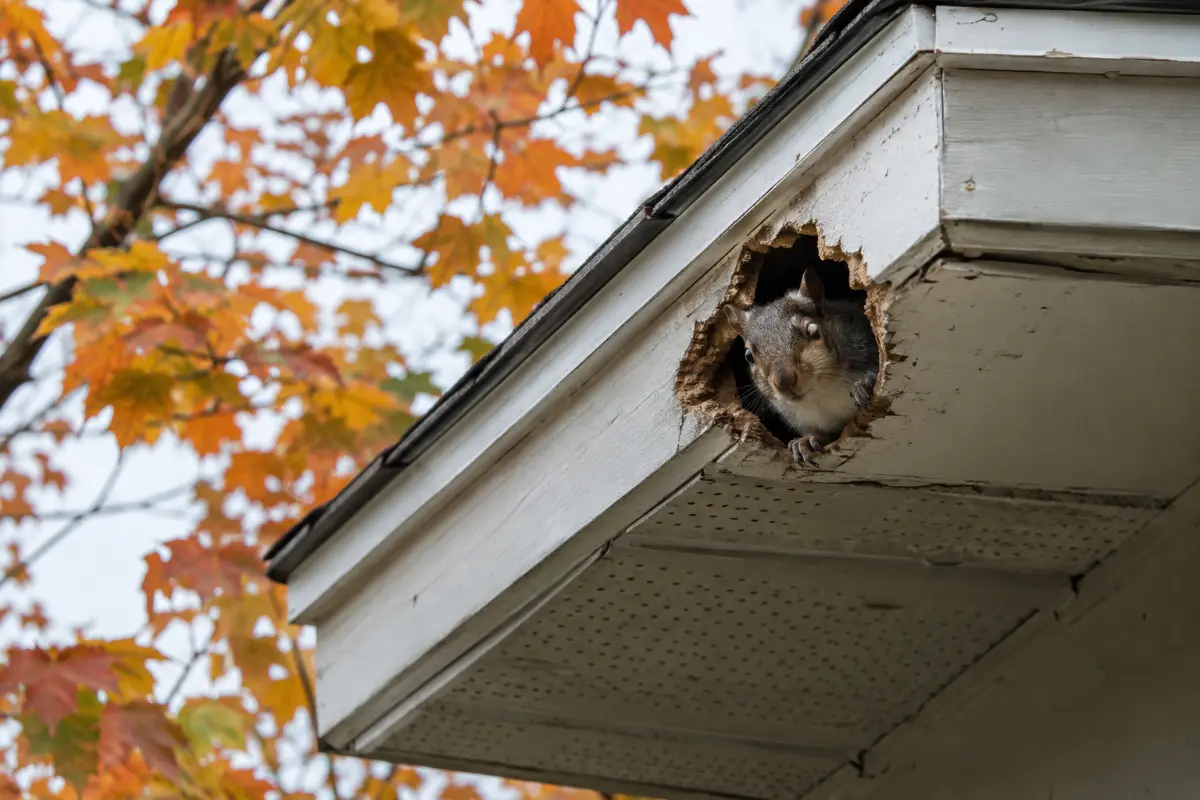
If you’ve started hearing scratching and scurrying over the ceiling around sunrise, you may have squirrels in the attic. Cleveland homeowners hear this a lot from October on. Gray squirrels breed in mid-December and early January, so fall is when they look for a warm, dry place to nest. A gap along a roofline next to a mature oak or maple works fine for them. This guide covers how to confirm it’s squirrels, what Ohio law allows, what you can do yourself, and when to bring in a licensed professional.
Is it squirrels, or something else?
The timing of the noise is the best clue.
- Squirrels are active during the day. You’ll usually hear them at dawn and again in late afternoon, when they leave to feed and come back.
- Raccoons are nocturnal and much heavier. Expect thumping and dragging late at night rather than light, quick scratching.
- Mice and rats also move at night, mostly inside walls and along the attic floor. The sound is softer and more constant.
- Bats are mostly quiet. You’re more likely to notice droppings or see them leave at dusk.
Signs of squirrels in the attic
- A chewed, roughly round hole about the size of a baseball, often at a roof-return corner, soffit, gable vent or ridge vent
- Shredded insulation, leaves or twigs piled into a nest, usually near the eaves
- Gnawed wood, wire insulation or vent screens
- Droppings and urine stains on insulation or stored boxes
- Squirrels running along a power line, gutter or overhanging branch straight to the roof
Some of these signs overlap with other animals. Our guide to humane wildlife removal for Ohio homeowners covers raccoons and bats in more detail.
Why squirrels in the attic are more than a noise problem
Squirrels chew constantly to keep their teeth worn down. In an attic, that means wood, insulation and the plastic coating on electrical wiring. Penn State Extension warns that wiring stripped bare by chewing squirrels can start a fire. They also pack nesting material into insulation, leave droppings and urine behind, and tend to widen whatever opening they use. Water can follow them in through that hole.
Can you trap and relocate a squirrel in Ohio?
Ohio allows homeowners to trap nuisance wild animals on their own property, with conditions. Under Ohio Administrative Code rule 1501:31-15-03, in plain terms:
- Squirrels can be released or euthanized. A released squirrel can’t be let go inside the limits of any incorporated city or village. Releasing it on someone else’s land requires that landowner’s permission.
- If you aren’t licensed, you can’t hold a trapped animal for more than 24 hours, and you can’t charge anyone for trapping it.
- Traps generally have to be checked at least once every calendar day.
Most of Cuyahoga County is inside city or village limits, so a squirrel caught in Lakewood, Parma or Euclid can’t simply be let go at a nearby park. Raccoons, skunks and opossums are stricter still: they must be released on site or euthanized. Rules change, so check the current text or ask a licensed operator before you set a trap.
There’s also a practical problem with trapping: removing a squirrel doesn’t close the hole, so another one can move right in.
What you can do yourself
Some homeowners handle a simple case themselves. These steps follow Penn State Extension’s guidance on tree squirrels.
- Find every opening. From the ground with binoculars, check roof returns, soffits, fascia boards, gable and ridge vents, chimney flashing and the spots where utility lines enter the house. Our guide to how pests get into Ohio homes lists the usual weak spots.
- Make sure no squirrels are left inside before you seal anything. A squirrel sealed into an attic will chew a new way out, sometimes into the living space.
- Use a one-way exclusion door. Mount it over the main entry hole so squirrels can leave but can’t get back in. Leave it in place for a few days, until you no longer hear activity.
- Seal openings with heavy half-inch wire mesh or a proper repair. Squirrels chew through foam, caulk and thin screening.
- Trim branches back 6 to 8 feet from the roof. Squirrels jump onto roofs from overhanging limbs.
A note on timing: gray squirrels also have litters in summer, and the late-winter breeding season is coming. If young squirrels are left inside after the adults are excluded, they can die in the walls or the adult may chew back in. If you hear high-pitched chirping, or you aren’t sure whether there’s a litter, get help before sealing.
When to call a professional
Call a pro if any of these apply:
- The entry points are on a second-story roofline, a steep pitch or a chimney you can’t reach safely from a ladder.
- You’ve found chewed wiring. Have an electrician check it as well.
- You hear babies, or you aren’t sure whether there’s a litter.
- You’ve already sealed a hole and the squirrels chewed a new one.
- You see signs of more than one kind of animal, or you suspect bats. Bat exclusion in Ohio has its own rules and seasonal restrictions; see our bat removal guide.
Apex Pest Control is licensed with the Ohio Department of Natural Resources, Division of Wildlife, to provide nuisance wild animal removal and control, and we’ve served Northeast Ohio since 1969. Depending on the situation, we use live traps, catch poles and exclusion methods to remove animals humanely, and we put together a plan for your home after an inspection. Learn more about our wildlife control services.
Apex also handles wildlife around Cleveland and across the Akron, Columbus and Dayton areas.
FAQ
How do I know if I have squirrels or raccoons in my attic?
Squirrels make light, quick scratching at dawn and dusk. Raccoons are louder and heavier and are active late at night. A baseball-sized chewed hole at the roofline points to squirrels. A torn-open vent or a peeled-back section of shingle or fascia points to a raccoon.
Will squirrels leave the attic on their own in winter?
Usually not. An attic is warm, dry and safe, which is exactly what they’re looking for, and they often raise young there in late winter. A one-way door plus sealed openings is what makes them leave for good.
Is it legal to relocate a squirrel in Ohio?
Only under specific conditions. Ohio rules say a trapped squirrel can be released or euthanized. Release can’t happen inside any incorporated city or village, and releasing it on someone else’s property requires the landowner’s permission. Non-licensed trappers can’t hold an animal for more than 24 hours.
Are squirrels in the attic dangerous?
The main risks are chewed electrical wiring, which Penn State Extension notes can cause a fire, plus damaged insulation and water getting in through enlarged holes. Don’t handle squirrels with bare hands.
When is the best time to get squirrels out of the attic?
As soon as you notice them, and ideally before winter litters arrive. Sealing in fall, once you’ve confirmed the attic is empty, avoids trapping young inside.
Hearing squirrels overhead? Get it handled before winter
If you’re dealing with squirrels in the attic in Cleveland or anywhere in Northeast Ohio, call Apex Pest Control at (440) 786-8520, or fill in the form below for a free estimate. We’ll find how they’re getting in and close it off for good.