



TL;DR:
- Humane wildlife removal involves ethically evicting nuisance animals using non-lethal methods that prioritize animal welfare and legal compliance. It primarily relies on habitat modification, deterrents, and exclusion devices, with trapping as a last resort, to ensure permanent, humane resolution. In Ohio, licensing, seasonal restrictions, and relocation laws govern the process, making professional, licensed services essential for lawful and effective wildlife control.
Humane wildlife removal is defined as the ethical, non-lethal process of evicting nuisance animals from residential and commercial properties using exclusion strategies, deterrents, and safe animal relocation that prioritize animal welfare and comply with Ohio law. For homeowners and property managers in Oakwood, Ohio, this approach matters because the area’s mix of older residential neighborhoods, mature tree canopy, and proximity to green corridors creates ideal conditions for raccoons, bats, squirrels, and opossums to move in uninvited. The industry term for licensed practitioners is “nuisance wild animal control operator,” and understanding what separates ethical wildlife management from harmful shortcuts protects both your property and the animals involved.
What is humane wildlife removal and how does it work?
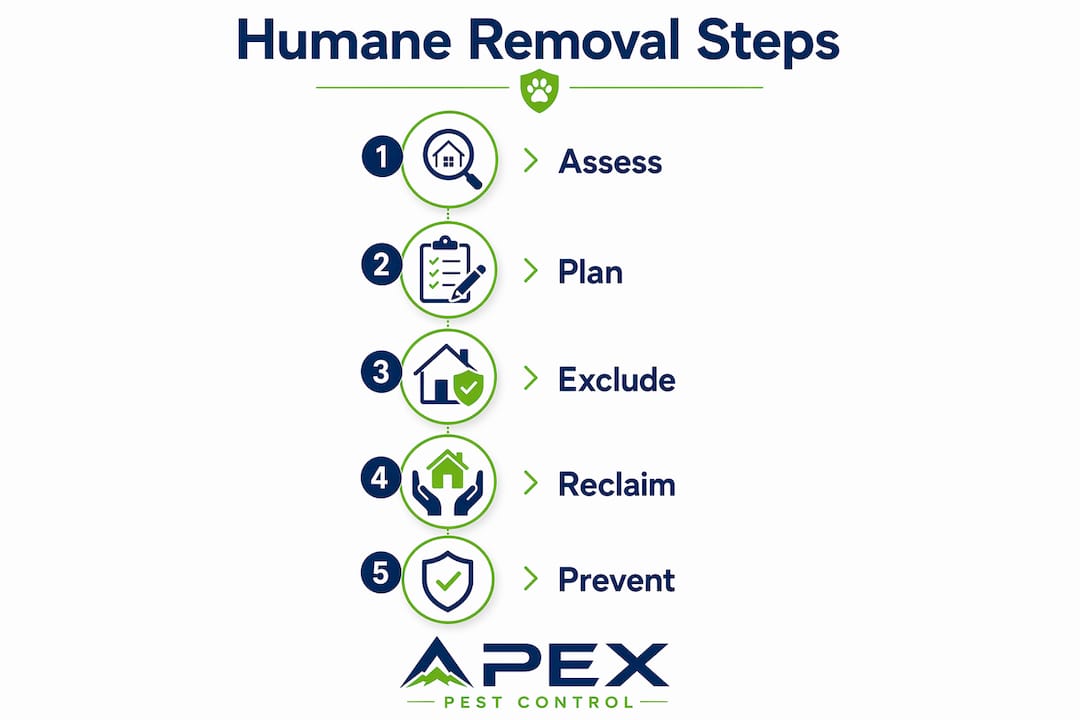
Humane wildlife removal is the practice of resolving wildlife conflicts without killing or injuring animals. It relies on a sequence of methods: first modify the habitat to make it less attractive, then apply deterrents, and finally use exclusion devices or humane trapping only when necessary. This sequence matters because it addresses the root cause rather than just removing the symptom.
The core toolkit for ethical wildlife management includes the following methods, applied in order of preference:
- Habitat modification removes food sources, nesting materials, and shelter that attract wildlife. Trimming branches that overhang rooflines, securing compost bins, and removing brush piles near foundations all reduce the property’s appeal before any animal is disturbed.
- Deterrents include motion-activated lights, sound devices, and scent repellents placed along known travel paths. These are most effective when deployed before animals establish a nesting routine.
- Exclusion devices, including one-way doors, allow animals to exit a structure but physically block re-entry. Guaranteed eviction strategies using one-way doors and animal-proofing with at least a one-year re-entry guarantee are the standard recommended by Humane World for Animals for long-term resolution.
- Sealing entry points follows exclusion. Every gap, soffit vent, and foundation crack is closed with hardware cloth, caulk, or metal flashing after the animal has exited.
- Humane trapping is a last resort. Traps must be placed near animal travel paths and checked daily to comply with humane standards, and they are only appropriate when exclusion alone cannot resolve the problem.
Pro Tip: Schedule exclusion work in Oakwood between late summer and early fall. Most wildlife species have finished raising young by August, which means you avoid separating mothers from dependent offspring and reduce the risk of animals dying inside sealed structures.
How do Ohio wildlife laws affect humane removal practices?
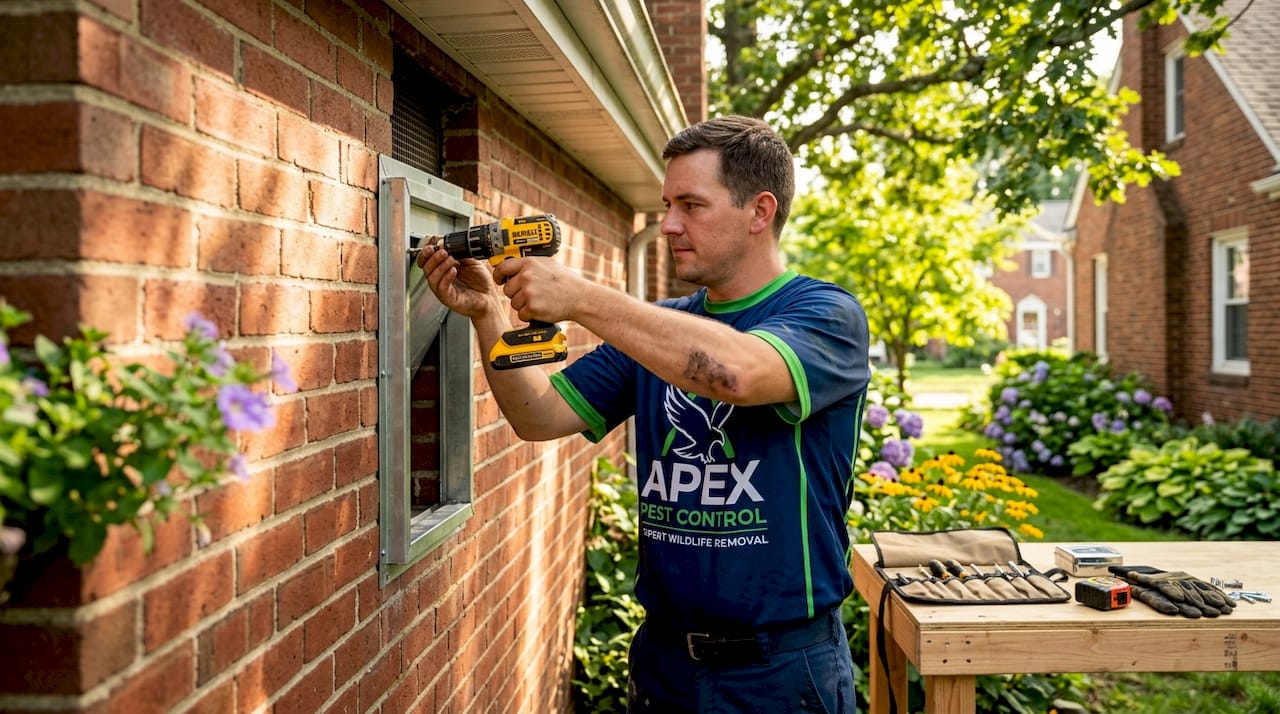
Ohio law draws a clear line between what homeowners can handle themselves and what requires a licensed professional. Getting this wrong carries real legal and financial consequences.
Key legal requirements for wildlife removal in Ohio include:
- Licensing: Ohio requires nuisance wildlife control services to hold a commercial nuisance wild animal control operator’s license. Removing or relocating certain animals without this authorization can result in fines or criminal charges.
- Annual renewal and certification: Ohio operators must renew licenses annually and complete certification courses every three years covering public safety and animal life history. This requirement exists to keep practitioners current on both legal changes and species behavior.
- Relocation restrictions: Relocating nuisance wildlife is largely restricted or illegal in Ohio for rabies-vector species such as raccoons and foxes. Relocation often fails to account for animal survival rates and legal restrictions, making exclusion the preferred humane approach. In some cases, Ohio law mandates euthanasia rather than relocation, which conflicts with common assumptions about what “humane” means. Following Ohio Department of Natural Resources (ODNR) rules is non-negotiable.
- Bat-specific rules: Bat exclusion is the only legal removal method in Ohio, and it comes with strict seasonal windows. Ideal exclusion periods are April 1 through May 15 and August 1 through October 15. Work outside these dates requires written authorization from the Ohio Division of Wildlife.
“Exclusions outside permitted dates require written authorization. Ohio’s bat exclusion timing is critical to avoid harming pups during maternity periods.” — Ohio bat exclusion guidance
The practical takeaway for Oakwood property owners is straightforward: never hire a wildlife removal company that cannot produce a valid Ohio license on request. An unlicensed contractor exposes you to shared liability for any violations committed on your property.
Which wildlife species commonly need removal in Oakwood, Ohio?
Oakwood’s housing stock, which includes a high proportion of older brick homes, colonial-style residences, and properties with large oak and maple trees, creates specific entry vulnerabilities that attract a predictable set of nuisance species. Raccoons and squirrels are among the most common wildlife issues in Ohio residential areas like Oakwood, posing both structural damage and health risks when left unmanaged.
The species most frequently requiring humane removal in Oakwood include:
- Raccoons enter attics through deteriorating fascia boards and uncapped chimneys. They are most active from March through October and often establish maternity dens in spring, which complicates removal timing.
- Bats exploit gaps as small as 3/8 of an inch around rooflines and behind shutters. Ohio’s little brown bat and big brown bat are the species most commonly found in Oakwood attics. Bat exclusion devices must remain in place for at least a week to confirm full eviction before entry points are sealed.
- Gray squirrels use overhanging tree branches as highways onto roofs, then chew through wood and insulation to establish nests. Oakwood’s mature tree canopy makes this a year-round concern.
- Virginia opossums favor crawl spaces and decks. They rarely cause structural damage but carry parasites and create sanitation issues.
- Rodents, including Norway rats and house mice, exploit foundation gaps and utility penetrations common in Oakwood’s older housing. Wild animals carry diseases and parasites that pose real risks to human health, making professional removal a safety priority, not just a comfort one.
Signs of wildlife presence include scratching sounds in walls or ceilings at night, droppings near entry points, chewed wiring or insulation, and strong ammonia odors in attics or crawl spaces.
How to choose a trustworthy humane wildlife removal professional
Selecting the right wildlife control service in Oakwood requires asking specific questions before any work begins. The table below compares what a reputable humane operator provides versus what should raise concern.
| What a reputable operator provides | What should raise concern |
|---|---|
| Valid Ohio nuisance wild animal control operator’s license | Cannot produce license documentation on request |
| Written guarantee of at least one year against re-entry | Verbal-only assurances with no written warranty |
| Transparent plan for offspring and animal welfare | Vague answers about what happens to trapped animals |
| Proof of liability insurance and workers’ compensation | No insurance documentation available |
| Fixed-scope contract with defined deliverables | Open-ended contracts with recurring fees and no clear endpoint |
Homeowners should verify that wildlife removal companies provide written assurance of compliance with federal, state, and local laws and carry the necessary insurance. This protects you from liability and confirms the company operates ethically.
Your first questions to any prospective wildlife control service should focus on animal treatment details, offspring reunification plans, and the long-term exclusion strategy rather than on how fast they can remove the animal. Speed without a prevention plan means the problem returns within a season.
Pro Tip: Ask specifically whether the company’s exclusion warranty covers the same entry point if an animal re-enters within 12 months. A company confident in its work will answer yes without hesitation.
What ongoing prevention supports humane wildlife solutions long-term?
Removing an animal solves today’s problem. Preventing re-entry solves the problem permanently. Oakwood homeowners who invest in ongoing property maintenance after a removal event see significantly fewer repeat intrusions.
Effective long-term prevention covers five areas:
- Seal entry points and inspect annually. Focus on roofline gaps, soffit vents, chimney caps, and foundation penetrations. Schedule inspections each fall before animals seek winter shelter.
- Remove food sources. Secure trash cans with locking lids, bring pet food indoors at night, and harvest garden produce promptly. Unsecured food is the single most reliable wildlife attractant around residential properties.
- Manage landscaping. Keep tree branches trimmed at least 6 feet from rooflines. Remove brush piles, wood stacks, and dense ground cover within 10 feet of the foundation.
- Apply seasonal deterrents. Motion-activated lights and sprinklers are most effective when deployed in March before raccoon denning season and again in September before squirrels begin caching food near structures.
- Use integrated pest management principles. Rodent control combined with exclusion and habitat modification creates a layered defense that is far more durable than any single intervention. Non-lethal pest control works best as a system, not a one-time fix.
Key takeaways
Humane wildlife removal works because it combines legal compliance, species-specific exclusion methods, and long-term prevention to resolve wildlife conflicts without harm to animals or property owners.
| Point | Details |
|---|---|
| Exclusion is the core method | One-way doors and sealed entry points resolve most wildlife conflicts without trapping. |
| Ohio law governs every step | Licensed operators, seasonal bat rules, and relocation restrictions apply to all removal work. |
| Trapping is a last resort | Habitat modification and deterrents should be exhausted before any trap is set. |
| Verify credentials before hiring | Demand a valid Ohio license, written warranty, and proof of insurance from any contractor. |
| Prevention prevents repeat intrusions | Annual inspections, food source removal, and landscaping management stop wildlife from returning. |
Why humane removal is the only approach worth taking in Oakwood
I have seen what happens when Oakwood homeowners hire the cheapest option available. The animal is gone in 48 hours, the entry point stays open, and three weeks later there is a new tenant in the attic. That is not a wildlife removal service. That is a temporary inconvenience for the animal and a recurring expense for the homeowner.
What actually works is the slower, more methodical approach: inspect thoroughly, identify every possible entry point, install exclusion devices correctly, wait for full eviction, then seal. For bats, that process alone takes a minimum of a week by Ohio law. For raccoons with young, it may take longer if offspring need to mature before the family can be safely evicted. Rushing that process causes harm to the animals and often creates a worse problem when a trapped animal panics inside a sealed structure.
The legal dimension also matters more than most homeowners realize. Ohio’s rules on rabies-vector species are strict, and the assumption that “humane” always means “relocate to a park” is simply wrong under Ohio law. Working with a properly licensed nuisance wild animal control operator is not just the ethical choice. It is the legally protected one. Apexpestcontrol has operated in Ohio since 1969, and the professionals who do this work correctly understand that the goal is permanent resolution, not a quick fix.
— Dushan
How Apexpestcontrol handles humane wildlife removal in Oakwood
Apexpestcontrol has served Ohio homeowners and property managers since 1969, and humane wildlife solutions are part of that long-standing commitment to responsible pest management. The team uses licensed nuisance wild animal control operators who apply exclusion-first strategies, including one-way doors and guaranteed sealing of entry points, backed by written warranties. If rodents are part of your wildlife problem, the rodent removal service page covers the full scope of what Apexpestcontrol offers for Oakwood properties. For any wildlife concern, from bats in the attic to raccoons in the crawl space, contact Apexpestcontrol for a free quote and a removal plan built around your property’s specific vulnerabilities.
FAQ
What does humane wildlife removal actually mean?
Humane wildlife removal means evicting nuisance animals using non-lethal methods such as one-way exclusion doors, habitat modification, and deterrents, then sealing entry points to prevent re-entry. The goal is to resolve the conflict without injuring or killing the animal.
Is it legal to relocate wildlife in Ohio?
Relocating rabies-vector species such as raccoons is largely restricted or illegal in Ohio. Licensed operators must follow ODNR rules, which in some cases require on-site release or euthanasia rather than relocation to another area.
When is the right time to remove bats from an Ohio home?
The approved exclusion windows in Ohio are April 1 through May 15 and August 1 through October 15. Work outside these periods requires written authorization from the Ohio Division of Wildlife to avoid harming bat pups during maternity season.
How do I know if a wildlife removal company is legitimate in Ohio?
Ask for the company’s commercial nuisance wild animal control operator’s license, proof of liability insurance, and a written warranty covering re-entry for at least one year. A legitimate operator will provide all three without hesitation.
Can I handle wildlife removal myself as a homeowner?
Minor deterrent measures and habitat modification are within a homeowner’s ability, but exclusion work, trapping, and any handling of rabies-vector species require a licensed operator in Ohio. Attempting unlicensed removal of protected species can result in fines or criminal charges.