


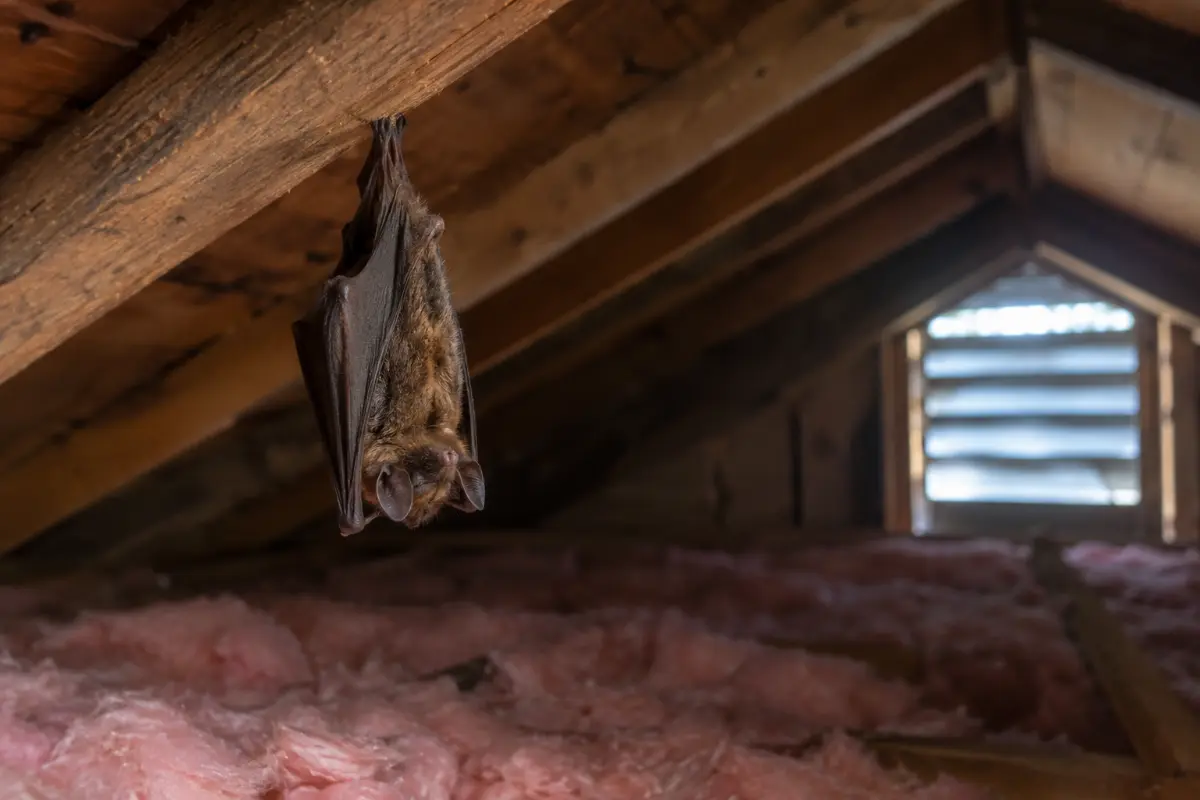
A bat swooping through the living room in November is unsettling, and the first instinct is to get it out and seal every gap. In Ohio, it isn’t that simple. Bat removal in Columbus, Ohio, and across the state is restricted from October 15 to March 31 whenever bats are present in a building. This guide covers what that rule means, what to do with a bat inside your home right now, which repairs can happen this winter, and when to call a licensed professional.
Why bats turn up in Columbus homes in late fall and winter
Ohio’s bats hibernate from late October to early April, according to the Ohio Department of Health. Most head for caves and mines. Some, especially big brown bats, spend the winter in attics, wall voids and other parts of buildings. Purdue Extension notes that it’s common for small numbers, typically one to four, to hibernate in homes.
Hibernating bats don’t stay put all winter. During warm spells they wake up, find nothing to eat, and sometimes move toward warmth, which can mean your hallway or bedroom. Wildlife rehabilitators in Ohio reported exactly this after a warm stretch in January 2026.
Older Columbus-area homes tend to have more of the gaps bats use: loose flashing, gaps around chimneys, worn soffits and the joints where rooflines meet. A bat needs very little room. The Ohio Department of Health recommends sealing openings larger than a quarter inch by half an inch.
Ohio’s bat exclusion rules: the dates that matter
“Exclusion” is the standard way to remove bats. One-way devices go over the openings bats use, so they can leave but can’t get back in. Under Ohio Administrative Code 1501:31-15-03, the ODNR Division of Wildlife restricts when that can happen:
| Period | Rule |
|---|---|
| April 1 – May 15 | Ideal time for exclusion |
| May 16 – July 31 | Restricted when 5 or more bats are present (pups can’t fly yet) |
| August 1 – October 15 | Ideal time for exclusion |
| October 15 – March 31 | Restricted if any bats are present (hibernation) |
During a restricted period, exclusion needs written permission from the Division of Wildlife. Permission is considered when human health or safety is at risk. In October it’s also considered when nighttime temperatures stay above 40°F for the full 10-day forecast. The reason is simple: a bat pushed out in freezing weather often can’t get back to shelter and dies.
A few things are illegal at any time of year:
- Glue traps, poisons, chemicals or foggers used on bats
- Sealing all the entry points while bats are still inside
- Killing a bat, unless a bite or possible rabies exposure has occurred
Ohio also limits who can be paid for this work. Only licensed commercial nuisance wild animal control operators can charge for bat exclusion. The rules are strict for a reason. Four of Ohio’s bat species are state-endangered, and ODNR says declines in some species that roost in buildings may be as high as 96% to 99%, largely because of white-nose syndrome.
Found a bat in the house? What to do right now
What you do next depends on one question: could anyone, or any pet, have touched it?
If someone may have had contact
Treat it as a possible rabies exposure. Bats are the leading cause of human rabies deaths in the United States, and their bites can be small enough to go unnoticed. Health officials consider contact possible if the bat was in a room with someone who was asleep, a young child, or a person who can’t say for sure what happened.
- Don’t release the bat. Testing it can show whether anyone needs rabies treatment.
- Keep people and pets out of the room and close the doors.
- Wearing thick leather gloves, wait for the bat to land. Cover it with a box or plastic container, slide stiff cardboard underneath and tape it shut. Don’t use a towel or pillowcase, because bats can bite through fabric.
- Call your local health department. That’s Columbus Public Health inside the city and your county health department elsewhere. Call your doctor too, or your vet if a pet was involved.
The Ohio Department of Health’s bat guidance covers capture and testing in more detail.
If no one could have had contact
Close the room off and keep pets away. In warmer months, opening a window and turning off the lights is often enough to let the bat find its way out. In winter, a bat let outside into freezing weather may not survive. The Ohio Department of Health suggests a licensed nuisance wild animal operator or a wildlife rehabilitator for winter cases where no one was exposed.
Signs you have bats living in the house, not just a stray
One bat indoors doesn’t always mean a colony. These signs suggest bats are roosting in your attic or walls:
- Droppings in the attic or piled below a gap; old, dry droppings can look like coffee grounds
- Dark smudge marks around small openings in soffits, siding or chimney flashing
- Scratching or squeaking in walls or ceilings, especially around dusk
- Bats showing up in the living space more than once
Don’t sweep up a buildup of droppings yourself. Purdue Extension links long-term accumulations in attics to histoplasmosis, a fungal lung disease. Cleanup needs at least a respirator and the droppings misted first so they don’t turn to dust.
What you can do this winter, and what has to wait
You don’t have to sit on your hands until April.
You can do now:
- Seal interior routes into your living space. ODNR allows this at any time without a permit. Think gaps around attic doors and pull-down stairs, holes where pipes and wiring pass through, and loose ductwork.
- Add a draft guard under the attic door.
- Keep exterior doors closed and window screens in good repair.
- Book an inspection, so the exterior work is planned and ready for April 1.
What has to wait (unless authorized):
- Installing one-way devices on exterior openings while bats are present
- Sealing exterior gaps that bats are using
- Disturbing a roost in the attic
If bats keep getting into living areas and someone’s health is at risk, a licensed operator can apply to the Division of Wildlife for authorization to work now.
When to call a professional
Some bat situations are fine to handle yourself, like one bat in a room where no one could have been bitten, outside winter. Call a licensed professional if:
- Bats have come into your living space more than once
- You see droppings, staining or smudge marks that point to a roost
- You can hear bats in walls or the ceiling
- You need exterior entry points found and sealed, which often means ladder work at the roofline
- There’s a large amount of droppings to clean up
- You want to apply for winter authorization because of a health or safety risk
Ask whether the company is on ODNR’s list of licensed nuisance wild animal control operators and whether it does bat exclusion, since not all operators work with bats. Our step-by-step bat removal guide walks through how exclusion works once the season opens.
Bat removal in Columbus with Apex Pest Control
Apex is licensed with the Ohio Department of Natural Resources, Division of Wildlife, to provide nuisance wild animal removal and control, and we’ve been a family-owned Ohio company since 1969. Our bat exclusion starts by finding the bats’ entry and exit points and estimating the size of the colony. Once that’s done, we install one-way bat doors or netting so the bats can leave but can’t get back in. After all the bats have left, we permanently repair those openings so they can’t return.
In winter, we can inspect your home, seal what’s allowed now, and schedule exclusion for the spring window, or apply for authorization if there’s a health or safety risk. We serve Columbus and central Ohio, along with Greater Cleveland, Akron and Dayton. See our bat control page for more on how we handle bats, and our wildlife services for other animals in the attic.
Bat removal FAQ
Can I get bats out of my attic in winter in Ohio?
Not without permission while bats are present. From October 15 to March 31, exclusion needs written authorization from the ODNR Division of Wildlife. It’s considered when there’s a human health or safety risk.
Is it illegal to kill a bat in Ohio?
Yes, with one exception. Bats may not be killed unless a bite or possible rabies exposure has occurred. Glue traps, poisons and foggers are illegal for bats. Our guide to humane wildlife removal in Ohio covers other animals.
I found a bat in my bedroom. Do I need a rabies shot?
Possibly. If someone was asleep in the room, keep the bat if you can safely contain it, and call your local health department and doctor right away. If the bat tests negative, treatment usually isn’t needed.
When is the best time for bat exclusion in Ohio?
April 1 to May 15 and August 1 to October 15, when bats are active but not raising pups or hibernating.
Hearing bats in the attic? Get a plan before spring
If you think bats are roosting in your Columbus-area home, call Apex Pest Control at 1-800-MUG-A-BUG (1-800-684-2284), or fill in the form below for a free estimate. We’ll find how they’re getting in and tell you what can be done now and what should wait for spring.