



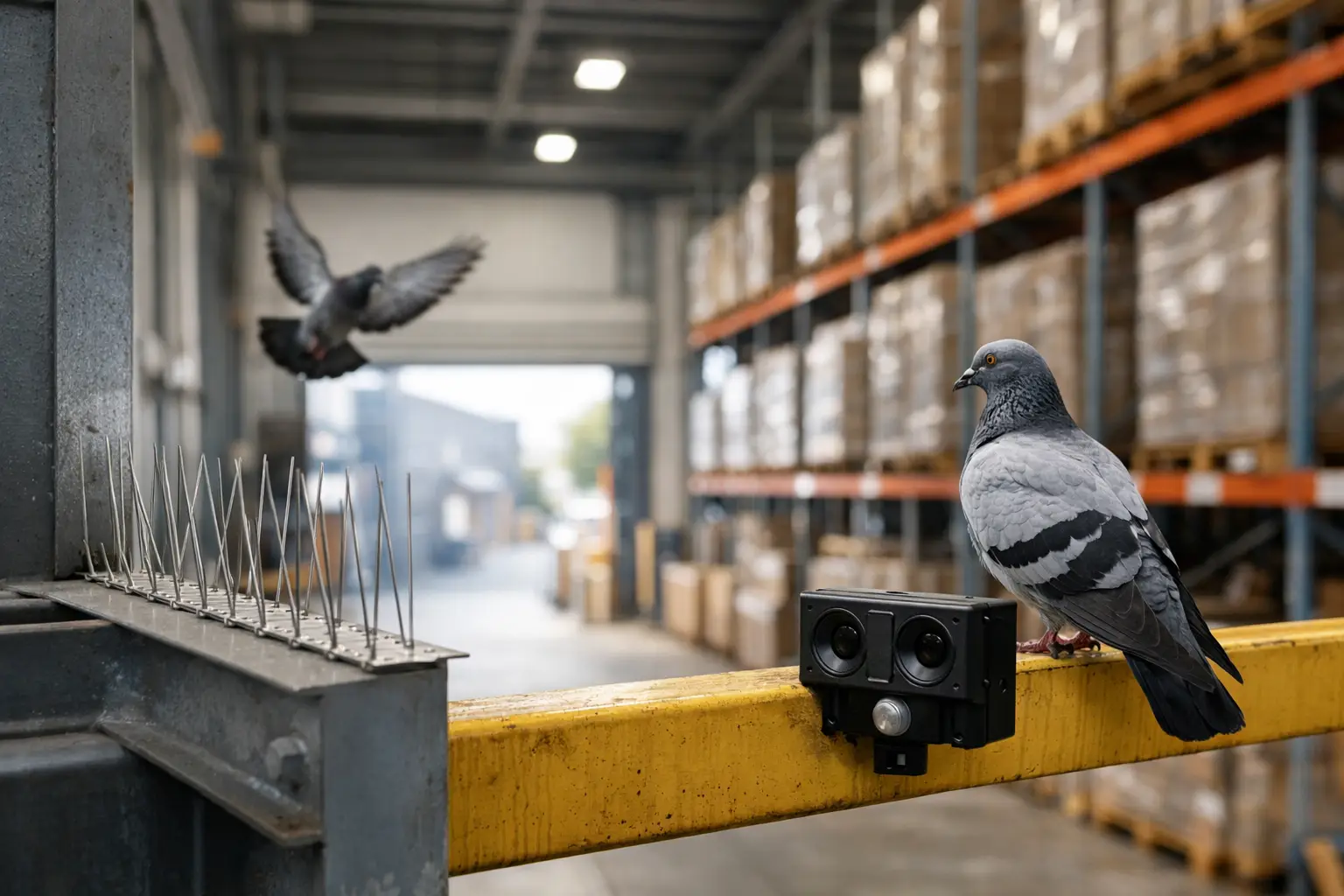
A few birds near a loading dock can turn into a costly warehouse problem faster than most teams expect. Bird control for warehouses is not just about stopping droppings on rafters. It is about protecting inventory, keeping walkways and equipment clean, reducing health risks, and avoiding the kind of recurring disruption that drains labor and maintenance budgets.
Warehouses create the exact conditions birds look for. They offer shelter from weather, high ledges for roosting, open doors for easy access, and in many facilities, food or water sources nearby. Once birds settle in, they rarely leave on their own. The longer the issue is ignored, the more established the roosting pattern becomes and the more expensive the cleanup and exclusion work usually gets.
Why birds become a serious warehouse issue
Facility managers often first notice the obvious signs – droppings on beams, feathers near dock doors, or birds flying overhead during receiving hours. What matters just as much is what those signs lead to. Bird droppings can contaminate products, damage packaging, create slip hazards, and corrode metal, concrete, and painted surfaces over time. In distribution, food handling, manufacturing, and storage environments, that quickly becomes an operational and compliance concern.
There is also a reputation issue. Customers, auditors, and employees notice when a facility has active bird activity indoors. A few pigeons in a warehouse ceiling may not look urgent at first, but they can signal poor exclusion, sanitation gaps, and weak preventive maintenance. For businesses that depend on inspections or strict cleanliness standards, that is not a minor detail.
Some birds are more persistent than others. Pigeons are a common warehouse problem because they adapt well to man-made structures and return repeatedly to familiar roosts. Sparrows and starlings also create trouble, especially around open dock areas and food-related operations. The species matters because control methods, legal restrictions, and nesting behaviors can vary.
Bird control for warehouses starts with access points
The most effective warehouse bird control plans begin with a clear answer to one question: how are the birds getting in and why are they staying? If a facility only focuses on removing birds without correcting access points, the problem tends to return.
Dock doors are often the biggest factor. Doors that remain open for long periods, damaged seals, and gaps around the frame can give birds repeated entry opportunities. Roof vents, broken windows, eave gaps, and structural openings along the upper exterior also matter. In larger facilities, one small opening may be enough to support a regular pattern of entry if the interior provides safe roosting space.
Inside the building, birds choose locations that are hard to reach and rarely disturbed. Ceiling trusses, light fixtures, signs, sprinkler piping, and steel beams all create elevated perches. If nearby food debris, standing water, or dumpster activity supports the site, the warehouse becomes even more attractive.
This is why inspection matters. A trained commercial pest professional does more than confirm bird presence. The goal is to map pressure points, identify species, locate interior and exterior harborage areas, and build a control plan that fits the facility layout and its operating schedule.
What actually works for warehouse bird problems
There is no single product that solves every bird issue. Effective bird control for warehouses usually combines exclusion, habitat reduction, and site-specific deterrents. The right mix depends on the building design, the severity of activity, and whether the birds are roosting, nesting, or entering only at certain times of day.
Exclusion is usually the backbone of a long-term solution. Bird netting can block access to overhead interior zones where birds roost. Spikes can help on select ledges and beams, although they are not appropriate for every surface or species. Screening and structural repairs around vents, openings, and dock-related gaps are often necessary. If birds can still get in, other measures tend to have limited staying power.
Deterrents can also play a role, but they need to be chosen carefully. Visual scare devices and off-the-shelf noise makers often lose effectiveness quickly in warehouse settings because birds adapt to them. In some cases, they create more frustration for staff than results for the facility. A professional plan focuses on devices and placements that match actual bird behavior, not just what looks active from the ground.
Sanitation and environmental correction matter more than many operators realize. Spilled grain, food residue, standing water, poorly managed waste areas, and cluttered exterior zones can all support bird pressure. Even when the main issue appears to be structural access, reducing attractants improves results and helps prevent re-infestation.
Why quick fixes usually fail
Warehouse teams often try to solve bird issues internally first, which is understandable. The challenge is that bird problems are rarely isolated to the one spot where droppings are most visible. If one beam is heavily affected, there are usually nearby travel paths, entry points, and secondary roosting areas that also need attention.
Another common mistake is relying on a single deterrent product. For example, placing spikes on one ledge may shift birds to another area rather than remove the pressure from the building. Closing one gap while leaving roofline openings untouched can produce the same result. Birds are highly adaptable. Partial solutions often move the problem instead of solving it.
Timing also matters. Nesting periods can limit what can be done immediately, depending on species and regulations. That is one reason professional identification is important. Bird management has to be effective, but it also has to be handled correctly.
Compliance, safety, and cleanup considerations
In commercial settings, bird activity is not just a nuisance issue. It intersects with worker safety, sanitation standards, and facility condition. Droppings on floors, catwalks, ladders, or dock surfaces raise slip-and-fall concerns. Accumulated waste around beams and equipment can expose maintenance staff during cleanup or repairs. In facilities that store food, ingredients, or sensitive materials, bird presence can trigger much broader quality concerns.
Cleanup should never be treated as an afterthought. Once birds have occupied a warehouse, the contamination left behind needs to be addressed alongside exclusion and control. Otherwise, the environment may continue attracting birds, and staff may remain exposed to unsanitary conditions. Proper cleanup methods protect both the facility and the people working in it.
Documentation is another practical issue for larger operations. Many warehouses need service records, inspection findings, and corrective action reports to support internal programs or third-party audits. A commercial pest partner with experience in regulated and high-traffic facilities can make that process far easier.
Choosing the right bird control plan for your warehouse
The best plan is the one that fits how your warehouse actually operates. A distribution center with constant dock traffic may need a different strategy than a food storage site, a manufacturing warehouse, or a seasonal facility with fluctuating occupancy. Ceiling height, product type, sanitation conditions, and employee traffic all influence what will work.
That is why cookie-cutter treatments are rarely enough. A dependable provider should assess structural vulnerabilities, explain the trade-offs of each control method, and recommend a program built around prevention as well as removal. In some sites, a one-time correction may handle the issue. In others, ongoing inspection and maintenance are the smarter investment because bird pressure is tied to the surrounding environment and day-to-day operations.
For multi-site operators, consistency matters too. Standardized reporting, documented inspections, and scalable service can help ensure one warehouse does not become the weak point in a larger network.
A company like Apex Pest Control approaches warehouse bird issues the way commercial clients need them handled – with a site-specific plan, experienced technicians, and attention to safety, compliance, and long-term prevention.
When to call for professional warehouse bird control
If birds are already roosting indoors, if droppings are appearing on inventory or work surfaces, or if staff keep seeing bird activity near dock doors and rafters, it is time to act. The longer birds remain active in a warehouse, the harder they are to displace and the more cleanup and repair work usually follows.
Professional service is especially important when the building has high ceilings, complex rooflines, active nesting, repeated re-entry points, or sanitation-sensitive operations. These are not conditions where trial-and-error usually pays off. An expert inspection can identify what is driving the problem and what needs to be done first, which saves time and reduces repeated disruption.
The right bird control plan does more than remove a nuisance. It protects the condition of your warehouse, supports safer daily operations, and helps preserve confidence in the way your facility is managed. When birds start treating your building like a permanent home, a fast, structured response is the best way to take control back.