




TL;DR:
- Ohio property damage from birds includes corrosion, health risks, and liability issues.
- Effective bird control combines inspection, exclusion devices, sanitation, and ongoing monitoring.
- Professional intervention is crucial for large infestations and long-term prevention.
Bird damage is not just an eyesore. Droppings corrode roofing materials, nests clog gutters and vents, and flocks near commercial buildings create real liability and health risks for Ohio property owners. Whether you’re managing a warehouse roof covered in pigeon waste or chasing Canada geese off your lawn every spring, the frustration is real and the costs add up fast. This guide walks you through a step-by-step, research-backed process for identifying, removing, and preventing pest birds using professional methods that actually work long-term.
Table of Contents
- Understanding Ohio’s bird pests and their impact
- Essential tools and materials for effective bird control
- Step-by-step process: Humane, professional bird control in Ohio
- Sanitation, restoration, and ongoing prevention
- The hard truths about DIY vs. professional bird control
- Connect with Ohio’s bird control experts
- Frequently asked questions
Key Takeaways
| Point | Details |
|---|---|
| Know your bird pests | Correctly identifying Ohio’s problem birds is the first key to control. |
| Use proven exclusion tools | Netting and spikes provide the most effective protection against intruding birds. |
| Follow a stepwise process | A structured approach yields long-term, humane bird control on your property. |
| Sanitation matters | Proper cleaning and repairs are essential for preventing reinfestation and health issues. |
| Get expert help when needed | Persistent or large-scale bird problems require professional evaluation and intervention. |
Understanding Ohio’s bird pests and their impact
Ohio has a serious bird pest problem, and if you’ve noticed growing flocks on or near your property, you’re not imagining it. High starling and blackbird populations, along with Canada geese, are among the most common nuisance birds in the state. Pigeons round out the top offenders, particularly in urban and suburban areas around Columbus, Cleveland, and Cincinnati.
Each species creates its own category of damage:
- European starlings and blackbirds gather in massive winter roosts, sometimes numbering in the tens of thousands. Their droppings accumulate rapidly, corroding metals, staining concrete, and creating slip-and-fall hazards.
- Canada geese graze aggressively on lawns, foul ponds and retention basins, and become dangerously territorial during nesting season.
- Pigeons nest on ledges, HVAC units, and rooftop equipment. Nesting materials combined with dry droppings create a real fire risk near electrical systems.
The health stakes are not small. Bird droppings can carry over 60 documented diseases, including histoplasmosis and salmonella. For commercial property managers, that translates into legal exposure if employees or visitors are harmed. Some birds, including migratory species like geese and starlings, are also protected under the Migratory Bird Treaty Act, which means removal methods must comply with federal regulations.
| Bird species | Primary damage | Peak season |
|---|---|---|
| European starling | Droppings, fire risk from nests | Fall through winter |
| Canada goose | Lawn damage, water contamination | Spring (nesting) and fall |
| Pigeon | Structural corrosion, disease spread | Year-round |
| Blackbird | Crop and feed contamination | Late summer into fall |
Seasonal awareness matters. Bird activity spikes in late summer and fall as flocks gather before migration, and again in spring during nesting. Knowing when your property is most vulnerable helps you time interventions before problems escalate. Reviewing bird control methods early in the season gives you a real advantage, and pairing that with year-round pest protection closes the gaps that birds exploit between seasons.
“Ohio properties face multi-species pressure. A single rooftop can attract pigeons in warm months and serve as a winter starling roost, meaning control strategies must address all potential tenants.”
Essential tools and materials for effective bird control
Choosing the right tool is not guesswork. Each method has specific use cases, and mismatching the solution to the problem wastes money and gives birds time to settle deeper into your property.
Here’s how the most widely used professional bird control methods compare:
| Method | Best for | Key benefit | Limitation |
|---|---|---|---|
| Bird spikes | Ledges, signs, rooflines | Durable, low maintenance | Won’t deter geese or ground nesters |
| Exclusion netting | Large open areas, eaves, warehouses | Total exclusion, species-neutral | Requires professional installation |
| Shock tracks | Narrow ledges, HVAC units | Humane conditioning, subtle look | Higher upfront cost |
| Laser deterrents | Open lots, retention ponds, fields | No chemicals, effective on geese | Requires consistent application |
| Vent guards | Dryer vents, soffits, roof openings | Prevents nesting inside structures | Must be properly sized and sealed |
| Live traps | Small pigeon flocks, isolated birds | Capture without harm | Labor intensive, permit may be needed |
| Avicides (DRC-1339) | Large starling/blackbird roosts | Fast population reduction | Regulated, requires USDA approval |
For most residential situations, the two most practical tools are netting and spikes. A bird control products comparison from Oregon State Extension shows that physical netting provides absolute exclusion, meaning birds simply cannot access the treated area, while spikes prevent landing and roosting on targeted surfaces.
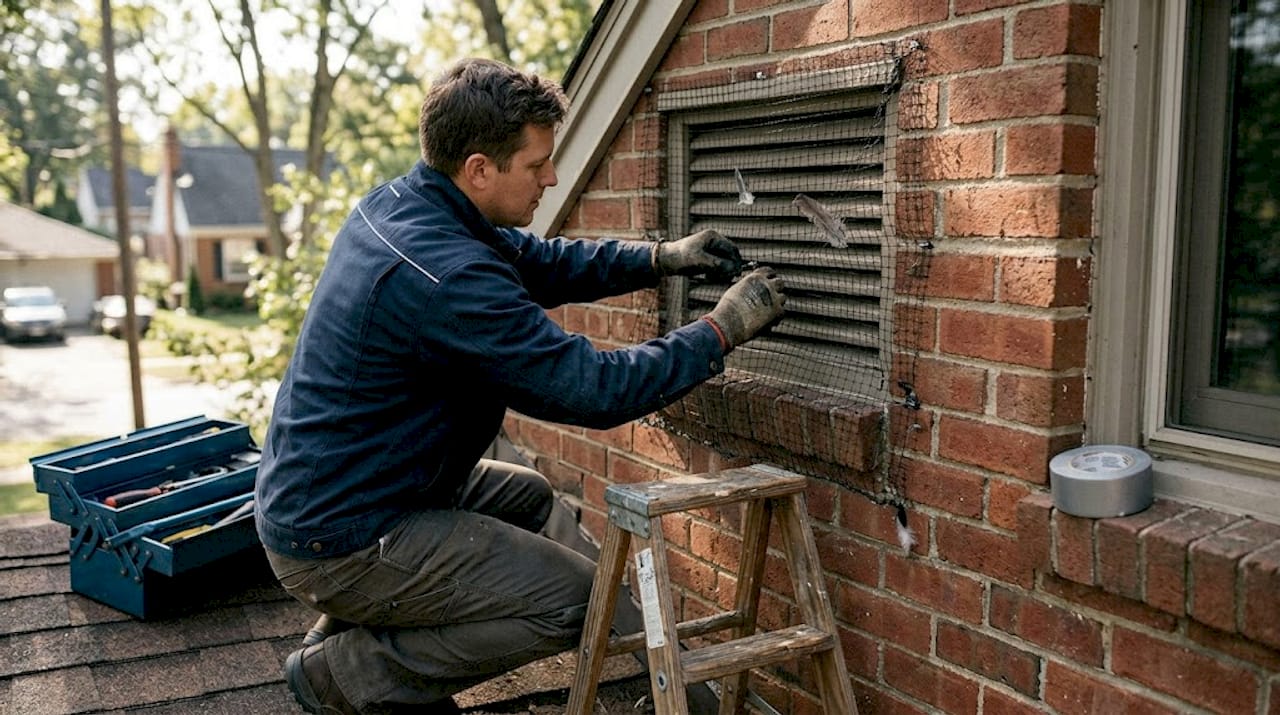
Laser deterrents are worth mentioning because many homeowners are skeptical of them. They work by triggering a bird’s natural escape instinct. They’re effective for geese on open lawns and parking lots, but they require repeated use to condition birds away from an area. A one-time sweep doesn’t cut it.
Pro Tip: Use netting for any recessed area, eave, or structural gap where birds are nesting inside or above. Use spikes on exposed ledges and flat surfaces where pigeons roost but don’t nest. Combining both on the same structure closes virtually every entry point.
For chemical options like avicides, always consult pest control tips from licensed professionals before attempting any treatment. These products are federally regulated and require specific licensing in Ohio.
Step-by-step process: Humane, professional bird control in Ohio
Once you’ve selected the right tools, execution matters just as much as the products you choose. A multi-step approach that combines immediate removal with long-term prevention consistently outperforms single-method attempts.
Follow these steps in order:
- Inspect the full property. Walk the perimeter and check rooftops, vents, gutters, ledges, and any elevated structural features. Look for droppings, nesting materials, feathers, and entry points. Note where birds congregate most heavily and at what times of day.
- Identify the species and scale. Different birds respond to different deterrents. Knowing whether you’re dealing with roosting pigeons or nesting starlings changes your entire approach. Estimate flock size and document it.
- Remove food and water attractants. Open dumpsters, standing water in gutters, spilled grain near loading docks, and ornamental ponds all act as magnets. Eliminating these reduces the property’s appeal before you install a single device.
- Install exclusion and deterrent devices. Start from the highest and most heavily used areas first. Netting goes up before spikes on the same structure to avoid giving birds alternative landing spots. Seal all gaps 0.5 inches or larger with hardware cloth or vent guards.
- Perform humane removal as needed. For active nests with eggs or juveniles, timing matters legally. For large controlling large bird infestations, professionals use specialized trapping or avicidal programs under federal oversight.
- Monitor and adjust. Return to the property within one to two weeks to check for new activity, gaps in exclusion, or birds that have shifted to adjacent zones.
Pro Tip: Schedule droppings cleanup and minor structural repairs at the same time as exclusion installation. Birds are strongly attracted to previous nesting sites by scent and familiarity. Cleaning removes those cues and makes your deterrents far more effective. The role of sanitation in pest control is just as important as the physical barriers themselves.
“Skipping the inspection phase is the single most common mistake. Without knowing exactly where and why birds are using your property, even the best products fail.”
For a more detailed breakdown of device placement and sequencing, the step-by-step bird control resource covers Ohio-specific installation scenarios.
Sanitation, restoration, and ongoing prevention
Getting birds off your property is a win. Keeping them off requires consistent follow-through, and that starts with cleaning up everything they left behind.
Sanitation and restoration are not optional finishing steps. They are core parts of the bird control process. Here’s what that looks like in practice:
- Remove all droppings using PPE (gloves, N95 masks, eye protection). Dried droppings become airborne and are a primary exposure route for histoplasmosis.
- Clear out old nesting materials from gutters, vents, ledges, and roof cavities. Nesting materials harbor mites, fleas, and other secondary pests.
- Disinfect contaminated surfaces with an enzymatic cleaner rated for bird waste. Standard bleach does not neutralize all biological residue from heavy droppings accumulation.
- Repair structural damage including corroded flashing, rotted fascia boards, and cracked soffits. Birds exploit damaged areas for re-entry.
- Eliminate persistent attractants by trimming berry-producing shrubs near the building, securing compost bins, and sealing roof drain gaps where standing water collects.
Pro Tip: Document every repair, cleaning session, and deterrent installation with dated photos. For commercial property managers, this creates a defensible record if you ever face tenant complaints, insurance claims, or regulatory inquiries related to pest birds.
Ongoing prevention means monitoring doesn’t stop after cleanup. Walk the property monthly during high-activity seasons and respond to any new droppings or nesting signs within days, not weeks. The longer a bird establishes a routine on your property, the harder it is to break. Pairing pest control sanitation with natural pest prevention strategies reduces the likelihood of recurring infestations across bird species and other common Ohio pests.
The hard truths about DIY vs. professional bird control
Here’s something we’ve seen over decades in Ohio pest management: most homeowners underestimate birds. Not because birds are exotic threats, but because they are incredibly persistent and behaviorally adaptive. A plastic owl from the hardware store works for about a week. Tape and mesh applied without sealing all access points just redirects birds two feet to the left.
DIY efforts move birds temporarily. They rarely resolve the underlying attraction or access conditions that brought birds to your property in the first place. Property managers dealing with flocks of 50 or more birds, or any structural nesting inside the building envelope, are almost always dealing with a problem that is beyond consumer-grade tools.
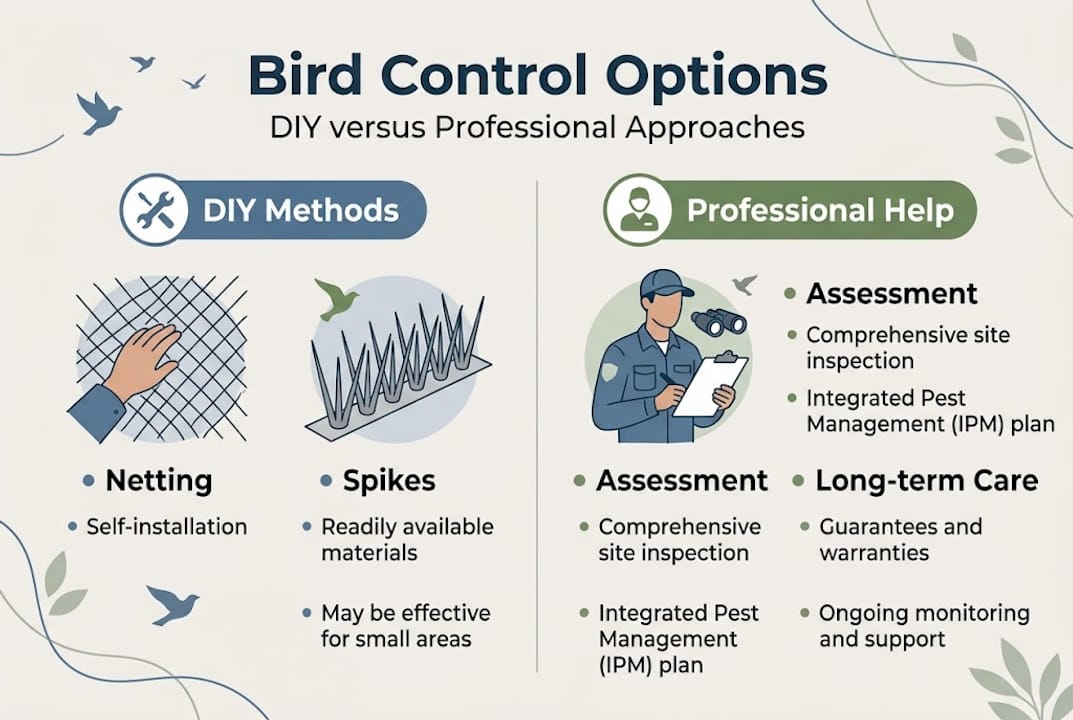
The real cost calculation is not product price versus service call price. It’s damage left unresolved versus damage stopped early. Structural corrosion, contaminated HVAC systems, and health claims from exposed workers or tenants far exceed the cost of professional intervention. We’ve seen Ohio commercial properties spend more cleaning up a single season of unchecked pigeon damage than they would have spent on a multi-year professional exclusion program.
For a realistic look at what professional programs involve, the Ohio bird control perspective breaks down what a proper assessment and treatment plan actually includes.
Connect with Ohio’s bird control experts
If bird problems on your property are growing, acting fast limits both the damage and the cost of cleanup. At Apex Pest Control, we’ve been protecting Ohio homes and commercial properties since 1969, and we understand that bird control is not one-size-fits-all. Our team assesses your specific bird species, property layout, and risk factors before recommending any solution. Whether you need exclusion netting for a warehouse roof or full sanitation and restoration after a long-term infestation, we bring licensed, field-tested expertise to every job. Explore our fast pest and rodent removal services or get a free quote today and take the first step toward a bird-free property.
Frequently asked questions
What are the most effective bird control methods for residential properties in Ohio?
Physical netting and bird spikes, paired with sanitation and habitat modification, provide the most reliable long-term control for Ohio homes. These methods address both access and attraction without chemicals.
Why is bird sanitation important after removal?
Cleaning up droppings and nests removes the scent cues and biological hazards that draw birds back, and sanitation after removal directly reduces disease risk for occupants.
When should large infestations be reported to professionals?
Contact professionals for flocks over 50 birds or when birds persist after exclusion attempts. Large starling infestations over 1,000 birds may require federally regulated avicidal treatment that only licensed specialists can apply.
Are lasers safe and practical for bird deterrence in Ohio?
Yes. Lasers are effective for hazing Canada geese and flocking species in urban Ohio settings when applied consistently and at the right times of day.
How can property managers maintain long-term bird-free status?
Regular monthly inspections, prompt structural repairs, and consistent sanitation practices are the foundation. A multi-faceted prevention approach combining physical barriers with habitat modification is what actually sustains results over multiple seasons.