




TL;DR:
- Least-toxic pest control in Ohio emphasizes prevention, monitoring, and non-chemical methods over sprays.
- It is effective for most pests but may require professional treatment for severe infestations.
- This approach reduces chemical use, costs, and environmental risks while protecting family and pets.
Most Ohio homeowners assume that pest control means strong chemical sprays and the unmistakable smell of pesticides lingering in every room. That assumption is worth questioning. Integrated Pest Management shows that least-toxic approaches work for the vast majority of common Ohio pests, from ants and aphids to cockroaches and rodents. These methods protect your kids, your pets, and your garden’s beneficial insects without sacrificing results. Better yet, they tend to cost less over time and create fewer of the resistance problems that make tough pests even harder to eliminate down the road.
Table of Contents
- What is least-toxic pest control?
- The least-toxic pest control process explained
- Least-toxic methods and products: What works in Ohio
- Results and limitations: What to expect from least-toxic pest control
- Why most Ohio pest control misses the mark—and how to truly protect your home
- Need help with least-toxic pest control?
- Frequently asked questions
Key Takeaways
| Point | Details |
|---|---|
| IPM is the foundation | Least-toxic pest control relies on Integrated Pest Management, which prioritizes prevention and non-chemical methods. |
| Safer for families | Least-toxic pest control significantly reduces risks to pets, kids, and pollinators. |
| Highly effective | Empirical studies show IPM controls pests as well as conventional methods with lower cost and chemical use. |
| Know the limits | Heavy infestations or new invasive pests may need professional, targeted treatments beyond least-toxic methods. |
What is least-toxic pest control?
Least-toxic pest control is not a single product or technique. It is a philosophy backed by decades of field research, and it puts prevention and non-chemical solutions at the front of the line before any spray bottle ever enters the picture. The core idea is straightforward: solve the problem with the lowest possible risk to people, pets, and the surrounding environment.
The backbone of this approach is Integrated Pest Management in Ohio, commonly called IPM. IPM combines cultural, mechanical, biological, and targeted chemical controls with a clear goal: keep pests below damaging levels without necessarily wiping them out entirely. That distinction matters. A few aphids on your tomatoes are not a crisis. A colony of carpenter ants tunneling through your floor joists absolutely is.
Here is what least-toxic pest control looks like in practice for Ohio homeowners and businesses:
- Prevention first: Seal entry points, fix moisture problems, and eliminate food sources before pests arrive.
- Accurate pest ID: Knowing exactly which pest you are dealing with determines every decision that follows.
- Monitoring: Regular scouting tells you whether a problem is growing or fading, so you respond based on facts rather than fear.
- Non-chemical interventions: Traps, barriers, vacuums, and beneficial insects tackle most problems without chemicals.
- Targeted chemical use: When a spray is truly needed, you choose the option with the lowest toxicity that still works.
One of the biggest misconceptions is that least-toxic means less effective. In reality, eco-friendly pest control in Ohio often outperforms conventional approaches over a full season because it addresses the root cause rather than just killing visible pests. Spraying for ants without fixing the moisture issue that drew them indoors is like mopping the floor with the faucet still running.
Pro Tip: Before buying any product, identify the pest accurately. Misidentification is the single biggest reason DIY pest control fails, and it wastes money on products that cannot work against the wrong target.
The least-toxic pest control process explained
Knowing the theory is one thing. Seeing exactly how IPM unfolds in an Ohio home or small business is what makes the strategy feel real and doable. The process follows five clear stages, and you move to the next stage only when the current one is not enough.
- Prevention and cultural controls: Start by eliminating what attracts pests. Store food in sealed containers, fix leaky pipes, clear leaf litter from your foundation, and trim back vegetation that touches your siding. These habits change the environment so pests cannot thrive.
- Monitoring: Walk your property weekly and look for signs of activity: frass (insect droppings), gnaw marks, webbing, or entry holes. Use sticky traps in kitchens and basements to catch early activity. Good monitoring data tells you whether your prevention steps are working or whether action is needed.
- Mechanical and physical controls: This step includes anything that physically removes or blocks pests. Caulk gaps around pipes, install door sweeps, use copper mesh to seal rodent entry points, and hand-pick caterpillars from garden plants. These IPM steps for Ohio homes are highly effective and carry zero chemical risk.
- Biological controls: Introduce or protect natural enemies. Encourage parasitic wasps, release ladybugs for aphid pressure, or apply Bacillus thuringiensis (Bt), a naturally occurring soil bacteria that kills caterpillars without harming other insects. Ohio State Extension guidelines support biological controls as a key IPM layer.
- Least-toxic chemical controls: Only after the first four steps prove insufficient do you reach for a product. Choose monthly prevention tips and options like insecticidal soap, neem oil, or diatomaceous earth rather than broad-spectrum synthetic pesticides.
“The goal of IPM is not zero pests. It is keeping pests below the threshold where they cause real damage, using the safest tools available at each stage.” This mindset shift is what separates sustainable pest management from the spray-and-repeat cycle many Ohio households know too well.
Every stage protects kids and pets a little more. By the time you reach any chemical step, you are using a fraction of the product volume that conventional programs require, and you are applying it only where the pest actually lives.
Least-toxic methods and products: What works in Ohio
Ohio gardeners and homeowners have solid options at every price point. The key is matching the right tool to the right pest at the right time. Here is a side-by-side look at the most common least-toxic tools:
| Method | Target pests | Safety profile | Limitations |
|---|---|---|---|
| Diatomaceous earth (DE) | Crawling insects, ants, roaches | Very low toxicity to mammals | Loses effectiveness when wet |
| Neem oil | Aphids, mites, fungus gnats | Low toxicity, biodegrades quickly | Can harm beneficials if sprayed in bloom |
| Insecticidal soap | Soft-bodied insects, whiteflies | Very low toxicity | No residual effect; must contact pest |
| Bt (Bacillus thuringiensis) | Caterpillars, mosquito larvae | Non-toxic to mammals, birds, fish | Only works on larvae, not adults |
| Sticky traps | Fungus gnats, whiteflies, moths | Zero chemical exposure | Monitoring tool, not a control solution |
| Row covers / barriers | Flea beetles, squash bugs | No chemical exposure | Labor intensive for large areas |
OSU research recommends biorationals like Bt and azadirachtin over preventative spraying, and suggests DE, neem, and essential oils as practical garden tools. A recent field trial meta-analysis confirms that rotating biorational methods reduces pest resistance and protects beneficial insect populations far better than single-product programs.

For Ohio businesses managing food service areas, DE and insecticidal soap around entry points and drains offer defensible, low-residue options that satisfy health department scrutiny. Explore eco-friendly product options to see what fits your specific setting.
Pro Tip: Even neem oil can injure bees if you spray during bloom. Apply any liquid product in the early morning or evening when pollinators are less active, and always read the label before use. For homes with dogs or cats, check pet-safe pest control guidance before choosing a product.
Results and limitations: What to expect from least-toxic pest control
Here is the honest picture. IPM and least-toxic approaches deliver real, measurable results for the vast majority of Ohio pest situations. But they are not magic, and setting the right expectations upfront prevents frustration.
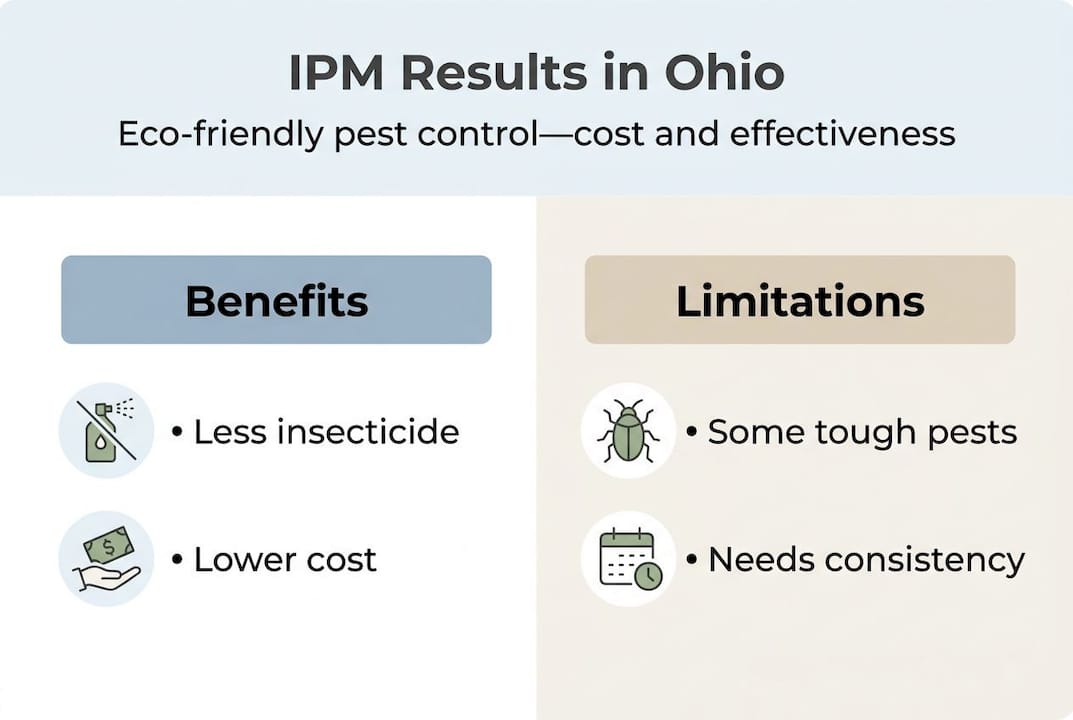
A large-scale analysis found that IPM reduces insecticide use by 44% and cuts costs by up to 40% while maintaining control outcomes comparable to conventional programs. That is a meaningful gain for any homeowner or business watching their maintenance budget.
Environmental impact scores tell a sharper story. The Environmental Impact Quotient (EIQ) measures the ecological risk of a pest control product. Essential oils score around 1.3 on this index, while synthetic pyrethroids average 29. That gap represents a dramatic reduction in risk to waterways, pollinators, and soil organisms with every application you swap out.
| Factor | IPM / least-toxic | Conventional |
|---|---|---|
| Average chemical use | 44% lower | Baseline |
| Program cost | Up to 40% lower | Baseline |
| Pollinator safety | High | Low to moderate |
| Pest resistance risk | Lower | Higher |
| Speed of initial control | Moderate | Fast |
Real limitations exist. IPM struggles most against heavy infestations already out of control and against newly arrived invasive species.
For example, box tree moth management in Ohio has proven challenging for IPM-only approaches because the pest is new, its natural enemies are not yet established here, and population spikes happen fast. The same principle applies to severe bed bug infestations or large rodent colonies inside commercial buildings. In those cases, targeted chemical treatment under professional supervision may be the right call, combined with IPM to prevent recurrence.
Explore practical IPM examples to see how Ohio homeowners have handled real infestations with these methods.
Why most Ohio pest control misses the mark—and how to truly protect your home
After decades of working in Ohio pest management, we have seen a pattern repeat itself: a homeowner calls frustrated because the ants came back a week after a spray treatment. The spray was not the failure. The failure was treating the symptom while ignoring what brought the ants inside in the first place.
Conventional spray-first programs often create secondary problems. Kill the predatory beetles, and spider mites explode. Use a broad-spectrum product indoors, and cockroaches develop resistance within a few generations. The cycle accelerates, and costs climb.
Least-toxic pest management demands something most programs skip: consistency and attention. It requires you to walk the property, notice changes, and adapt. That is more work upfront, but it builds a home environment that pests do not want to return to. The contrarian truth here is that the most powerful pest control tool available to any Ohio homeowner is a good flashlight and ten minutes of inspection every week.
We recommend that every homeowner invest in learning basic pest ID, understanding Ohio’s seasonal pest calendar, and following a safe pest control workflow built around monitoring rather than reaction. That investment pays off year after year.
Need help with least-toxic pest control?
If you have worked through prevention and monitoring and still have a pest problem that is not resolving, professional support makes a real difference. At Apex Pest Control, we have been managing Ohio pest problems since 1969 using approaches that prioritize your family’s safety and the environment. Our team applies IPM principles to residential and commercial situations across Ohio, selecting the right tool at the right time rather than defaulting to chemical-heavy programs. Browse our organic pest control services in Ohio, see real-life IPM examples from homes like yours, and get a free quote to get started with safer, smarter pest control.
Frequently asked questions
What is the difference between least-toxic pest control and traditional pest control?
Least-toxic pest control relies on non-chemical and targeted methods first, reserving low-risk sprays as a last resort, while traditional control leans heavily on synthetic pesticides from the start. IPM combines non-chemical controls with least-toxic options only when thresholds are crossed.
Are least-toxic methods really effective on tough pests in Ohio?
Yes, IPM controls most common Ohio pests effectively, though heavy infestations or newly arrived invasives may require targeted professional treatment alongside IPM strategies. IPM is less effective against pests like box tree moth when populations are already high.
How do I know when to use a least-toxic spray?
Use a least-toxic spray only after prevention, monitoring, and physical or biological controls have not reduced the pest below your action threshold. Threshold-based IPM prevents unnecessary product use and keeps costs down.
Will least-toxic pest control protect my pets and family?
Yes, because IPM minimizes pesticide use and focuses on targeted application, it significantly reduces chemical exposure for household members and pets. IPM methods lower risk to pollinators, pets, and people compared to conventional spray programs.