



TL;DR:
- Pest resistance occurs when pests adapt biologically, making pesticides less effective over time. Repeated use of the same chemical and misidentification accelerate resistance development, especially in older Oakwood homes. Implementing IPM strategies like chemical rotation, accurate pest identification, habitat modification, and professional diagnosis helps homeowners manage resistance effectively.
Pest resistance is defined as the reduced sensitivity of a pest population to a pesticide, caused by biological adaptation that limits how well that product works over time. For homeowners and property managers in Oakwood, Ohio, understanding pest resistance is not an abstract science problem. It is the reason your ant spray stopped working by mid-summer, or why rodent bait stations in older Oakwood homes near Ackerman Park seem less effective than they once were. The EPA frames resistance management as central to sustainable pest control and Integrated Pest Management (IPM) programs. Getting this right protects your property and your budget.
What are the biological mechanisms behind pest resistance?
Four primary resistance mechanisms explain why pesticides fail against adapted pest populations: metabolic detoxification, altered target sites, behavioral avoidance, and cuticular resistance. Each one works differently, and knowing which is at play matters more than most homeowners realize.

Metabolic detoxification means the pest’s body breaks down the pesticide before it causes harm. Certain ant species common in Oakwood, including odorous house ants and pavement ants, have shown this capacity when exposed to the same pyrethroids repeatedly. Altered target sites occur when the pest’s nervous system mutates so the chemical no longer binds where it should. This is one reason some cockroach populations in northeast Ohio housing stock respond poorly to products that worked a decade ago.
Behavioral avoidance is the mechanism most homeowners misread. Pests escape treated surfaces by detecting and avoiding them, which looks exactly like product failure but is actually a learned or inherited behavioral shift. Cuticular resistance means the pest’s outer shell becomes less permeable, slowing absorption of the active ingredient. Homeowners typically cannot diagnose which mechanism is active without professional analysis, which is why rotating modes of action is the standard recommendation.
- Metabolic detoxification: pest enzymes neutralize the chemical
- Altered target site: the chemical’s binding point mutates
- Behavioral avoidance: pests detect and route around treated zones
- Cuticular resistance: thicker or altered cuticle slows chemical absorption
Pro Tip: When a product stops working, do not automatically switch to a higher concentration of the same chemical class. You are likely selecting for resistance rather than overcoming it.
How does pest resistance develop in Oakwood properties?
Resistance develops through selection pressure, the evolutionary process where repeated pesticide use kills susceptible individuals and leaves resistant ones to reproduce. Each generation of survivors passes resistance traits to offspring. Over several pest generations, which for ants and rodents can happen within a single Ohio calendar year, the entire local population shifts toward resistance.
Oakwood’s housing stock plays a direct role. Older brick and frame homes near Oakwood Park and along Far Hills Avenue have more entry points, more harborage space, and longer histories of repeated pesticide application than newer construction. That history of application is precisely what builds selection pressure. When the same product is used season after season, the pest population adapts faster.
Ohio’s seasonal dynamics compound the problem. Ant colonies in the Dayton metro area, including Oakwood, peak in late spring and again in late summer. Rodent pressure spikes in October as temperatures drop and animals seek shelter. Homeowners who spray at each peak with the same product are running a resistance-accelerating cycle without knowing it.
The EPA’s guidance is direct: rotating modes of action reduces selection pressure and is one of the most effective tools available to slow resistance development. This applies to Ohio homeowners just as it does to commercial agricultural operations.
“Resistance management relies on correct application and rotation. Changing products without changing the mode of action does not reduce selection pressure. It just changes the label on the same problem.” — EPA Resistance Management Guidance
- A single pesticide is applied repeatedly to the same pest population.
- Susceptible individuals die; resistant individuals survive and reproduce.
- Resistant traits become dominant in the local population within seasons.
- The original product fails, and homeowners escalate to higher doses or new products in the same chemical class.
- Selection pressure intensifies, and resistance spreads faster.
What IPM strategies effectively reduce pest resistance risk?
Integrated Pest Management is the most proven framework for slowing resistance while keeping pest populations under control. IPM operates as a decision pyramid built on correct pest identification, monitoring, threshold-based decisions, and timed interventions. Chemical control is the last step, not the first.
For Oakwood homeowners, the practical starting point is accurate identification. Treating odorous house ants with a product designed for carpenter ants is not just ineffective. It is a misapplication that adds selection pressure without solving the problem. The role of exclusion in pest management is equally critical: sealing gaps around utility lines, weatherstripping doors, and capping foundation cracks removes the conditions that make chemical treatment necessary in the first place.
Pesticide rotation is the chemical component of IPM that directly addresses resistance. The EPA recommends alternating pesticide chemistries with different modes of action rather than switching brand names that share the same active ingredient class. Two products with different names can belong to the same chemical family and create identical selection pressure.
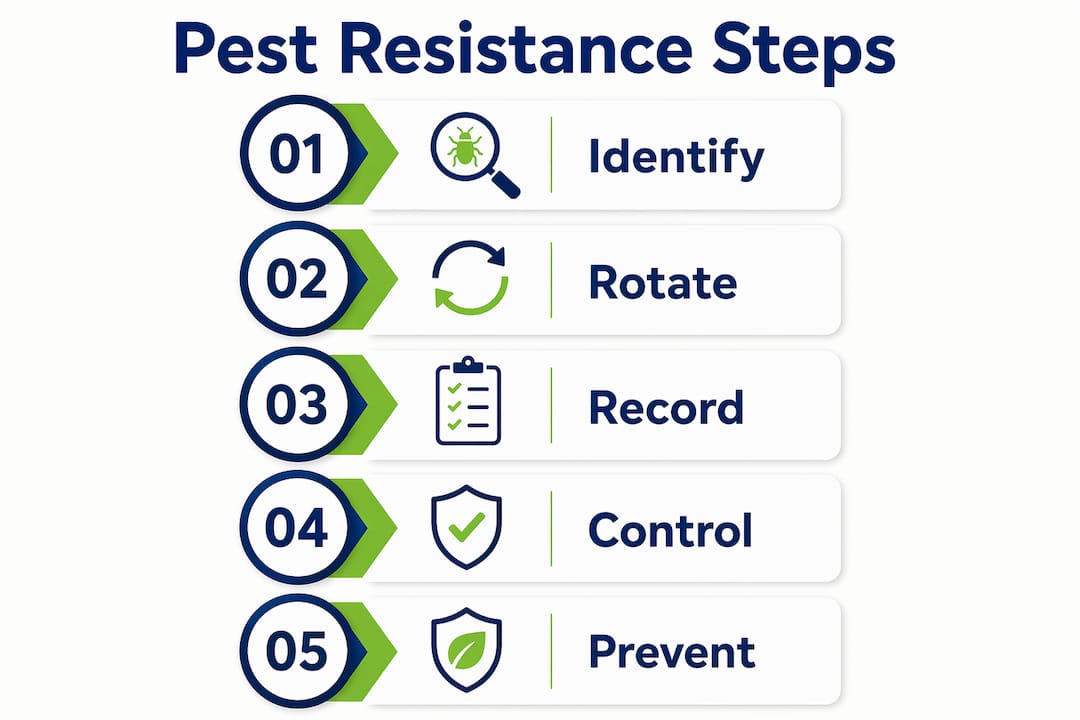
Record-keeping is a tactic most homeowners skip but professionals treat as non-negotiable. Tracking applications by active ingredient and mode of action prevents inadvertent repetition, especially when products are purchased under different brand names across seasons.
Pro Tip: Before buying any pest control product, check the active ingredient and its mode of action group number on the label. Two products with different names but the same group number will not rotate resistance pressure.
| Strategy | Chemical approach | Non-chemical approach |
|---|---|---|
| Pest identification | Confirms correct active ingredient class | Confirms correct trap or exclusion method |
| Monitoring | Tracks whether chemical is working | Tracks population size and entry points |
| Threshold decisions | Prevents unnecessary applications | Prevents unnecessary mechanical interventions |
| Rotation | Alternates modes of action each season | Alternates trap types and bait formulations |
| Habitat modification | Reduces need for repeated chemical use | Removes food, water, and harborage directly |
Biological controls, such as using boric acid baits that pests carry back to colonies rather than contact sprays, reduce the selection pressure applied to the broader population. Targeted treatments that focus on active harborage zones rather than blanket applications also preserve susceptible pest sub-populations, which is the same principle behind EPA’s refuge strategy used in agricultural resistance management. You can find practical IPM steps for Ohio homes that apply these principles directly to residential settings.
Common mistakes Ohio homeowners make that accelerate resistance
Most resistance problems in Oakwood homes are not caused by unusually tough pests. They are caused by application habits that accelerate the natural resistance process. Recognizing these patterns is the first step toward breaking them.
- Using one product all season: Applying the same pyrethroid spray from April through October is the fastest way to select for a resistant ant or cockroach population in your home.
- Misidentifying the pest: Misapplication from wrong identification accounts for a large share of resistance complaints. Treating the wrong species with the wrong product adds selection pressure with zero control benefit.
- Ignoring label instructions: Labels specify application rates, timing, and reapplication intervals for a reason. Exceeding the rate does not kill resistant pests faster. It increases selection pressure and environmental exposure simultaneously.
- Spraying without a threshold decision: Spraying at the first sight of a single ant or mouse dropping is not pest management. It is pesticide overuse that builds resistance without addressing the source population.
- DIY mixing of products: Combining pesticides or adding household cleaners to pest sprays does not increase effectiveness. It creates unpredictable chemistry and voids any label guidance, which NPIC guidance explicitly warns against.
Pro Tip: If you have used the same product more than twice in one season without improvement, stop. Call a licensed applicator before applying again. You may be deepening a resistance problem rather than solving a pest problem.
Avoiding these habits is covered in detail in Apexpestcontrol’s guide on common pest control mistakes for northeast Ohio homeowners.
Key takeaways
Pest resistance is a biological process driven by selection pressure, and the only way to manage it effectively is through rotating modes of action, accurate pest identification, and IPM-based decision-making rather than repeated chemical applications.
| Point | Details |
|---|---|
| Resistance has four mechanisms | Metabolic detoxification, altered target sites, behavioral avoidance, and cuticular resistance each require different management responses. |
| Selection pressure drives resistance | Repeated use of the same pesticide class accelerates resistance by eliminating susceptible individuals and leaving resistant ones to reproduce. |
| IPM is the proven framework | Correct identification, monitoring, thresholds, and rotation of modes of action together reduce resistance risk more than any single tactic. |
| Record-keeping prevents repetition | Tracking active ingredients and mode of action groups stops accidental reuse of the same chemistry under different brand names. |
| Misidentification is a major driver | Many resistance complaints trace back to treating the wrong pest with the wrong product, not true chemical resistance. |
What I’ve learned managing pest resistance in Oakwood homes
After working with Ohio properties for years, the pattern I see most often is not a resistant super-pest. It is a homeowner who has been spraying the same pyrethroid product since spring, wondering why ants are still crossing the kitchen counter in August. The resistance is real, but it was built by the treatment routine itself.
What surprises most people is that behavioral resistance is often the first sign they notice. Ants rerouting around a treated baseboard, or rodents avoiding a bait station placed in a high-traffic zone, look like product failure. They are actually the pest population adapting in real time. That distinction matters because the response is different. Behavioral resistance calls for repositioning, timing changes, and monitoring. Metabolic resistance calls for a mode of action switch.
Oakwood’s older residential neighborhoods present a specific challenge. Homes with original 1950s and 1960s construction have decades of pesticide history in their walls and foundations. That history shapes the local pest populations in ways that make off-the-shelf products less reliable than they would be in newer construction. This is exactly where professional diagnosis, not a different product from the hardware store, makes the real difference. The IPM principles for Ohio homes are not complicated, but applying them correctly requires knowing what you are actually dealing with.
— Dushan
How Apexpestcontrol helps Oakwood homeowners stay ahead of resistance
Apexpestcontrol has served Ohio homeowners since 1969, and resistance management is built into every service plan. For Oakwood properties dealing with ants, rodents, or recurring pest pressure, Apexpestcontrol uses mode-of-action rotation, targeted application, and ongoing monitoring to prevent the resistance cycles that DIY treatments create. If rodents are your primary concern, the rodent extermination service covers identification, exclusion, and treatment tailored to your property. For broader residential coverage, the residential pest control guide explains exactly what a professional program includes. Call 1-800-684-2284 or request a free quote to get started.
FAQ
What is pest resistance in simple terms?
Pest resistance is when a pest population becomes less sensitive to a pesticide because repeated exposure has selected for individuals that can survive it. Over time, those survivors reproduce and the resistant trait spreads through the population.
Why does my ant spray stop working after a few weeks?
Repeated use of the same product selects for ants that can detoxify or avoid the active ingredient, leaving a resistant sub-population to reproduce. Switching to a product with a different mode of action, combined with source treatment, is more effective than reapplying the same spray.
How do I prevent pest resistance in my Oakwood home?
Rotate pesticide products by mode of action rather than just brand name, use non-chemical controls like exclusion and habitat modification, and base treatments on monitoring and thresholds rather than calendar spraying. Following IPM principles is the most reliable prevention strategy.
Can I tell if a pest is resistant just by watching it?
Behavioral resistance, where pests avoid treated surfaces, is visible. Other mechanisms like metabolic detoxification or altered target sites are not visible and require professional diagnosis. If a correctly applied product from a different chemical class also fails, resistance is likely.
When should I call a professional instead of treating myself?
Call a licensed applicator when the same product has failed twice in one season, when you cannot identify the pest species with confidence, or when the infestation is in structural areas like wall voids or crawl spaces. Misidentification and misapplication are the leading causes of resistance complaints that professionals can diagnose and correct.