


TL;DR:
- Proactive risk assessment and integrated pest management prioritize prevention, monitoring, and minimal pesticide use.
- Ohio regulations require licensed applicators, proper record-keeping, and tenant notification for pest control activities.
- Eco-friendly solutions like exclusion, sanitation, and targeted baits are effective and safer for families and the environment.
Most Ohio homeowners assume pest control means a technician shows up, sprays everything in sight, and the job is done. That assumption costs money, creates health risks, and rarely solves the real problem. Modern pest management in Ohio prioritizes monitoring, prevention, and minimal pesticide use for safety and environmental responsibility. The smarter starting point is risk assessment: identifying where pests come from, why they stay, and what conditions allow them to thrive. This guide walks you through how risk assessment works, what Ohio law requires, and which eco-friendly solutions actually deliver results.
Table of Contents
- What is risk assessment in pest management?
- Integrated pest management steps: Building a safe action plan
- Ohio regulations: Legal and safety compliance for pest management
- Choosing eco-friendly pest solutions: Safety, cost, and effectiveness
- Why proactive risk assessment beats reactive pest control
- Connect with Ohio’s top pest management experts
- Frequently asked questions
Key Takeaways
| Point | Details |
|---|---|
| IPM reduces risks | Integrated pest management minimizes health and environmental risks by focusing on prevention and monitoring. |
| Legal compliance matters | Ohio law requires licensed applicators, proper documentation, and tenant notification for responsible pest management. |
| Eco-friendly options | Non-chemical solutions like exclusion and sanitation are both effective and safer for families and pets. |
| Weekly inspections prevent escalation | Regular pest risk assessments help catch problems early and reduce the need for chemical treatments. |
| Proactive beats reactive | Ongoing risk assessment and management leads to better safety and long-term cost savings compared to one-time treatments. |
What is risk assessment in pest management?
Risk assessment in pest management is the process of identifying and evaluating conditions that allow pests to enter, survive, and spread through a property. It is not a one-time checklist. It is an ongoing cycle of observation and decision-making that shapes every action taken on your property.
In practice, risk assessment asks three questions: Where are pests getting in? What is attracting them? And how serious is the threat to people and property right now? The answers determine what actions to take, in what order, and with what level of urgency.
This approach is the backbone of IPM for safer Ohio homes. Integrated pest management, or IPM, is the structured framework that uses risk assessment to guide every control decision. IPM principles emphasize monitoring, prevention, and minimal pesticide use to prioritize safety and environmental responsibility. That means reaching for a caulk gun before a spray can, and fixing the leaky pipe before calling for a chemical treatment.
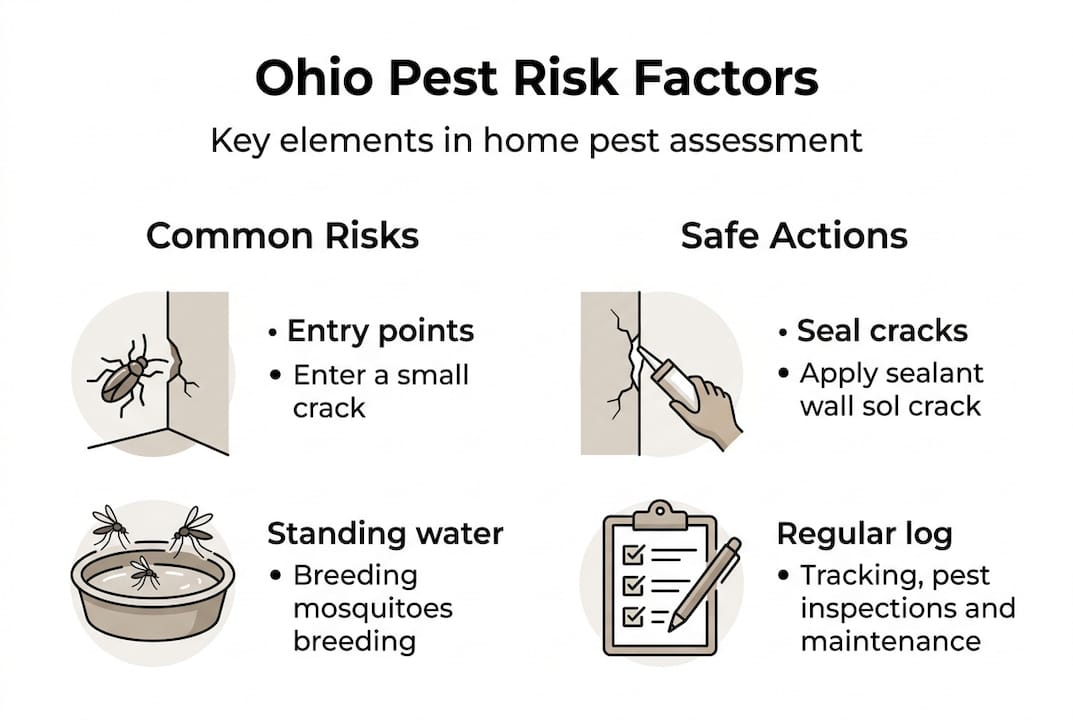
For Ohio homeowners, common risk factors include:
- Moisture problems: Leaky basements, standing water in gutters, and condensation around pipes attract cockroaches, silverfish, and rodents.
- Structural gaps: Cracks in foundations, gaps around utility lines, and damaged door sweeps are primary entry points.
- Landscaping habits: Mulch piled against the foundation, overgrown shrubs near windows, and firewood stacked against the house all create pest harborage.
- Food and waste access: Unsealed garbage bins, pet food left out overnight, and cluttered pantries are open invitations.
- Seasonal changes: Ohio winters push rodents indoors. Warm springs accelerate ant and stinging insect activity.
If you have children, elderly family members, or pets in your home, risk assessment becomes even more critical. These groups are more vulnerable to pesticide exposure, which makes prevention-first strategies not just smart, but necessary.
“The first step in any pest management plan is identifying and eliminating conditions that attract or support pests, before any chemical is considered.” This is the foundation of safe, responsible pest control.
Pro Tip: Walk your property perimeter twice a year, in early spring and late fall, and photograph any cracks, moisture sources, or entry points. This simple habit catches problems before pests do.
Knowing EPA pest management guidelines gives you a solid foundation for understanding why risk assessment matters long before any product is applied.
Integrated pest management steps: Building a safe action plan
With risk assessment as a foundation, building a safe pest management plan means following a structured, step-by-step process. IPM is not guesswork. It is a documented method that local Ohio pest benchmarks and national standards both support.
Here are the four core IPM steps every Ohio homeowner and property manager should follow:
- Set action thresholds. Decide in advance at what point a pest problem requires intervention. One ant in the kitchen is not a crisis. A trail leading to a food source signals a colony. Thresholds prevent overreaction and unnecessary chemical use.
- Monitor and identify. Check problem areas weekly. Sticky traps, visual inspections, and moisture meters help you track what is happening and where. Early detection via weekly inspections prevents escalation and keeps control costs low.
- Prevent. Seal entry points, fix moisture issues, store food properly, and manage outdoor harborage. Prevention is the highest-value action in IPM because it eliminates the root cause rather than treating the symptom.
- Control with least-risk methods first. If control action is needed, start with physical traps, baits, and exclusion materials. Chemical treatments are a last resort, and when used, targeted spot treatments are preferred over broad spraying. IPM action thresholds and least-risk controls are the standard for responsible pest management.
| Method | Safety | Cost over 12 months | Effectiveness |
|---|---|---|---|
| IPM (full program) | High | Moderate upfront, lower ongoing | High, sustained |
| One-time chemical spray | Low to moderate | Low upfront, high repeat cost | Short-term only |
| Exclusion only | Very high | Low | High for entry pests |
| Reactive treatment only | Variable | Highest long-term | Inconsistent |
The comparison is clear: reactive chemical-only approaches cost more over time and deliver inconsistent results. IPM costs more to set up but stabilizes quickly once prevention measures are in place.
Pro Tip: Create a simple log for each inspection. Note the date, what you found, and what action you took. This record becomes invaluable if a pest problem escalates or if you need to demonstrate compliance as a property manager. An Ohio IPM step-by-step guide can help you structure your log from the start.
When you identify pest risk factors early, you dramatically reduce the window in which pests can establish and reproduce.

Ohio regulations: Legal and safety compliance for pest management
Understanding how IPM guides the process, compliance with Ohio regulations is the next crucial step. Pest management in Ohio is not an unregulated activity. There are clear legal requirements for who can apply pesticides, how records must be kept, and what must be communicated to tenants.
| Requirement | Who it applies to | Key detail |
|---|---|---|
| Licensed applicator | Commercial and multi-family property managers | ODA license required for pesticide application |
| Record-keeping | All licensed applicators | Logs must be kept for a minimum of 2 years |
| Tenant notification | Multi-family property owners | Written notice required before treatment |
| Product label compliance | All users | Label instructions are legally binding |
Here is what Ohio homeowners and property managers need to know:
- Licensing: Ohio regulations require licensed applicators and compliance with ODA rules, record-keeping, and tenant notification. If you manage a rental property and hire someone to apply pesticides, verify their ODA license before work begins.
- Record-keeping: Licensed applicators must document every treatment, including the product name, application rate, target pest, and date. These records protect you legally and help identify patterns over time.
- Tenant communication: In multi-family properties, document all activities for legal protection, coordinate with tenants to prevent spread, and avoid over-application to prevent resistance. Written notice is not optional.
- Label law: The pesticide label is a federal legal document. Applying any product at a rate or location not listed on the label is a violation, regardless of intent.
“Failing to notify tenants before a pesticide application is one of the most common and costly compliance mistakes Ohio property managers make. The paperwork takes minutes. The liability exposure does not.”
For homeowners doing their own pest control, licensing is generally not required for personal residence applications. However, using products correctly and keeping notes is still strongly recommended. Connecting this compliance work to your broader environmental pest impact strategy ensures you are protecting your property, your family, and your local ecosystem.
Choosing eco-friendly pest solutions: Safety, cost, and effectiveness
With regulations in mind, let’s examine how to choose pest solutions that are safe, effective, and fit your property’s needs. Eco-friendly does not mean weak. When applied correctly within an IPM framework, non-chemical controls consistently outperform spray-heavy approaches for long-term results.
IPM and non-chemical controls are preferred for long-term safety and cost-effectiveness over spray-heavy approaches. Here is how to put that into practice:
- Exclusion: Seal cracks in the foundation, install door sweeps, repair window screens, and use copper mesh or hardware cloth around utility penetrations. This is the single most cost-effective pest control action available to Ohio homeowners.
- Sanitation: Keep indoor and outdoor trash sealed, clean up pet food and water dishes nightly, and eliminate clutter that provides harborage for rodents and insects.
- Targeted baits: Bait stations for ants, cockroaches, and rodents apply very small amounts of active ingredient exactly where pests travel. This dramatically reduces chemical exposure compared to broadcast spraying.
- Biological controls: In garden and landscape areas, beneficial insects and nematodes can suppress pest populations without any synthetic pesticide involvement.
- Physical traps: Snap traps for rodents and sticky monitors for crawling insects are highly effective and pose zero chemical risk to children or pets.
To protect sensitive household members, always store any pest control products in locked cabinets, read labels before use, and allow treated areas to fully dry before allowing children or pets back in.
Pro Tip: Before purchasing any pest control product, check whether it carries an EPA-registered reduced-risk classification or is OMRI listed for organic use. These labels indicate lower toxicity and environmental impact, which matters especially in Ohio homes with well water or proximity to waterways.
Exploring eco-friendly pest control options gives you a clear picture of what is available in Ohio, and learning how to pest-proof your home gives you the hands-on strategies to make it work.
Why proactive risk assessment beats reactive pest control
Here is a perspective you will not find in most pest control guides: reactive pest treatment is not just less effective, it is often the reason infestations grow larger and more expensive to resolve.
When a homeowner calls for help only after seeing a rodent or a trail of ants, the pest population has already had weeks or months to establish. Each reactive treatment resets the surface problem without addressing the root cause. Resistance builds. Costs compound. And the cycle repeats.
IPM is preferred for long-term safety and cost-effectiveness precisely because it interrupts this cycle before it starts. Proactive risk assessment means you find the gap in the foundation before the mouse does. You fix the dripping pipe before the cockroaches arrive.
The piece most homeowners undervalue is documentation. Keeping a simple treatment and inspection log is not bureaucracy. It is intelligence. Patterns in your log reveal which seasons bring pressure, which areas of your property are vulnerable, and whether your current prevention measures are actually working.
At Apex Pest Control, we have seen this pattern since 1969: the clients who invest in early, ongoing assessment spend less over time and deal with fewer emergencies. A deeper IPM explanation makes the case even clearer. Prevention is not a soft option. It is the highest-return investment in your property’s health.
Connect with Ohio’s top pest management experts
If you are ready to move from theory to action, Apex Pest Control has been serving Ohio homeowners and property managers since 1969 with safety-first, environmentally responsible pest solutions. Our team conducts thorough risk assessments before recommending any treatment, ensuring you get targeted solutions rather than broad chemical applications. Browse our Ohio residential pest solutions to compare service options matched to your property type. If rodents are your primary concern, our rodent extermination services address both the infestation and the entry points that caused it. The best first step is simple: request a pest assessment and let our experts identify what your property actually needs.
Frequently asked questions
What is the safest pest management approach for a family home?
Integrated pest management, which focuses on prevention, monitoring, and minimal pesticide use, is considered the safest approach for households with children, pets, and sensitive individuals.
Are property managers in Ohio required to use licensed pest applicators?
Yes. Ohio regulations require licensed applicators for pesticide use in managed properties, along with proper record-keeping and tenant notification before treatments.
How often should pest risk assessments be performed?
Weekly inspections are recommended for early detection, with formal seasonal assessments each spring and fall to align with Ohio’s pest activity cycles.
What documentation should property managers keep for pest management?
Managers should log treatment dates, products used, target pests, application locations, tenant notifications, and any documented activities needed for legal protection and compliance records.
Which eco-friendly pest solutions are most effective in Ohio?
Exclusion, sanitation, and targeted baits are the most proven non-chemical methods. Non-chemical controls are prioritized first in any responsible Ohio pest management plan to minimize environmental impact and health risks.